The French Revolution began in 1789 when royal debt, unequal taxes, high bread prices, and a battle over political power collided.
Why did one of Europe's most powerful monarchies face a revolution in 1789? The immediate answer is that France's government could not repair its finances without challenging the privileges of influential groups. At the same time, food shortages made daily life harder, while demands for political representation turned a fiscal dispute into a struggle over sovereignty. The revolution was not caused by one speech, one riot, or a single unpopular king.
France under Louis XVI had a flourishing cultural life, a large population, and important trade networks. Yet the monarchy's ability to raise money was constrained, and many people believed the system distributed burdens unfairly. By the spring of 1789, a question about taxes had become a question about who had the right to govern. Understanding that transformation explains why the crisis changed France so profoundly.
Why Was the French Monarchy Already in Crisis?
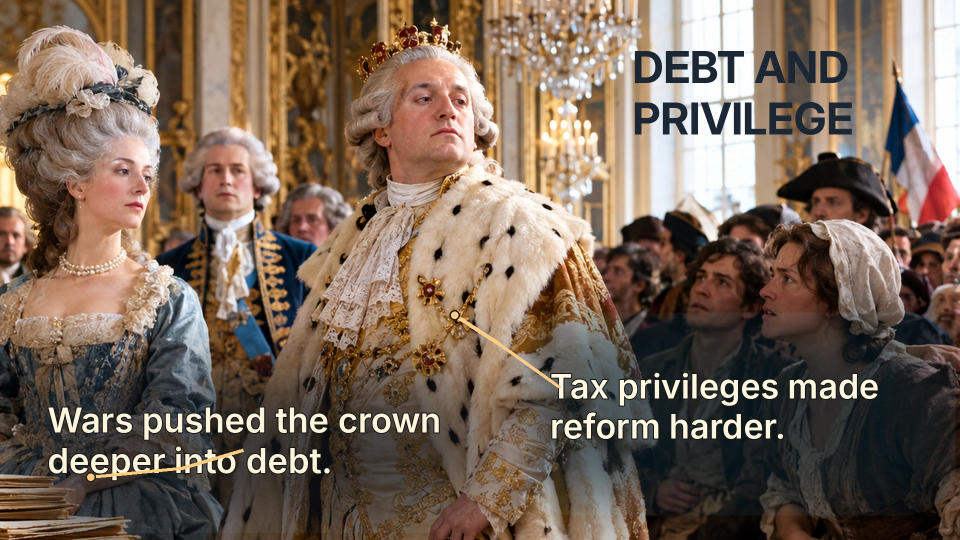
Decades of warfare and borrowing had strained the royal treasury. France's costly involvement in the Seven Years' War and its support for the American struggle for independence added to a debt that was increasingly expensive to service. The state could still draw on the resources of a wealthy kingdom, but raising enough reliable revenue was another matter. New loans became harder to secure on favorable terms.
Taxation made the problem especially difficult. French society was traditionally divided into three estates: the clergy, the nobility, and the Third Estate, which covered everyone else. The system was not a simple division between uniformly rich nobles and uniformly poor commoners. Some members of the Third Estate were prosperous, while some parish priests had modest incomes. Nevertheless, exemptions, local privileges, Church arrangements, royal taxes, and seigneurial dues created an uneven burden, especially for many rural households.
Finance ministers proposed reforms that would have reached more privileged property holders. Resistance from powerful bodies, including the Assembly of Notables in 1787 and the parlements, frustrated these efforts. This mattered because a government that could neither reform taxation nor borrow confidently was losing room to maneuver. The royal court remained a symbol of hierarchy even as the state searched for money.
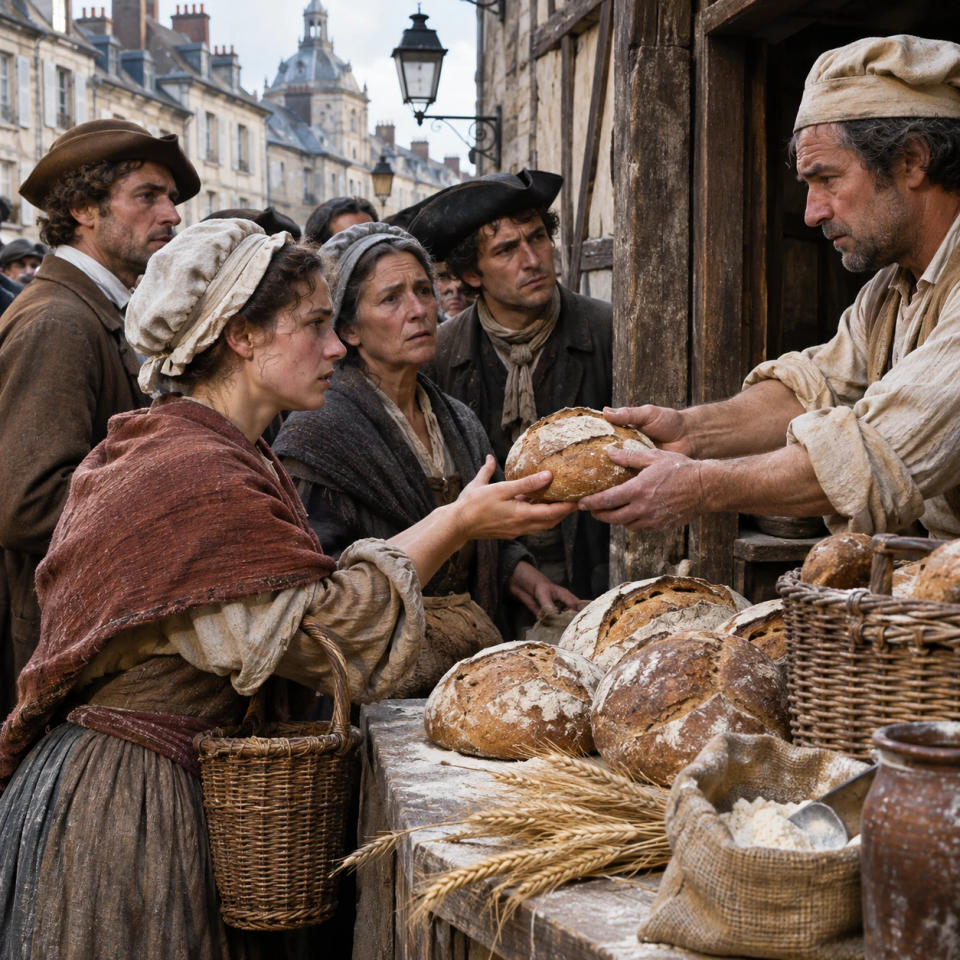
Economic pressure was not confined to the government. Poor harvests in 1788 reduced grain supplies, and the price of bread rose. Bread was central to many households' diets, so a price increase could absorb a painful share of limited earnings. For farmers facing dues and taxes, urban laborers struggling with food costs, and workers whose purchasing power was falling, hardship could quickly become political anger.
It is misleading to say the French simply revolted because they were hungry. Historians also emphasize growing expectations of reform and political argument. Food insecurity, however, made the monarchy's failures immediate and visible in marketplaces and streets.
How Did a Tax Dispute Become a Political Revolution?
Unable to escape the financial and political deadlock, Louis XVI called the Estates-General, an assembly that had not met since 1614. It opened at Versailles on 5 May 1789. Deputies arrived with cahiers de doléances, or lists of grievances and proposals gathered during elections. Many people still hoped reform could occur under the monarchy.
The decisive disagreement concerned voting. The Third Estate had been granted roughly twice as many deputies as either of the other orders, but if each estate cast one collective vote, clergy and nobility together could outvote it two to one. Third Estate representatives demanded voting by individual deputy. The issue went beyond procedure: it asked whether political authority belonged to separate legally privileged orders or to representatives of the nation.
On 17 June 1789, deputies of the Third Estate, joined by some clergy, declared themselves the National Assembly. When they found their usual meeting hall unavailable, they gathered at the nearby royal tennis court. On 20 June, they swore not to disperse until France had a constitution. The Tennis Court Oath was a direct challenge to the assumption that the king alone could determine the political rules.
Meanwhile, uncertainty around royal troops and the dismissal of minister Jacques Necker heightened tensions in Paris. On 14 July 1789, crowds attacked the Bastille, a fortress-prison associated with royal authority, and sought weapons and ammunition. The event was important not because the prison held a large population, but because the seizure showed that political conflict had become armed popular action.

These were different kinds of revolution working together. Deputies at Versailles claimed new constitutional authority, while people in Paris took direct action. Neither the vote dispute nor the Bastille alone explains the explosion. The state's financial weakness, social grievances, public expectations, and fear of royal repression reinforced one another.
Why Did the Events of 1789 Change France So Quickly?
After July, unrest spread beyond Paris. In many rural districts, fears of disorder and hostility to seigneurial obligations contributed to the upheavals remembered as the Great Fear. During the night of 4 August 1789, the National Constituent Assembly began dismantling feudal rights and privileges. The legal details and implementation remained complicated, but the principle challenged the hierarchy of the old regime.
On 26 August 1789, the Assembly adopted the Declaration of the Rights of Man and of the Citizen. Its statements about liberty, legal equality, and sovereignty marked a fundamental change in political language. These principles did not immediately give everyone equal rights. Women did not gain the same political standing as men, and slavery continued in French colonies. Revolutionary claims and actual inclusion were not identical.
In October, protesters driven partly by renewed concerns about bread traveled to Versailles. The royal family was compelled to move to Paris, bringing the monarchy under closer public pressure. The king had not yet been overthrown, and France's future government was still contested. Nevertheless, the assumption that royal authority was beyond challenge had been broken.
Scholars still debate how much weight to give economic distress, class relations, Enlightenment ideas, political culture, and the decisions made by royal officials. A single-cause explanation cannot account for the different people who participated or their sometimes conflicting aims. The strongest explanation is that several crises collided at a moment when institutions could no longer contain them.
Conclusion
The French Revolution began because an indebted monarchy confronted an unequal tax structure, worsening living conditions, and demands for representation it could not easily satisfy. In 1789, the Estates-General transformed arguments about reform into a contest over sovereignty, while Parisian action made the conflict impossible to ignore. The revolution did not produce a stable democracy overnight. It began a struggle over power, rights, and social order that would reshape France and influence political movements far beyond its borders.
Sources & Further Reading
- Palace of Versailles — Versailles at the Heart of the French Revolution
- Swansea University — The Long and Short Reasons for Why Revolution Broke Out in France in 1789
- Citéco — French Revolution: Economic Causes and Environment
- French National Assembly — Assemblée nationale constituante