Around 508 BCE, Athens introduced direct democracy—but voting belonged to male citizens, not everyone who lived there.

Ancient Athens is often called the birthplace of democracy because its citizens could debate and decide public business themselves rather than only choosing representatives. The decisive constitutional changes came with Cleisthenes around 508–507 BCE, following earlier reforms associated with Solon. Yet the word citizens matters: political participation was reserved for a defined body of Athenian men. Women, enslaved people, and foreigners living in the city did not receive an equal vote.
To understand how this system worked, imagine two different civic scenes: citizens raising their hands at a public assembly and eligible jurors being selected by a lottery device. Both belonged to Athenian democracy, but they answered different questions about government.
How Did Democracy Begin in Ancient Athens?
In the centuries before democracy, Athenian politics was dominated by powerful families. Wealth, ancestry, and control of offices gave an advantage to the aristocracy. The system did not suddenly become democratic in one year. Solon, traditionally dated to the early sixth century BCE, addressed serious social conflict through reforms connected with debt, status, and civic institutions. He did not create the fully developed democracy later associated with Athens, but his changes helped alter the relationship between citizens and political authority.
The turning point came after a struggle for control of the city at the end of the sixth century BCE. In 508–507 BCE, Cleisthenes reorganized the citizen body into ten tribes and new local units called demes. These arrangements weakened some older aristocratic loyalties and created a wider basis for participation in public affairs. The Metropolitan Museum of Art identifies the reforms as the foundation of Classical Athenian democracy; a PBS historical overview likewise highlights the role of a citizens’ assembly.
Over the fifth century BCE, that political system developed further. The Council of Five Hundred prepared public business, while the assembly, or ekklesia, provided a setting for citizens to argue about it and make decisions. These institutions did not eliminate influential leaders, family networks, or political rivalry. Instead, they changed where formal authority was located: a decision might require an assembly vote rather than merely the command of an aristocratic ruler.

The illustration reconstructs the open-air Pnyx meeting place rather than reproducing a surviving ancient photograph. Exact clothing, the faces of individual attendees, and the appearance of any particular meeting cannot be recovered. Its important features—the public setting, eligible male participants, debate, and voting by raised hands—illustrate the attested institution.
How Did Athenians Vote and Choose Public Officials?
In an Athenian assembly, a qualified citizen could speak on public matters and take part in decisions about war, finances, and policy. Many resolutions were decided by a show of hands, known as cheirotonia. This was not the same as a modern secret ballot: officials judged the visible response of the gathering, and certain special decisions used different procedures. The University of St Andrews’ discussion of classical voting, reproducing scholarship by P. J. Rhodes, explains the distinction between a raised-hand vote in the assembly and ballot voting in courts.
Voting was only one form of participation. For numerous public duties, Athenians selected people by lot rather than holding a competitive election. This helped spread official responsibilities beyond the most visible or wealthy speakers. Some specialist roles, including military command, were instead filled through election. The Council of Five Hundred also depended on selection by lot, subject to rules of eligibility and representation.
The courts offer a striking material example. An eligible juror carried a small bronze or wooden identification ticket, called a pinakion. Tickets were inserted into slots in a stone allotment machine, the kleroterion. A system involving black and white balls selected or rejected rows, producing juries through a procedure intended to prevent individuals from simply choosing their preferred panel. The Institute for Advanced Study describes the tickets and jury selection; the Athenian Agora Excavations database documents a surviving marble machine fragment with rows of slots and traces of an attachment for a lottery tube.
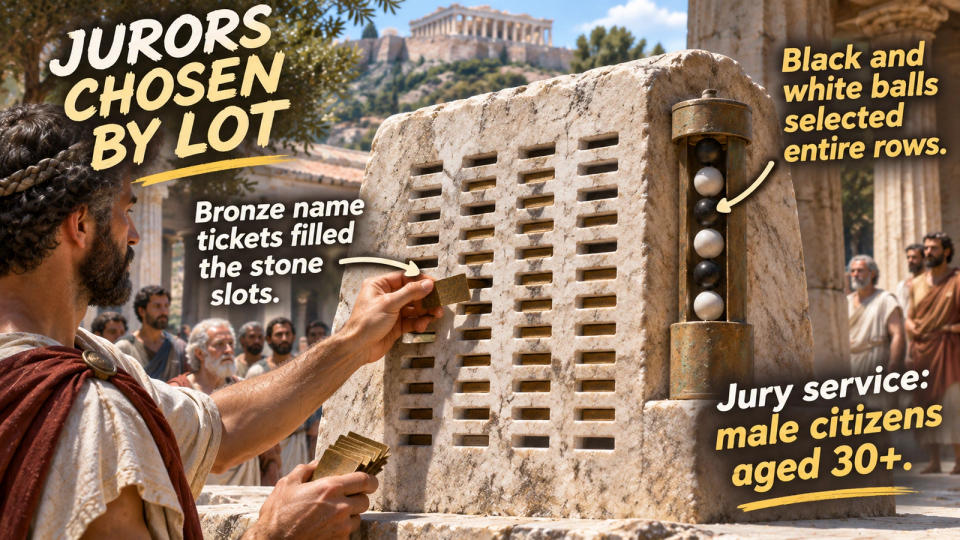
Importantly, this machine selected jurors; it was not the device citizens used to vote in the assembly. Jury service in Classical Athens required a male citizen to be at least thirty years old. That age rule should not be confused with ordinary assembly participation. Our most detailed descriptions of the allotment procedure relate to particular later periods, so the image is an evidence-informed reconstruction, not a claim that every century used an identical machine.
Who Could Vote—and Who Was Excluded?
In the developed Athenian democracy, participation in the ekklesia was a privilege of adult male citizens. Citizenship was a legal and social category, not simply a statement that someone lived in Athens or spoke Greek. An individual’s family status and registration in a deme mattered. Rules changed over time; in the mid-fifth century BCE, a law associated with Pericles made Athenian parentage on both sides important for the transmission of citizenship.
Citizen women could be central to households, religious ceremonies, and the continuity of citizen families, but they could not vote in the political assembly or serve as its officials. The Metropolitan Museum’s account of women in Classical Greece describes important public religious roles alongside restrictions in civic life. It would be misleading to say that women had no social influence whatsoever; the narrower, well-supported statement is that they were excluded from formal democratic voting.
Another large group consisted of metics: free resident foreigners, many of whom worked and traded in the city. Their presence contributed to Athens’ economy, but residence by itself did not grant them the citizen vote. Enslaved people, whose work also underpinned Athenian life, possessed no political voting rights. Children had not yet attained adult civic status. These exclusions meant that a government celebrated for political equality within its citizen body was not equally open to the wider population.
It is tempting to assign one precise percentage of the population to the electorate. Such a figure depends on the date, the territory counted, and uncertain estimates for women, children, foreigners, and enslaved people. Rather than pretending that a single percentage applies to all of Classical Athens, the defensible conclusion is simpler: eligible male citizens were a minority of the people living under Athenian rule. Democracy was direct for those inside the citizen body, yet distinctly exclusionary for those outside it.
Conclusion
Athenian democracy emerged through reforms, most importantly Cleisthenes’ reorganization in 508–507 BCE, and developed through the fifth century. Its defining feature was direct citizen involvement in an assembly where public questions could be debated and decided. Jury lotteries and other forms of selection by lot also distributed responsibility among eligible citizens.
But the question “who could vote?” changes the meaning of this achievement. Adult male Athenians enjoyed political rights denied to women, metics, enslaved people, and children. Ancient Athens provides both an influential example of civic participation and a reminder that the historical word democracy did not automatically mean universal political equality.
Sources & Further Reading
- The Metropolitan Museum of Art — The Art of Classical Greece (ca. 480–323 B.C.)
- PBS — The Greeks: Cleisthenes Recalled
- University of St Andrews — Elections: How the Greeks and Romans Did Them
- Institute for Advanced Study — Ancient Jury Duty Comes to Life
- Athenian Agora Excavations — Kleroterion, Object I 3967
- The Metropolitan Museum of Art — Women in Classical Greece