The 1914 assassination in Sarajevo sparked World War I, but ultimatums, mobilizations, and invasions turned a Balkan crisis into global war.
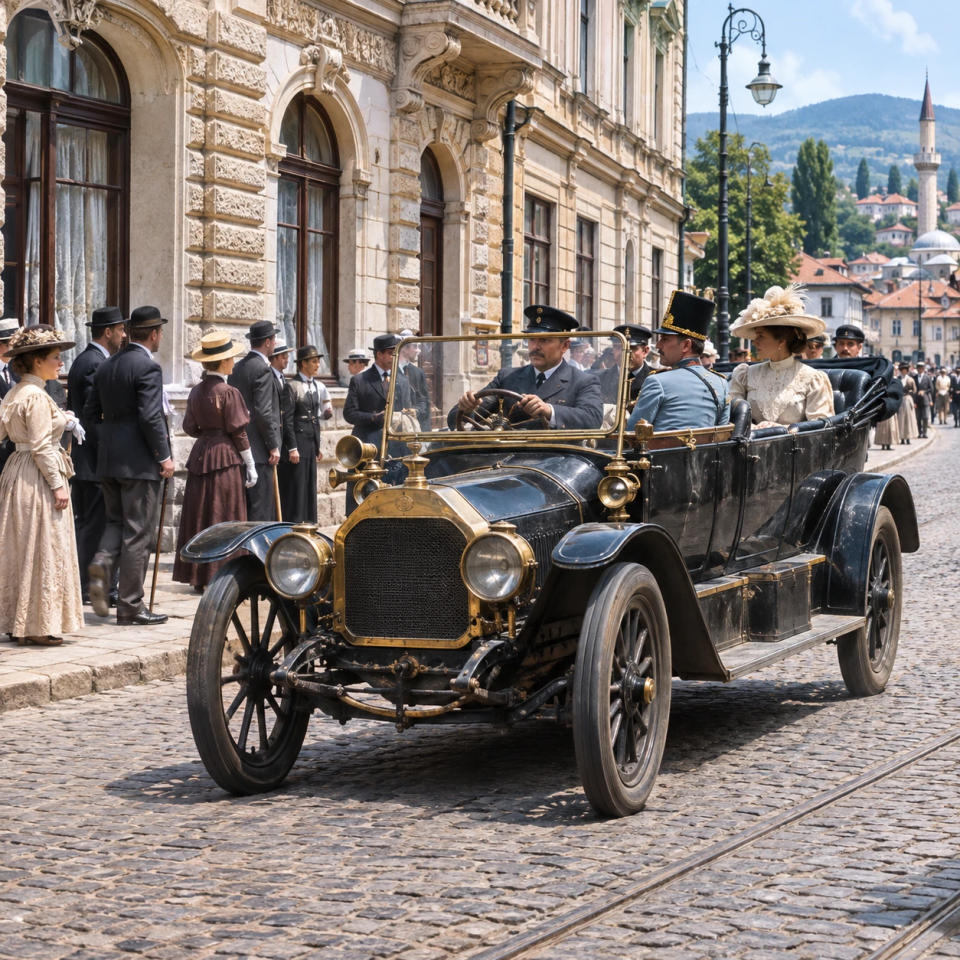
World War I began with a political murder, but it did not begin because of a murder alone. On 28 June 1914, a Bosnian Serb nationalist killed Archduke Franz Ferdinand, heir to the Austro-Hungarian throne, and his wife Sophie in Sarajevo. A month later Austria-Hungary declared war on Serbia. Within another week Germany, Russia, France, and Britain were drawn into a much larger conflict. Understanding that transformation means separating the immediate spark from the rivalries and decisions that made a European war possible.
Why Was Europe Already So Unstable Before Sarajevo?
Europe in 1914 was not a single unified political community. It was dominated by competing empires and states, each worried about its security, power, and status. Austria-Hungary governed many different national and linguistic groups, including South Slavs who did not all wish to remain under Habsburg rule. Serbia, an independent kingdom, championed its own regional ambitions, while Russia viewed the Balkans as an important sphere of influence.
The dispute was not new. Austria-Hungary formally annexed Bosnia and Herzegovina in 1908, angering Serbia and increasing tension with Russia. Sarajevo was therefore not an isolated stage for an unpredictable crime. It stood within a contested region where sovereignty, nationalism, imperial authority, and outside powers intersected. These competing claims helped Vienna interpret the assassination as a threat to the monarchy itself.
Elsewhere, the German Empire had become a major continental power following its nineteenth-century unification. France still lived with the consequences of its defeat by Prussia in 1870–71. German naval expansion intensified British anxieties, and competition between imperial powers widened mistrust. Governments invested heavily in armies, fleets, railway planning, and mobilization timetables. Military preparation was supposed to deter enemies, yet it also encouraged leaders to think in terms of rapid deployment if a crisis came.
Europe also had overlapping alliances, but they should not be mistaken for an automatic mechanism that forced every nation into war. Germany and Austria-Hungary were closely linked. France and Russia had a formal alliance. Britain had diplomatic understandings with France and Russia, not a blanket treaty compelling immediate British entry into every continental war. Italy, although a member of the Triple Alliance before the conflict, remained neutral in August 1914. These differences matter: governments still made consequential political choices.
The broader conditions explain why the continent was vulnerable, but none alone identifies the precise day war became inevitable. Historians continue to debate the responsibility and relative weight of nationalism, imperial competition, military planning, and leaders' decisions. The chronology of June and July shows where opportunities to avoid escalation were lost.
How Did the Sarajevo Assassination Become a War?
On 28 June, Gavrilo Princip, associated with the Young Bosnia movement, shot Franz Ferdinand and Sophie during their visit to Sarajevo. There had already been an unsuccessful bombing attempt that morning. The killing was real and immediate; exactly how far political authorities in Serbia were responsible for the wider plot is a more complex historical question. Vienna held Serbia politically responsible, but that was a government position, not proof that the Serbian state as a whole directed the murder.
At first, a general European war was not an unavoidable response. The decisive change came as Austria-Hungary weighed how to punish Serbia. On 5–6 July, Germany signaled strong backing for its ally, often described as the “blank cheque.” That assurance encouraged Austrian leaders to pursue a hard line even if Russia might object. It was a diplomatic choice, not the consequence of an alliance acting by itself.
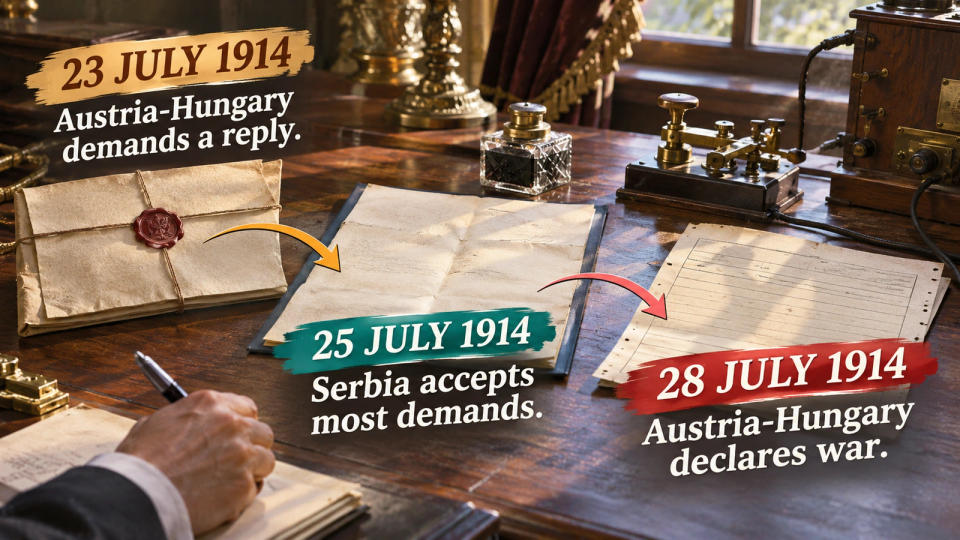
On 23 July, Austria-Hungary delivered an ultimatum to Serbia and demanded an answer within 48 hours. The demands concerned anti-Austrian agitation and investigation of the assassination, but they also challenged Serbian sovereignty by requiring intrusive Austro-Hungarian participation. Serbia replied on 25 July, accepting most of the demands while contesting important parts of the proposed external involvement. Austria-Hungary broke diplomatic relations anyway.
British officials floated a mediation conference, and other proposals were discussed during the final days of July. Yet distrust and the desire to avoid a humiliating retreat outweighed compromise. On 28 July 1914, Austria-Hungary declared war on Serbia. The assassination had become an interstate war through a sequence of decisions stretching over four weeks, not through a single instantaneous chain reaction.
How Did a Balkan Conflict Turn Into a Global War?
Austria-Hungary intended to confront Serbia, but neighboring states believed their own security was now in danger. Russia, which had longstanding political and strategic interests in the Balkans, ordered general mobilization on 30 July. This did not itself amount to a declaration of war, yet German leaders regarded Russian military preparations as a grave threat. Germany declared war on Russia on 1 August.
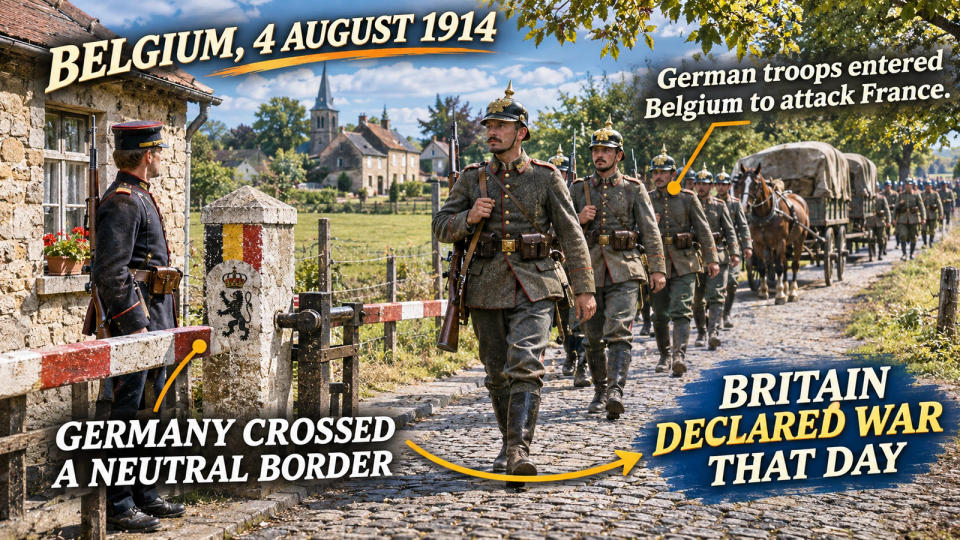
Germany's war planning assumed a likely conflict with both Russia and France. Rather than fight defensively on two borders, German forces moved toward a rapid offensive in the west. Germany declared war on France on 3 August. Its advance through neutral Belgium, beginning on 4 August, brought a further government into the crisis and directly challenged an important principle of European diplomacy.
Britain had not automatically entered the war simply because France and Russia were involved. The German invasion of Belgium and the wider strategic danger to the European balance of power were central to the British decision. Britain declared war on Germany on 4 August. Belgium's neutrality was legally and politically significant, but Britain's decision also arose from a broader assessment of its interests and security.
Even this account describes only the first stage of the conflict's widening. The British and French empires connected European fighting to people, resources, trade routes, and territories across the world. Japan entered the war against Germany in 1914; the Ottoman Empire joined the Central Powers later that year. Fighting spread into Africa, the Middle East, and overseas waters. The United States remained neutral at first and entered the war in April 1917. A crisis that began in the Balkans had become a worldwide struggle over time.
That expansion also explains why the familiar image of alliances as falling dominoes is incomplete. Formal treaties, colonial connections, strategic plans, political fears, and deliberate government decisions interacted. A military timetable may have made negotiation harder, but it did not erase political responsibility. Nor does the assassination alone explain why millions of people far from Sarajevo eventually experienced a war that lasted until 1918.
Conclusion
The immediate trigger of World War I was the assassination of Franz Ferdinand and Sophie on 28 June 1914. The wider war began because leaders transformed the murder into a confrontation between states: Germany supported Austria-Hungary, Vienna issued an ultimatum, Russia mobilized, Germany declared war on Russia and France, and the invasion of Belgium drew Britain into the fighting. Nationalism, imperial competition, alliances, and war plans made those decisions especially dangerous. Sarajevo lit the spark, but the escalation of July and early August turned it into a global war.
Sources & Further Reading
- The Open University — The July Crisis: A Chronology
- UK Government History Blog / The National Archives — The July Crisis
- Museum of Military History, Vienna — World War I
- Canadian War Museum — War Begins in Europe
- NZHistory — Origins of the War
- UK Parliament — Correspondence Respecting the European Crisis