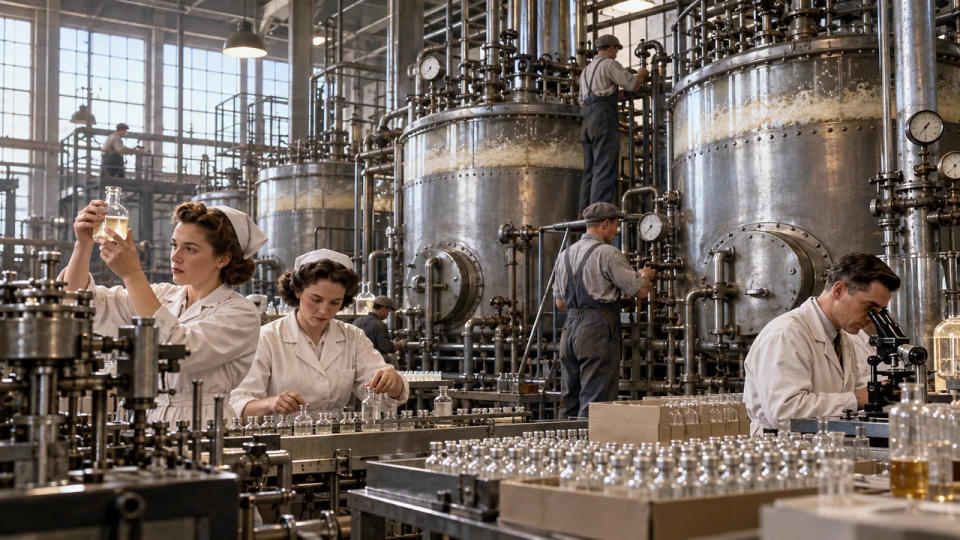
How did a fragile mold extract that was almost impossible to make in quantity become one of the most important medicines of the twentieth century? The decisive change came during World War II, when British researchers, American government laboratories, and pharmaceutical companies turned penicillin from a scarce experimental treatment into an industrial product.
Alexander Fleming had noticed penicillin's antibacterial effect in 1928, but discovery was only the beginning. The wartime achievement was learning how to purify it, grow the mold efficiently, extract the drug reliably, and manufacture enough of it for thousands and then millions of doses. That production revolution, more than any single battlefield moment, is what made penicillin a global medicine.
From Fleming's Mold to an Oxford Medicine
Fleming's 1928 observation at St Mary's Hospital in London became famous later, but penicillin did not immediately become a drug. The substance was unstable and difficult to isolate. For years, it remained more useful as a laboratory curiosity than as a practical treatment.
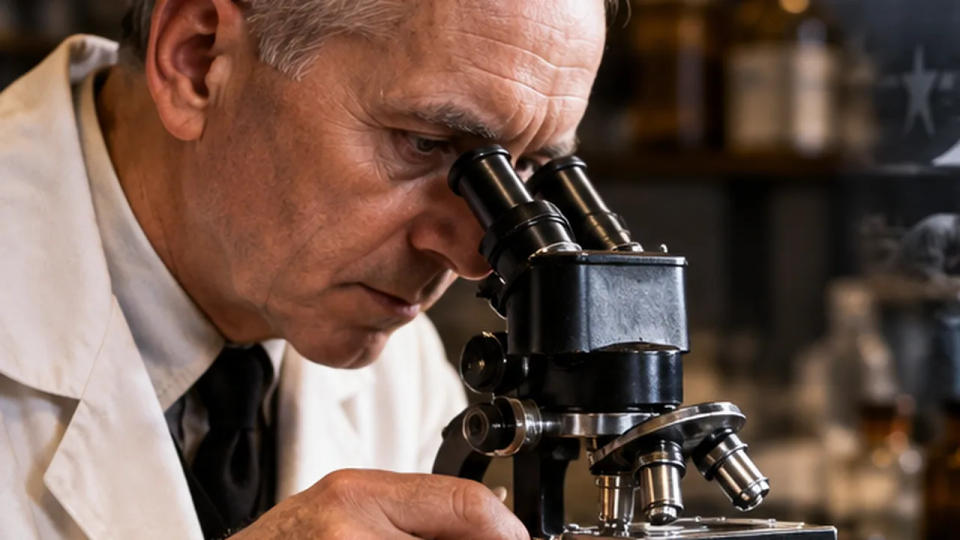
That changed at the University of Oxford. Beginning in 1939, a team led by Howard Florey and including Ernst Chain, Norman Heatley, Edward Abraham, and others returned to penicillin and worked out ways to extract, concentrate, and test it. Experiments in mice in 1940 showed that the substance had powerful potential against bacterial infection, and by 1941 the team was ready for human treatment.
The difficulty was supply. Oxford's laboratory effectively became a small production workshop, using rows of vessels and improvised equipment to grow the mold. The History of Science Museum notes that around 2,000 liters of culture fluid were needed to obtain enough penicillin to treat a single case of sepsis in these early efforts. The drug was so precious that researchers recovered active penicillin from patients' urine for reuse.
The best-known early Oxford patient, police officer Albert Alexander, improved after treatment began in February 1941, but the supply ran out before his infection was defeated. His case showed both sides of the problem: penicillin could work dramatically, yet medicine could not depend on a drug that took enormous labor to produce in tiny amounts.
Why World War II Made Mass Production Urgent
War did not create penicillin, but it gave the production problem extraordinary urgency. Wounds, surgery, burns, and crowded military conditions all created opportunities for bacterial infection. Existing antiseptics and sulfa drugs had value, but doctors needed more effective options for certain serious infections.
Britain, however, was already stretched by war. Industrial capacity, raw materials, and research facilities were under pressure. In 1941 Florey and Heatley traveled to the United States to seek help scaling the drug. Their visit helped connect the Oxford work with American government scientists and manufacturers that could experiment on a much larger scale.
The challenge was not simply to build more shallow trays. Penicillin-producing mold had to be fed, kept free from contamination, supplied with oxygen, and harvested without destroying the unstable antibiotic. A method that worked on a laboratory bench might fail inside a tank holding thousands of gallons.
Peoria, Corn Steep Liquor, and the Deep-Tank Breakthrough
One of the key centers was the U.S. Department of Agriculture's Northern Regional Research Laboratory in Peoria, Illinois. There, researchers including Andrew J. Moyer worked with the Oxford team on better culture methods. A major improvement came from adding corn steep liquor, a nutrient-rich by-product of corn milling, to the growth medium. Lactose also improved yields.
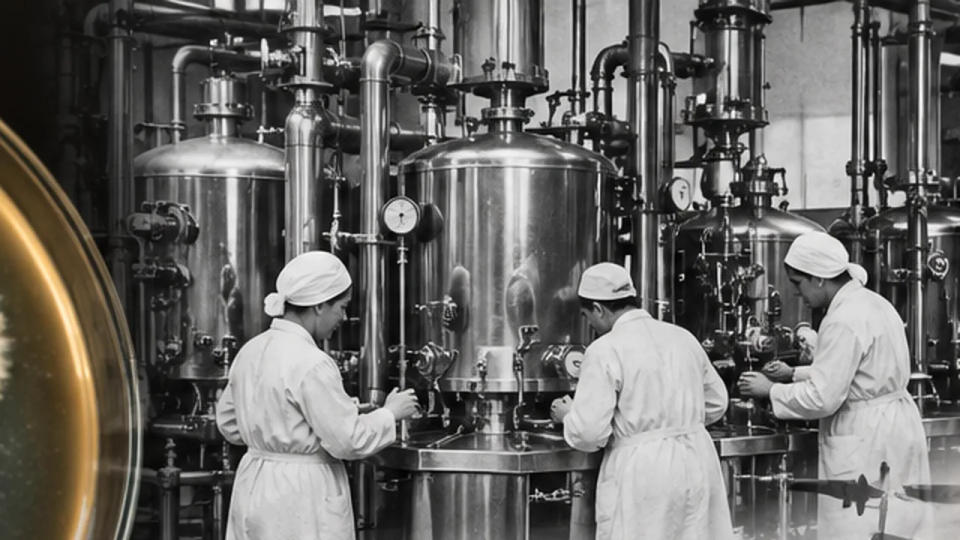
Researchers also searched for more productive strains of Penicillium. A particularly useful strain was isolated from a moldy cantaloupe found in Peoria. It was not a magical solution by itself, but together with improved nutrients, strain selection, and fermentation methods, it helped raise output sharply.
The most important engineering step was submerged, or deep-tank, fermentation. Instead of growing the mold mainly across the surface of many shallow containers, manufacturers learned to cultivate it in large tanks while carefully controlling aeration, temperature, nutrients, and sterility. Companies with fermentation experience could then adapt the process to industrial scale.
In 1943 the U.S. War Production Board made penicillin production a priority and selected 21 firms for an organized program, according to the American Chemical Society's historical account. Pfizer converted an old ice plant in Brooklyn into a large penicillin factory. When it opened in March 1944, the plant used fourteen 7,500-gallon tanks and soon became a major supplier.
From D-Day Supply to Civilian Medicine
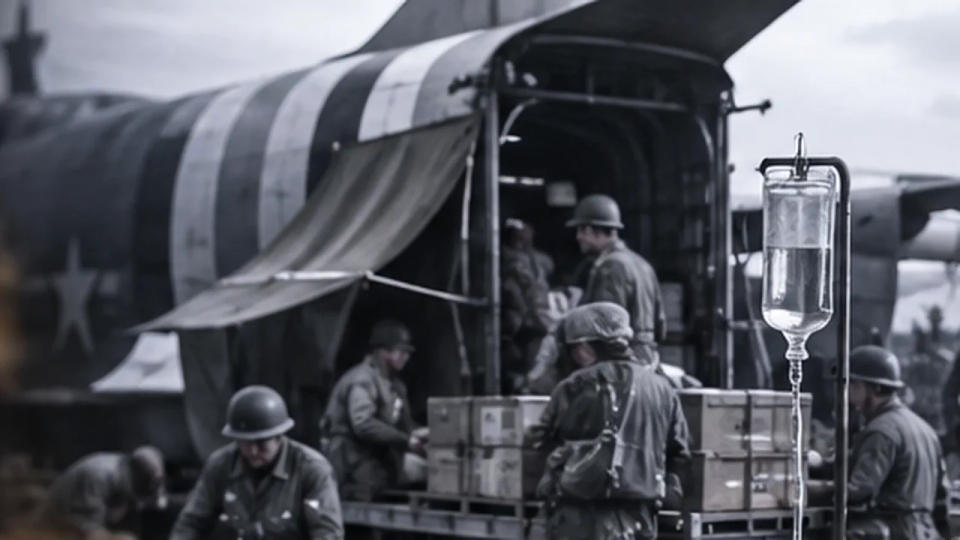
By the Normandy invasion in June 1944, penicillin was being produced in quantities that would have seemed impossible only a few years earlier. The USDA records that enough was available to treat Allied casualties on D-Day, while the American Chemical Society notes that most of the penicillin carried ashore with Allied forces came from Pfizer's Brooklyn plant.
Production statistics show how quickly the scale changed. The ACS reports that U.S. output rose from about 21 billion units in 1943 to 1,663 billion units in 1944 and more than 6.8 trillion units in 1945. Those figures describe an industrial transformation, not the work of a single inventor or company. Government coordination, academic science, agricultural microbiology, chemical engineering, and competing drug manufacturers all contributed.
Military demand received priority while supplies were tight, but the situation changed rapidly. By March 1945, rising output allowed large quantities to enter normal civilian distribution in the United States. As factories learned to make the drug more efficiently, penicillin became cheaper and more widely available, and wartime fermentation infrastructure could be adapted to other antibiotics.
The consequences extended far beyond wounded soldiers. Penicillin proved effective against many bacterial infections and helped establish the antibiotic era. It also changed expectations: infections that had once turned minor wounds, bacterial complications after childbirth or surgery, and some forms of pneumonia into life-threatening crises could sometimes be treated directly with an antibacterial drug.
Conclusion
World War II did not invent penicillin, but wartime pressure accelerated the science and engineering needed to make it practical. The crucial shift was from a few precious laboratory doses to controlled industrial fermentation, reliable purification, and mass distribution. That is why the history of penicillin is not only a story of discovery; it is also a story of production.
Sources & Further Reading
- History of Science Museum, Oxford — Original penicillin culture and specimen
- USDA Agricultural Research Service — Penicillin timeline
- American Chemical Society — Discovery and Development of Penicillin
- American Chemical Society — Penicillin Production through Deep-tank Fermentation
- University of Oxford Medical Sciences — 1900–1944