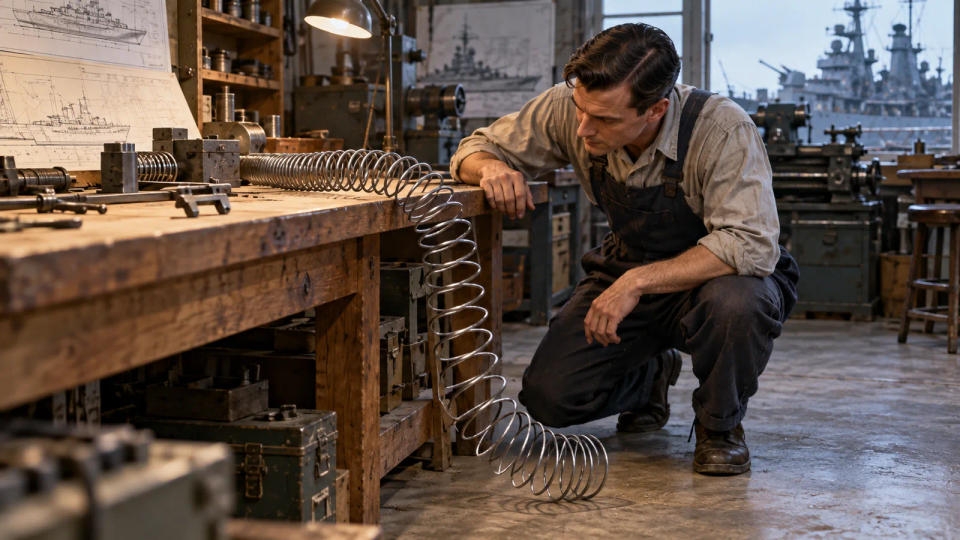
How did a spring meant for ships become one of the most recognizable toys of the 20th century? In 1943, engineer Richard James was experimenting with springs intended to help keep sensitive equipment steady aboard ships when a coil was accidentally knocked from a shelf. Instead of simply collapsing, it moved in a series of arcs—and James realized that the strange motion might be entertaining in its own right.
The Slinky was therefore not designed as a toy from the beginning. It emerged from wartime engineering work, then became a commercial product only after Richard and his wife, Betty James, spent time refining the spring, naming it, manufacturing it, and demonstrating what it could do.
The Wartime Engineering Problem Behind the Slinky
World War II created enormous demand for ships, instruments, communications equipment, and machinery that had to function under difficult conditions. According to The Strong National Museum of Play and MIT’s Lemelson program, Richard James was working in 1943 on springs that could support or stabilize sensitive shipboard equipment in rough seas.

That context matters because the familiar Slinky shape was not originally being explored for play. James was dealing with the mechanical behavior of springs: how they flexed, absorbed movement, and returned to position. Wartime research often produced useful side effects, and the Slinky became one of the more unusual examples—a consumer toy whose origin was tied to an engineering problem rather than a toy company’s design department.
The Navy itself did not adopt James’s spring system. MIT’s Lemelson Center notes that the service never showed interest in the springs for their intended purpose. What survived from the experiment was something James had not been looking for at all: the spring’s ability to transfer its coils forward in a smooth, almost walking motion.
The Accident That Changed the Spring’s Purpose
The famous turning point came when James accidentally knocked a spring from a shelf. Accounts preserved by The Strong and MIT describe the coil moving from one surface to another in graceful arcs instead of dropping into a simple heap. James began experimenting with the effect, including testing whether a properly proportioned coil could move down steps.
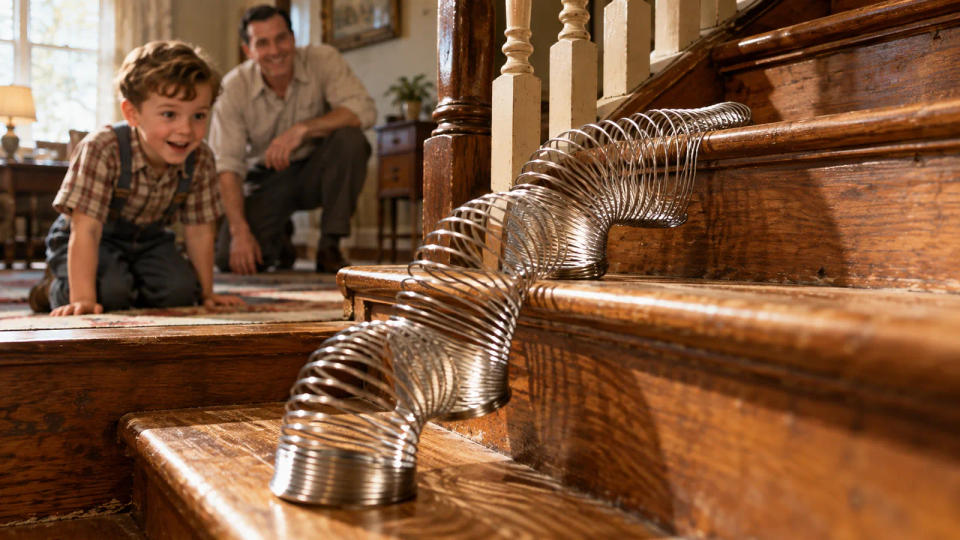
Richard was not solely responsible for turning the discovery into a product. Betty James recognized its promise as a plaything and searched for a name. She chose “Slinky,” a word suggesting smooth, sinuous movement. The couple borrowed $500 to manufacture their early toys, while Richard worked on a machine that could rapidly coil long lengths of steel wire into the compact spring shape.
This was the crucial transformation. The accident supplied the motion, but repeated testing and manufacturing work made the motion reliable enough to sell. A random spring falling from a shelf was interesting; a standardized spring that could repeatedly “walk” from one step to another was a product.
From Workshop Curiosity to Christmas Hit
The Slinky’s first challenge was not engineering but explanation. A plain metal coil does not immediately look like a toy, especially when it is sitting still. The Jameses needed people to see it move.

That happened dramatically during the 1945 Christmas shopping season at Gimbels department store in Philadelphia. MIT’s Lemelson program reports that 400 Slinkys sold in about 90 minutes during the demonstration. The Strong likewise records the department-store event as the moment when initially sluggish sales suddenly took off.
The success made sense once customers could watch the toy in action. A Slinky did not need batteries, a motor, or complicated instructions. Gravity supplied the energy after the user started it, and the spring’s own geometry created the flowing transfer of coils. The demonstration converted an ordinary-looking object into a performance.
Richard James later patented the toy. U.S. Patent 2,415,012, granted on January 28, 1947, describes a helical spring designed to “walk” down an inclined surface or set of steps under gravity after an initial start. The patent is valuable evidence because it shows that the walking motion was not merely advertising language; it was central to the mechanical design James claimed.
Why the Slinky Walks—and Why the Idea Lasted

A Slinky works because its coils store and release energy while gravity pulls the toy toward the next lower surface. When the upper end tips forward, the spring stretches across the gap. Coils then transfer toward the lower end, shifting the toy’s weight until the rear portion follows. Richard James’s patent carefully describes the relationship between the coil’s dimensions, spring forces, and ability to move from one landing point to the next.
The design also had the advantage of simplicity. The original metal Slinky contained no hidden mechanism. Its entertainment came from visible physics, which helped it remain useful beyond ordinary play. Teachers later used Slinkys to demonstrate wave behavior, and the toy became a familiar object for exploring motion and elasticity.
Betty James also played a major role in keeping the Slinky alive as a business. Pennsylvania’s Historical and Museum Commission credits her with taking over the company in the early 1960s and rebuilding it into a successful international operation. That later chapter is important because accidental invention alone does not explain longevity. The toy survived because it could be manufactured cheaply, demonstrated instantly, and understood without much explanation.
Conclusion
The Slinky began with a wartime engineering problem, but its lasting success came from seeing an unexpected possibility in a failed application. A spring designed for shipboard stability never became important naval equipment. Instead, its unusual motion led Richard and Betty James toward a toy whose appeal was simple: give it a push, let gravity take over, and watch the spring walk.
Sources & Further Reading
- The Strong National Museum of Play — “Slinky”
- MIT Lemelson — “Richard James”
- U.S. Patent 2,415,012 — “Toy and Process of Use”
- Smithsonian Magazine — “The Accidental Invention of the Slinky”
- Pennsylvania Historical & Museum Commission — Slinky Toy historical marker approval