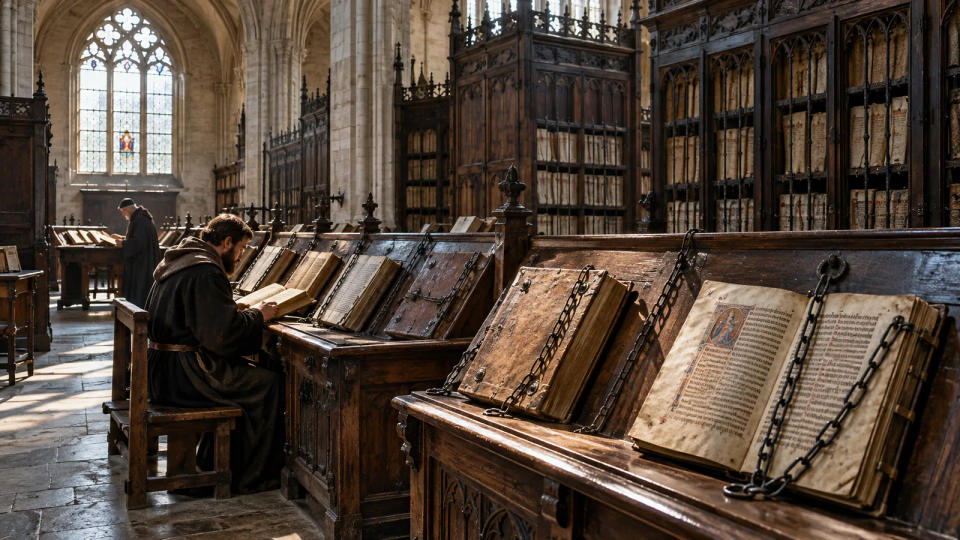
Why would a medieval library chain books to shelves or reading desks? The answer was not that librarians wanted to stop people reading. They wanted to stop scarce, costly volumes from disappearing while still allowing scholars to consult them in person.
In an age before mass-produced books, protecting one manuscript could mean safeguarding years of skilled work and knowledge that might be difficult to replace. The practice developed in different forms, from chains fixed to reading lecterns in medieval collections to the chained shelf systems preserved in some early-modern libraries.
Why a Medieval Book Was Too Valuable to Lose
A book in medieval Europe was not an ordinary consumer object. Before printing became widespread, pages had to be prepared, texts copied and corrected, and gatherings sewn into a binding. Parchment required the treatment of animal skins. Pens, ink, decorated initials and protective covers added labor and material costs. The Metropolitan Museum of Art describes medieval bookmaking as a process involving multiple skilled stages and, sometimes, entire workshops.
Many monasteries housed collections used for religious study, but their books could also contain philosophy, science, classical literature and other learning. As universities expanded, scholars needed works of law, theology and the liberal arts. Books were not merely expensive to make: a particular text could also be difficult to obtain or replace if the institution lost its copy.
The cost also varied enormously. A plain working copy and a lavish illuminated manuscript were not interchangeable objects, and not every volume required the same level of protection. A useful reference book might be important because generations of readers depended on it, even if its cover was modest. The point was continuity: a scholar could return to the same material next week, and a newcomer might use it years later. Fixing selected volumes near desks made a collection more dependable without forcing custodians to supervise every page turn in a locked storeroom.
Chaining was therefore a practical investment. Instead of hiding every reference work in a locked cupboard, a library could place important volumes where approved readers could reach them. A strong chain discouraged unauthorized removal while leaving the text available for study. The system protected an institution's shared resources, not just its property value.
This approach was not universal. Some books were kept under lock and key; others could be borrowed under rules. Whether a volume was chained depended on its collection, location, purpose and the institution's decisions. The image of every medieval book fastened to a shelf is a modern oversimplification.
How Did Chained Books Work?
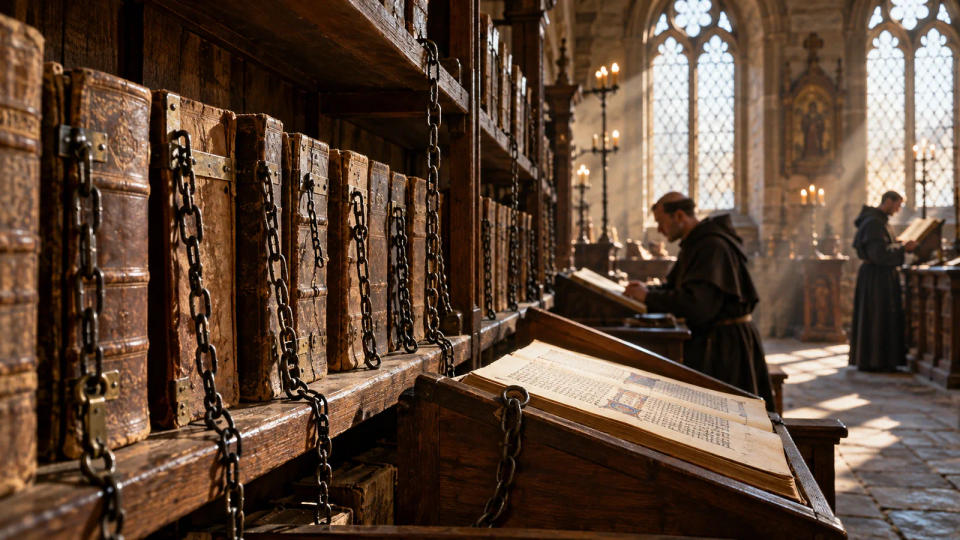
In surviving chained shelf libraries, the arrangement is surprisingly ingenious. One end of a metal chain connects to a fitting on a book's front cover or binding board. The other connects to a metal rod running along the shelving. The reader can lift the book onto a nearby desk and turn its pages, but cannot take it away without unlocking the arrangement.
Hereford Cathedral explains that its chained books are stored with their fore-edges—the page edges opposite the spine—facing outward. That looks backward to modern readers. But it permits a book to be lifted and opened without turning the volume around and tangling the chain. Attaching the hardware to a strong cover rather than to the spine also helps explain the importance of binding construction.
Not every chained library looked like Hereford. Earlier medieval arrangements frequently secured reference books to sloping lecterns, where scholars could read while standing or sitting nearby. The University of Chicago Library notes that browsable, chained reference collections appeared in the early 1300s, with desks positioned close to windows to take advantage of daylight.
One surviving manuscript described by the Chicago library, Ars Brevis (1313), retains evidence of a fourteenth-century hasp fitted to its front board. Such physical traces help historians distinguish actual historical practice from the familiar cinematic image of a room filled with chains.
Who Could Read Them, and Where Can We Still See Them?
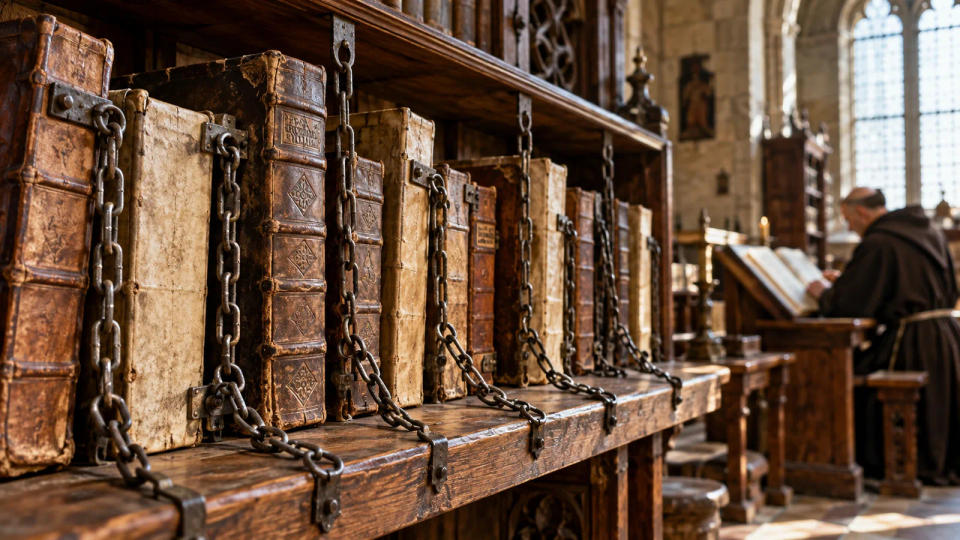
A chain did not itself tell you who was permitted to read. Access depended on an institution's rules. Some collections served religious communities, others university scholars, and some later libraries admitted a wider public. The central distinction was between consulting a volume in place and being permitted to carry it elsewhere.
Oriel College in Oxford offers a particularly clear example. Its history records both a lending library and a chained library. The statutes envisaged borrowed books being returned annually before fellows chose again. Other manuscripts were fixed to lecterns or shelves for study on site. According to the college, Bishop Thomas Cobham's books were chained in 1367, and the institution maintained chained collections into the eighteenth century.
By 1375, Oriel possessed 98 books, including works in arts, theology and law. That number comes from this particular college's surviving history; it is not a typical size for every medieval library. The records illustrate how valuable a comparatively small institutional collection could be, and why custody mattered.
Hereford Cathedral preserves an especially vivid later example. Its library includes medieval manuscripts, among them the eighth-century Hereford Gospels, but the surviving chained-library arrangement is principally seventeenth-century. The cathedral describes its intact chains, rods and locks as the largest surviving collection of this kind. Its present display reflects the arrangement used from 1611 to 1841. It would therefore be misleading to call the entire room an untouched medieval interior.
The way chains survived into the early-modern period also challenges the idea that they vanished the moment printing arrived. Printing gradually expanded the availability of books, but old manuscripts and major scholarly reference works remained valuable. Security customs changed at different speeds in different places.
Conclusion
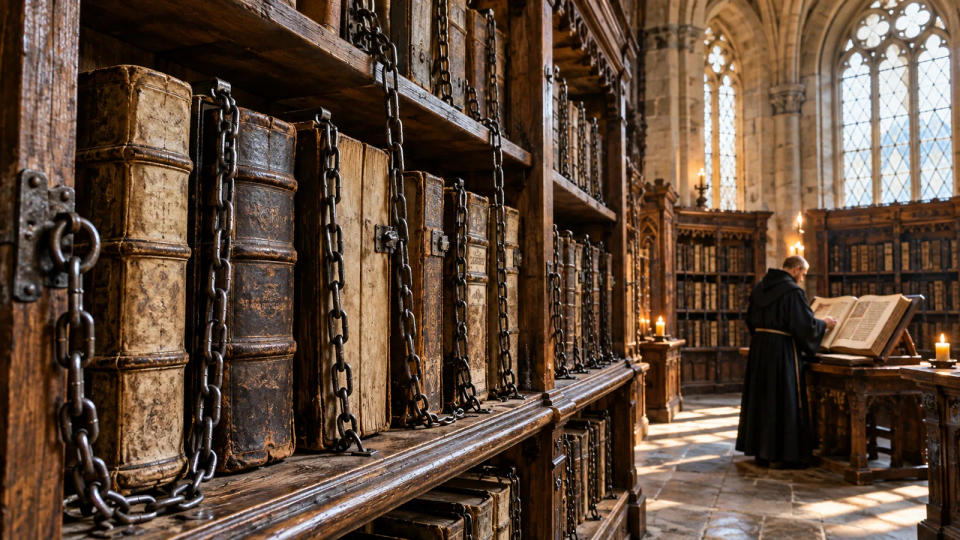
Medieval books were chained because a library had to balance two needs: keeping an irreplaceable volume safe and letting people actually use it. The chain allowed supervised on-site reading, not unrestricted borrowing. Surviving manuscripts, Oxford college records and Hereford's later chained shelves show how that idea evolved over centuries. Those iron links remind us that access to knowledge once required remarkable investments in materials, labor and shared spaces.
Sources & Further Reading
- University of Chicago Library — Chained libraries
- Oriel College, University of Oxford — The History of Oriel’s Library
- Hereford Cathedral — Chained Library
- The Metropolitan Museum of Art — The Art of the Book in the Middle Ages