
Why did so many Allied aircraft arrive over Normandy on June 6, 1944, wearing five enormous black-and-white bands? They were not meant to hide airplanes from the enemy. The markings, known as invasion stripes, were a fast, highly visible warning to Allied troops, sailors, and pilots: this aircraft was supposed to be on their side.
The danger they addressed was very real. Operation Overlord brought together aircraft, ships, and ground forces in a confined area, sometimes under dreadful visibility and intense pressure. A friendly airplane mistaken for an enemy attacker could be fired on before anyone had time to check its usual insignia. The stripes made recognition easier at a glance.
The Friendly-Fire Problem Before Normandy
Today, the large stripes look like a deliberate piece of wartime visual design. To Allied planners, they were a practical response to earlier disasters. During the July 1943 invasion of Sicily, Allied aircraft had suffered from mistaken identification and friendly anti-aircraft fire. The Royal Air Force Museum explicitly identifies those losses as one of the lessons shaping the air plan for Normandy.
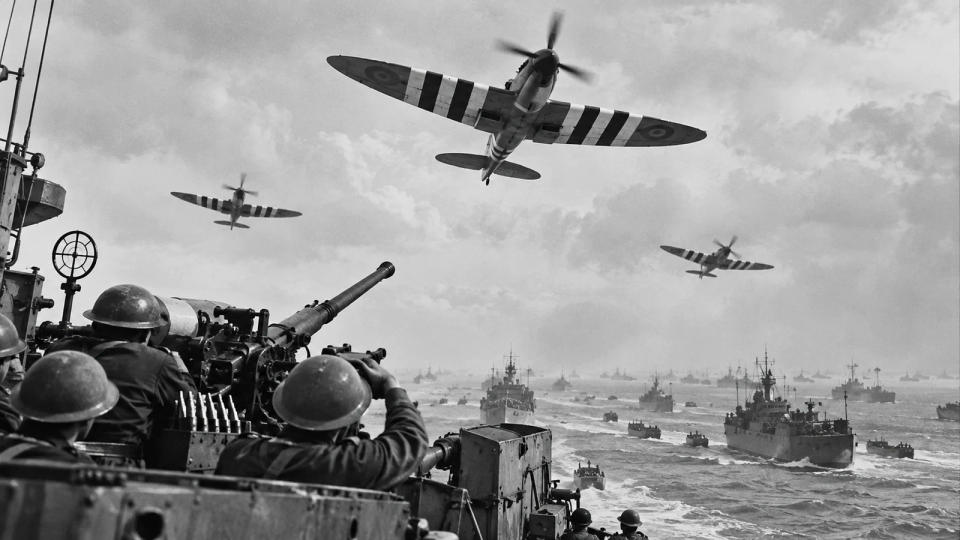
Spotting a plane in the distance is harder than identifying one parked on an airfield. A moving silhouette may be visible for only seconds. Low clouds, smoke, changing light, and the angle of an aircraft's approach can conceal its national roundel or star. Gunners aboard an invasion ship faced a particularly demanding task: defend the fleet from possible German aircraft without attacking their own air cover.
Allied aircraft also depended on radio and electronic recognition procedures, including Identification Friend or Foe systems. But those tools did not remove every possibility of error, particularly amid the extraordinary air traffic expected on D-Day. Planners wanted something that could be judged visually, immediately, and without waiting for a radio exchange.
That helps explain why the stripes had to be conspicuous rather than subtle. Camouflage is designed to make an object difficult to notice. These markings did the reverse: they sacrificed concealment to make a friendly aircraft unmistakable to someone who had only a moment to decide whether to shoot.
What the Five Black-and-White Stripes Actually Signaled
The familiar pattern consisted of five alternating bands: white, black, white, black, white. They appeared on the wings and around the rear fuselage of many aircraft participating in the operation. According to the Smithsonian's National Air and Space Museum, the specified stripe width was 18 inches (about 46 centimeters) for single-engined aircraft and 24 inches (about 61 centimeters) for twin-engined aircraft.
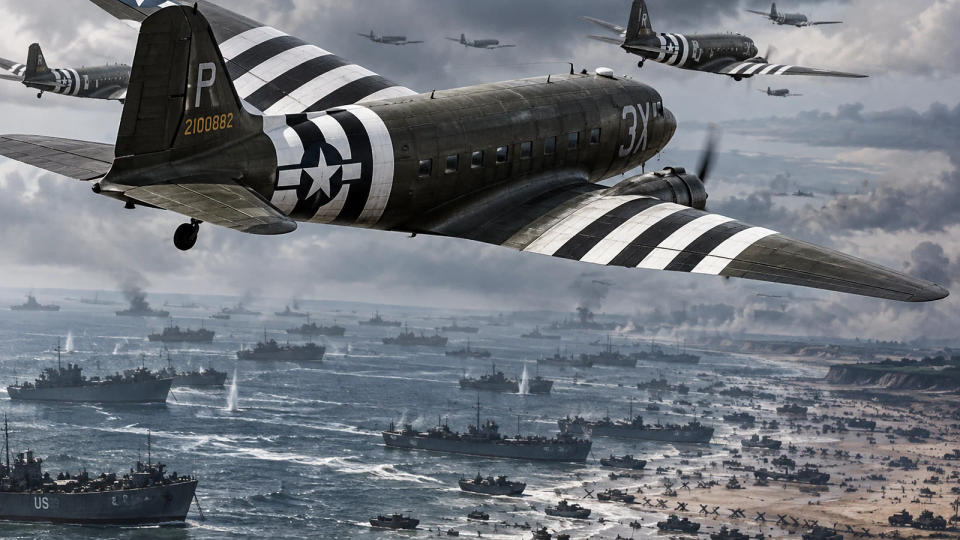
The scheme appeared on different types of machines serving different purposes, from fighters such as the Spitfire and P-51 Mustang to transports such as the C-47 Skytrain. It was not simply a fighter marking. Troop transports carried airborne forces into Normandy, and Allied fighters and bombers supported the invasion force from above.
Nor was it a universal decoration applied without exception to every Allied aircraft. Requirements differed across aircraft categories and operational roles; large four-engined bombers generally did not need the same markings. The important point was recognition among the aircraft most likely to be mistaken for a hostile machine near the invasion fleet and beaches.
These stripes were an additional recognition cue, not a replacement for normal national insignia. An observer could first register the broad high-contrast bands, then identify the aircraft more fully if there was time. Their usefulness lay in their simplicity: even an unfamiliar outline could carry a familiar visual signal.
Why Ground Crews Painted Them So Late
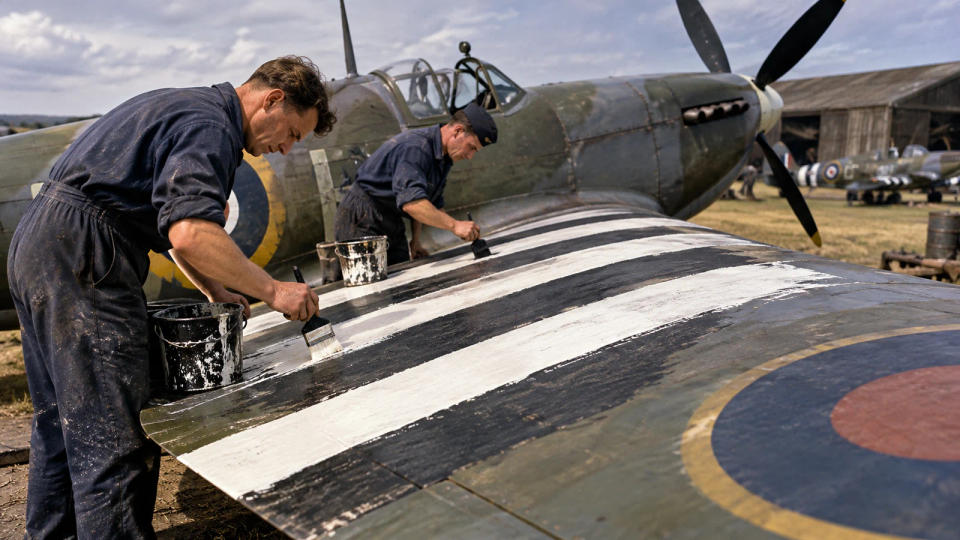
If the stripes were so important, why were they sometimes applied with hurried brushstrokes only hours before the landings? Secrecy. Allied commanders did not want the Luftwaffe to learn the pattern early and use similar markings to confuse Allied defenses. A clear signal could become dangerous if the other side knew exactly how to imitate it.
The Smithsonian records that a small flight of marked aircraft passed over the Allied fleet on June 1, giving crews a chance to see the stripes in flight. Troop-carrier units then received painting orders on June 3, while fighter and bomber units received them on June 4. The RAF Museum describes ground crews still painting aircraft just before D-Day, with some surfaces barely dry.
It was a huge assignment at a moment when aircraft also needed fuel, ammunition, checks, and maintenance. Airmen used ordinary paint and practical tools rather than the leisurely precision of a factory paint shop. That is why surviving photographs often show slightly uneven edges. Those imperfections are part of the historical story: the markings were meant to work, not to win a painting contest.
Early on June 6, many marked aircraft were in the air as the airborne and seaborne assaults began. The National Museum of the United States Air Force notes that the bands were applied to assist recognition and prevent casualties from friendly fire. Their high contrast made them especially useful to ship crews trying to distinguish an Allied plane from an approaching threat.
Did the Stripes Work, and Why Did They Disappear?
The markings almost certainly helped Allied personnel recognize familiar aircraft quickly, but their exact contribution cannot be isolated from the rest of the air operation. The Allies also enjoyed overwhelming air superiority over the invasion area, and German aircraft challenged the landing fleet far less than Allied planners had feared. It would be too strong to credit the stripes alone for the relatively limited friendly-fire problems on D-Day.
There is, however, clear evidence that the marking system was actively used. The Australian War Memorial preserves photographs of No. 453 Squadron RAAF Spitfires wearing the stripes while operating from Normandy airstrips in June 1944. Those photographs document not just a plan on paper but a recognizable aircraft marking in service.
As Allied forces expanded their bridgehead and established airfields in France, conspicuous upper-surface markings became less desirable, particularly when aircraft were parked on the ground. Many stripes were reduced or removed in stages during 1944. The Smithsonian notes that by December, units had been directed to remove the remaining markings.
That short lifespan is revealing. Invasion stripes were not intended as a permanent new identity for Allied air forces. They were a temporary, highly visible solution to a specific problem: identifying friend from foe during a crowded, fast-moving amphibious invasion.
Conclusion. The five black-and-white bands turned ordinary aircraft paint into an emergency recognition system. They became famous because the Normandy landings were famous, but their original purpose was much simpler and more urgent: preventing Allied troops from shooting at the aircraft sent to protect them.
Sources & Further Reading
- Royal Air Force Museum — D-Day Through the RAF Museum's Collection
- Smithsonian National Air and Space Museum — The Stripes of D-Day
- National Museum of the United States Air Force — Operation Overlord: D-Day
- Australian War Memorial — Spitfire Aircraft of No. 453 Squadron, Normandy, June 1944 (UK1523)
- Australian War Memorial — Spitfire Aircraft at Normandy Airstrip (UK1526)