
Why did Londoners call their coffeehouses “penny universities” when they offered no degrees and employed no professors? In the seventeenth and eighteenth centuries, a customer could pay roughly a penny and gain access not only to coffee but also to newspapers, fresh intelligence, and conversation with people who knew things they did not. The nickname celebrated an unusually accessible form of informal education.
Instead of attending a lecture hall, a visitor might hear arguments about politics, scientific experiments, overseas trade, or poetry while sitting at a shared table. The result was a network of places where news traveled, expertise circulated, and disagreements unfolded in public. But these establishments were never quite as democratic as their romantic nickname suggests.
Why a Penny Could Buy More Than Coffee
London’s coffeehouse culture grew during the seventeenth century, when printed news and commercial activity were expanding. Coffee arrived in a city already familiar with inns and taverns, but coffeehouses offered a distinct appeal: a relatively sober meeting place for reading, talking, and making contacts. Their clientele varied from house to house, so a visitor learned which addresses attracted merchants, writers, or people interested in natural philosophy.
The “penny” was not a standardized tuition payment charged by a real institution. Historical accounts describe an entry charge or the modest price associated with a dish of coffee, often bundled in practice with access to reading material and conversation. Prices and customs differed across establishments and periods. The important point is that one small outlay could put a guest in a room full of information.
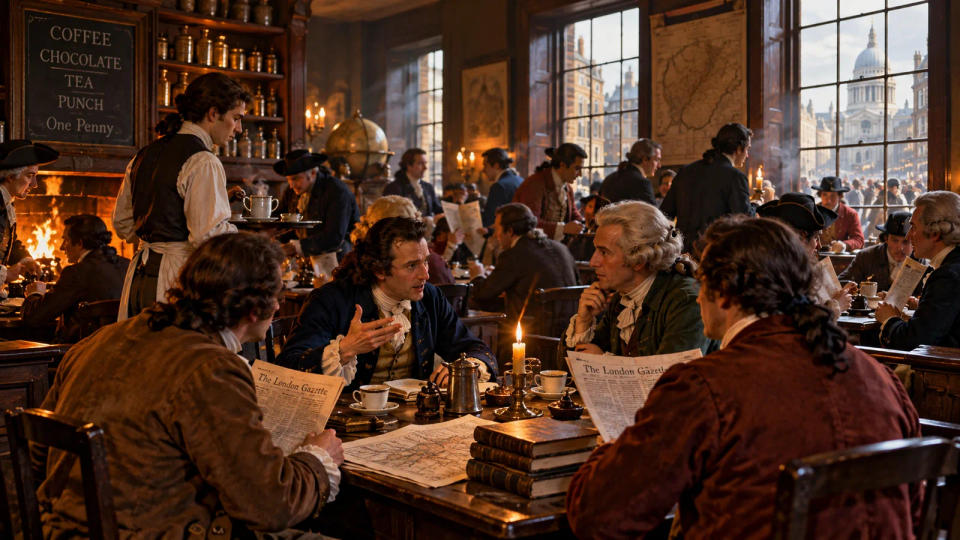
A printed sheet could be expensive or hard to obtain individually, but a newspaper shared among customers reached many readers. Coffeehouse proprietors made their premises attractive by supplying publications and encouraging regulars to return. An Oxford history project notes that some owners cooperated with printers and displayed information such as share prices. The coffeehouse therefore functioned as a place to consume, compare, and redistribute news.
There is an unusually tangible reminder of this world in the London Museum’s collection: a penny trade token from a coffeehouse in Exchange Alley, associated with the sign of a Turkish sultan. The token is not evidence that every coffeehouse had identical fees. It does show how closely coffee retailing, small payments, and the commercial streets of London belonged together.
How Conversation Became an Informal Classroom
The word “university” referred less to the coffee than to the conversations surrounding it. Customers brought newspapers, arguments, reports from abroad, and professional experience into shared spaces. A merchant might know shipping conditions; a writer might know the latest pamphlet; a physician or experimenter could explain an unfamiliar scientific idea. The exchange was informal, sometimes witty, and hardly always reliable, but it let people encounter knowledge outside their immediate occupations.
The Courtauld Institute of Art highlights a 1674 set of coffeehouse rules that welcomed gentlemen and tradesmen to sit without insisting on conventional rank. Such ideals suggest how coffeehouses wanted to present themselves: the quality of one’s conversation could matter more than the privileges attached to one’s title. That did not erase social hierarchy, but it made the image of a school open to paying customers plausible.
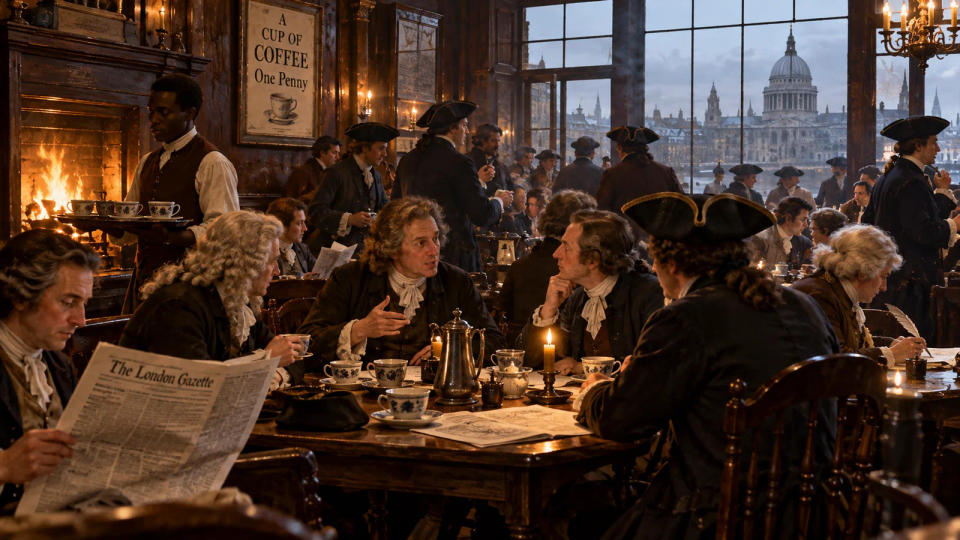
In some houses, learning moved beyond casual discussion. The University of St Andrews’ history of mathematics records advertised lecture series in coffeehouses, including a course planned for Button’s Coffee House in 1713–14 on subjects such as mechanics, optics, and the behavior of fluids and air. This was closer to organized instruction than to gossip over a cup. Yet these occasions should not be mistaken for modern universities with admissions systems, examinations, or degrees.
Scientific exchange also connected coffeehouse audiences to larger intellectual circles. Oxford’s Newton and the Mint project describes Royal Society fellows visiting coffeehouses to hear about publications and experiments. This does not mean the Royal Society itself was born in a London coffeehouse: its formal institutional history is separate. It means an established scientific community shared some of the same public channels of debate.
Business, Politics, and the Limits of Open Debate
Different coffeehouses developed recognizable specialties. The Grecian was associated with scholarly and scientific conversation, while Jonathan’s Coffee House in Exchange Alley drew traders and became part of the history surrounding organized securities dealing in London. Networks formed because people knew where to find a particular kind of knowledge. A coffeehouse could act as an address for correspondence, an informal market, and a meeting place all at once.
The legacy extended well beyond daily conversation. The Royal Society of Arts traces its founding to eleven men who met at Rawthmells coffeehouse in Covent Garden on 22 March 1754. That is an example of people organizing an institution through a coffeehouse meeting, not proof that every modern financial or scientific organization originated in one. The distinction matters: coffeehouses provided opportunities and connections, while later institutions developed their own structures.
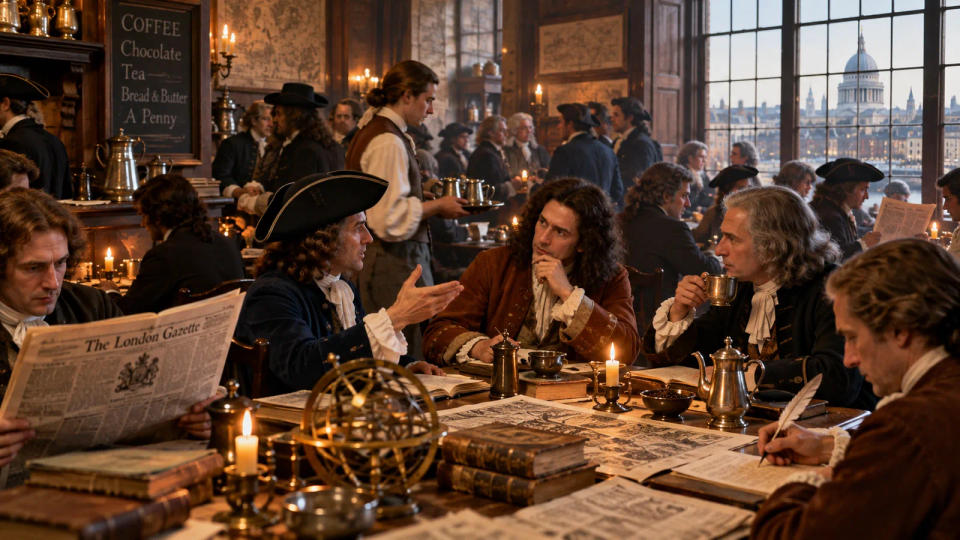
Political authorities understood the power of conversation, too. Coffeehouses carried criticism and rumors as well as serious argument. King Charles II attempted to suppress them in 1675, amid fears that public meeting places fostered disaffection. The measure was quickly withdrawn after opposition. Their reputation as centers of independent discussion was part of their attraction and part of what made them controversial.
We should also be skeptical of the claim that anyone could join equally. Oxford historians stress that women were generally excluded as patrons, although women did work in these establishments. Codes of behavior, social pressure, and the price itself could deter people of limited means. Some proprietors or customers encouraged exchanges across rank; others created exclusive circles. The term “penny university” was an ideal and a memorable nickname, not a guarantee of universal access.
Even the learning could be messy. News might be secondhand, a spirited debate could descend into insult, and gossip could be mistaken for evidence. The Courtauld’s account notes contemporary satires criticizing idleness and noisy conversation. These were places where information competed for attention, rather than carefully edited textbooks. Their educational value came from participation and comparison, not assured accuracy.
Conclusion
London’s coffeehouses became “penny universities” because a small payment opened the door to shared news, practical knowledge, spirited arguments, and sometimes formal lectures. They were neither universities nor perfectly inclusive public forums. Their historical importance lies in showing how much learning can happen when readers, professionals, and strangers meet regularly to exchange information outside official institutions.
Sources & Further Reading
- The Courtauld Institute of Art — Georgian London’s Coffeehouses
- University of Oxford — Science in London
- University of St Andrews, MacTutor — Coffee houses
- London Museum — The New Coffee House
- Royal Society of Arts — The Coffee House