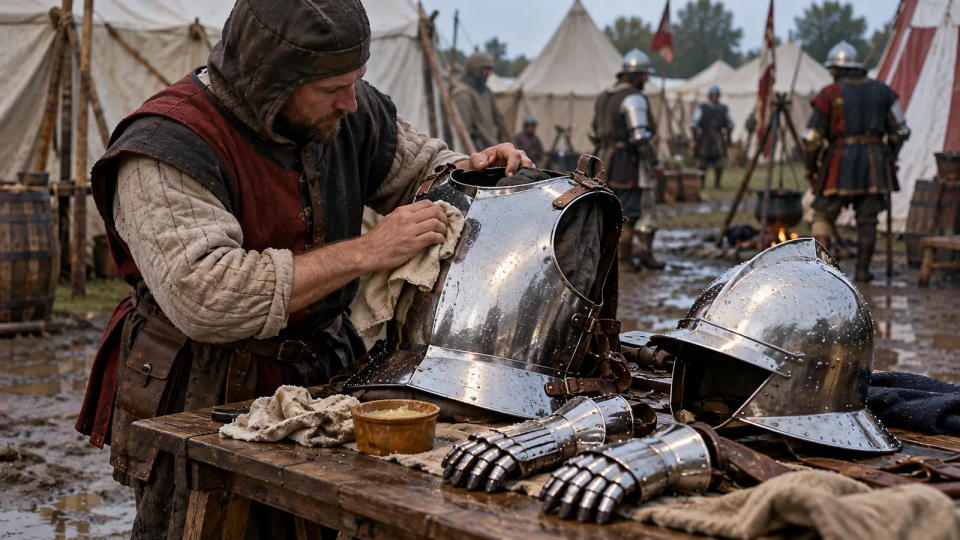
Rain has just stopped, a soldier has come back from the road, and his steel armor is damp, muddy, and marked by sweaty hands. What happened next mattered. Medieval fighters could not simply leave iron or steel equipment in a heap and expect it to survive.
In late medieval Europe, especially once plate armor became common, rust prevention was a routine job: remove dirt and moisture, dry the metal, polish away early corrosion, and leave a thin protective layer of grease or oil. Mail could be cleaned by tumbling it with abrasive material, while some armor was painted, blued, or otherwise finished in ways that also helped resist corrosion. The exact method varied by place, date, wealth, and type of armor, but the principle was simple—keep water and reactive grime away from exposed iron and steel.
Why Rust Was a Daily Threat
Medieval armor was designed to survive blows, not neglect. Iron and steel corrode when moisture and oxygen reach the surface, and dirt can hold moisture against the metal. Modern museum conservators face the same basic problem. The Metropolitan Museum of Art notes that polished steel is vulnerable even to salts and acids from fingerprints, while dust can attract moisture and encourage corrosion.
For a medieval fighting man, the danger was obvious after rain, river crossings, muddy marches, or combat. Plate armor also had hinges, rivets, sliding lames, leather straps, and hidden overlaps where water could linger. Mail created a different problem: thousands of small rings produced an enormous amount of metal surface that was awkward to clean one ring at a time.
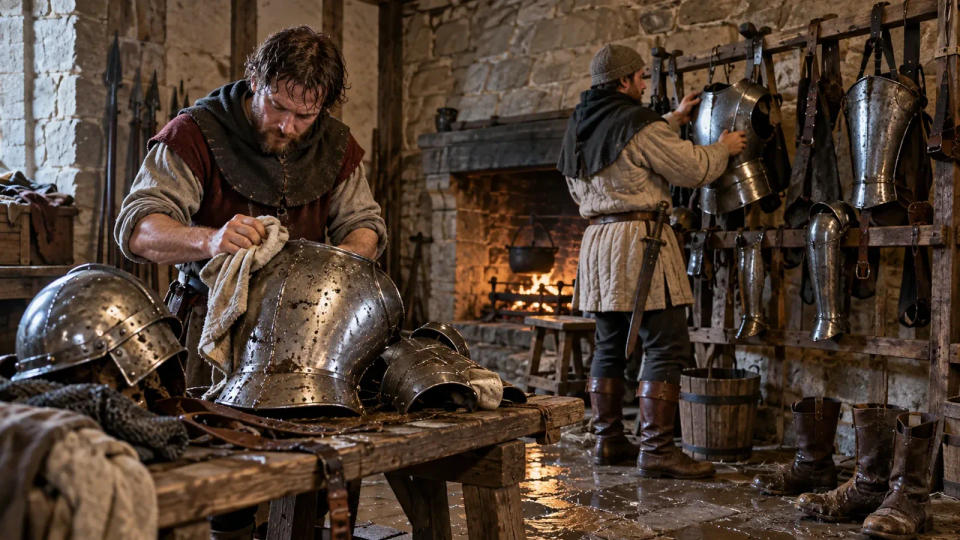
This does not mean every rusty spot ruined a harness. Working armor naturally accumulated scratches, dents, worn polish, and repairs. The challenge was to stop surface corrosion from becoming deep pitting or from stiffening moving parts. That made maintenance part of the useful life of the equipment, not merely a matter of appearance.
The First Defense: Clean and Dry It Quickly
The most basic protection was also the most practical: do not leave armor wet and dirty. Mud, sweat, and rainwater had to be wiped away, and pieces needed to be dried before storage. Plate elements could be cleaned separately, giving access to edges, joints, and areas hidden by straps or neighboring plates.
Late medieval armor was a sophisticated product that required specialist metalworking, and documentary evidence shows that professional armorers served elite patrons. A study of Henry V’s armor in royal accounts, for example, identifies named armorers working for the king and his circle during campaigns in France. Those royal records tell us much more about elite support than about rank-and-file routines, so we should avoid imagining one universal “knight’s cleaning routine” for every medieval soldier.
What we can say with confidence is that armor had to be kept in working order. A clean, dry surface was easier to inspect for damage, and articulated plate depended on rivets and sliding parts moving freely. Maintenance was therefore both corrosion control and mechanical care.
Grease and Oil Put a Barrier Between Steel and Water
After cleaning, a thin fatty or oily coating could slow corrosion by reducing direct contact between the metal and moisture. One unusually vivid piece of evidence comes from a 1402 recipe discussed by the Royal Armouries. It recommends preparing goat legs, removing the marrow, and using that marrow to grease armor so that the plates would remain bright even when wet.
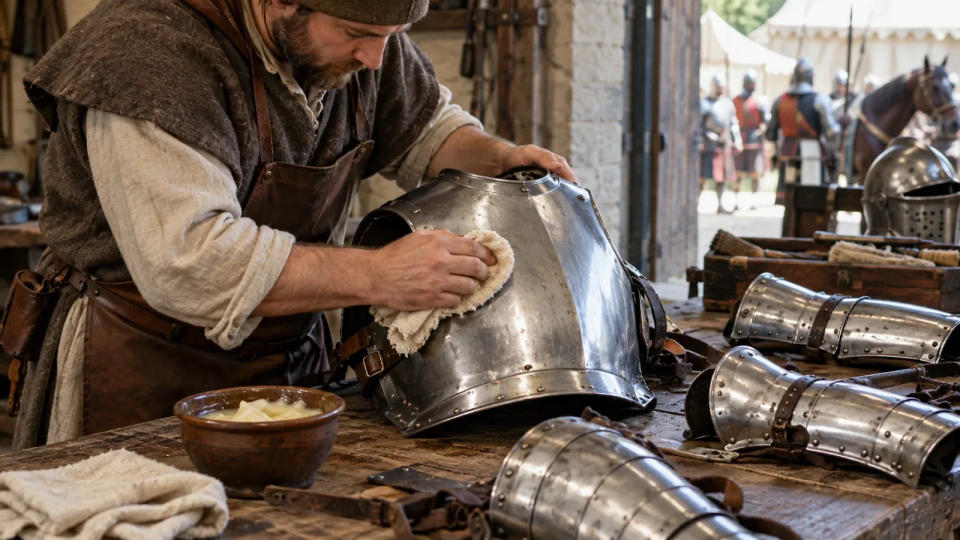
The recipe sounds strange to modern readers, but the logic is familiar. Fat creates a water-resistant film. Medieval households and workshops had access to animal fats and oils, and armor did not need a chemically perfect coating to benefit from a layer that reduced exposure to damp air and water.
The coating would not have been permanent. Handling, rain, dust, and repeated use could remove it, so protection had to be renewed. Too much grease would also collect dirt. The goal was not to soak a harness but to keep the metal clean and lightly protected. In a campaign environment, that sort of repeated, practical maintenance mattered more than achieving a museum-like shine.
Mail Could Be Tumbled, While Some Armor Was Finished to Resist Corrosion
Mail presented a special cleaning problem because a hauberk might contain tens of thousands of interlinked rings. The Metropolitan Museum of Art has documented a traditional method of cleaning mail by tumbling it in a barrel with sawdust sprinkled with oil. The movement lets the rings rub against the cleaning material and against one another, helping remove grime and light oxidation from many surfaces at once.
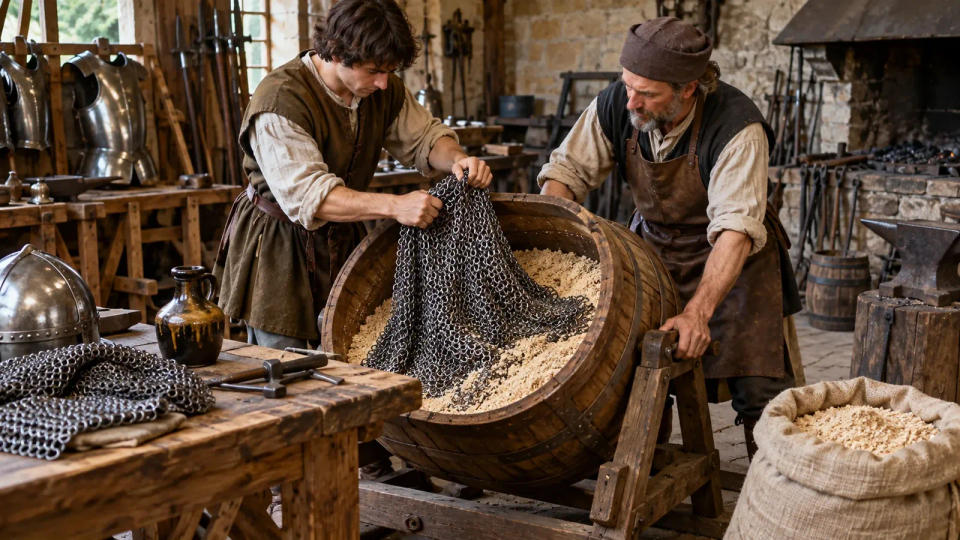
This is important because it shows that medieval armor care was not simply endless hand-polishing. Different forms of armor encouraged different methods. Flexible mail could be agitated with cleaning material; large plate surfaces could be wiped, rubbed, and polished directly.
Not all armor was supposed to look like bare silver-colored steel, either. The Met notes that iron and steel armor could be painted or deliberately patinated, including heat bluing, and that such finishes could inhibit rust as well as decorate the surface. Surviving examples and workshop evidence also show that armorers used a range of surface treatments and finishing techniques. A dark or colored surface, then, was not necessarily a sign of neglect.
Polishing itself was part of the craft. Research from the University of Leeds on late medieval German and Italian armor has used surviving tool marks, inventories, and workshop evidence to reconstruct how armorers shaped and finished plate. The final surface was the result of skilled work, and keeping it serviceable required continued care after the armor left the workshop.
Conclusion
Medieval soldiers did not have a magical rust-proof metal. They relied on maintenance: clean off mud and sweat, dry the armor, remove early corrosion, grease or oil exposed steel, and use cleaning methods suited to plate or mail. Some surfaces were also painted or blued, giving additional protection.
The polished harness seen in medieval art was therefore not simply the result of fine craftsmanship. It also represented repeated work. Armor stayed useful because someone kept caring for it—after rain, after travel, after battle, and before it was stored away again.
Sources & Further Reading
- Royal Armouries — The Hundred Years’ War 1337–1453
- The Metropolitan Museum of Art Bulletin, Vol. 28, No. 4 (1969)
- The Metropolitan Museum of Art — Techniques of Decoration on Arms and Armor
- University of Leeds — Nickolas Dupras, Armourers and their Workshops
- The Metropolitan Museum of Art — The Function of Armor in Medieval and Renaissance Europe