
What happened to a suit of armor after a wet march, a muddy battle, or hours of sweating inside it? Medieval soldiers did not have stainless steel, so iron and steel equipment could corrode quickly when moisture was left on the surface. The practical answer was constant maintenance: dry the metal, remove dirt, polish it when needed, and leave a thin protective layer of grease, oil, or another finish between the steel and damp air.
There was no single universal recipe used across every century and region. Surviving evidence is uneven, and some methods are known from later descriptions or museum traditions rather than detailed medieval manuals. Even so, the basic problem is clear: valuable armor could not simply be thrown into a chest wet and forgotten.
Why Rust Was a Daily Problem
Late medieval plate armor was made largely from iron or steel. Those materials were strong enough to resist weapons, but they had a weakness familiar to any modern owner of unprotected steel: water and oxygen could produce rust. Campaign life made that threat worse. Rain, river crossings, mud, wet tents, damp storage, and the wearer's own perspiration all brought moisture into contact with metal.
The Royal Armouries notes that the spread of plate armor created new maintenance demands as well as new defensive advantages. Armor used in battle had to be repaired and cleaned. A highly polished breastplate was therefore not just a fashion statement. A smooth, cared-for surface was easier to keep free of grime and developing corrosion than one left dirty and damp.
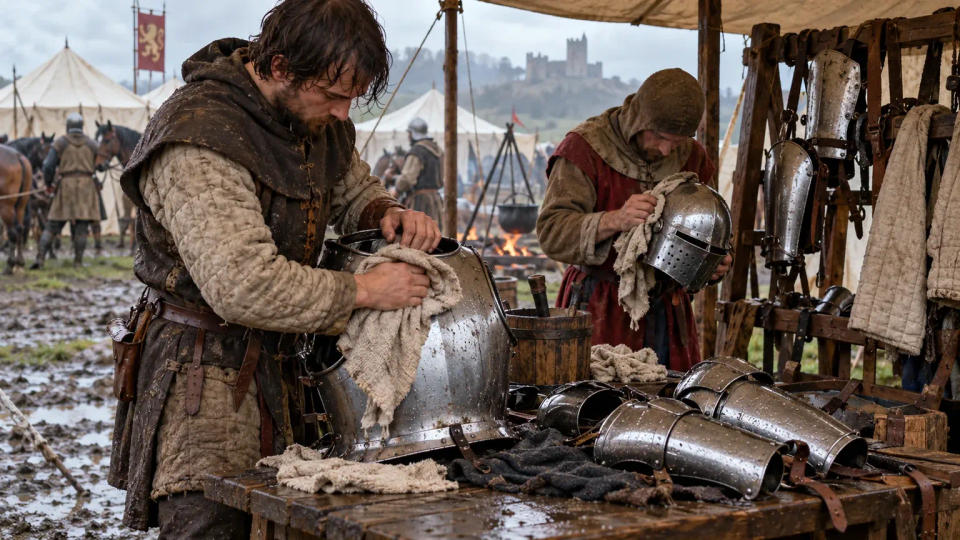
The first line of defense was simple and probably obvious to anyone responsible for expensive military equipment: get the armor dry. Mud and moisture could be wiped away, plates separated where possible, and joints, hinges, rivets, straps, and overlapping lames checked. Those narrow spaces mattered because trapped water could remain after the broad surfaces looked clean.
The Simple Routine: Clean, Dry, and Grease
One striking piece of evidence comes from a recipe dated to 1402 and cited by the Royal Armouries in connection with the English mercenary Sir John Hawkwood. The recipe recommended preparing goat-leg marrow and using the fat to grease armor so that the plates would remain bright even when wet. The details sound unusual today, but the principle is straightforward: a fatty coating helps keep water away from bare metal.
Medieval people had many animal and plant fats available to them, so the exact substance could vary. What mattered was leaving a thin protective film rather than a thick sticky layer that would trap dirt. After a day's use, an attendant could wipe down the plates, work grease over exposed steel, and pay attention to edges and moving parts. Similar logic still appears in modern conservation: metal objects are protected by controlling moisture and placing a barrier between steel and the environment.
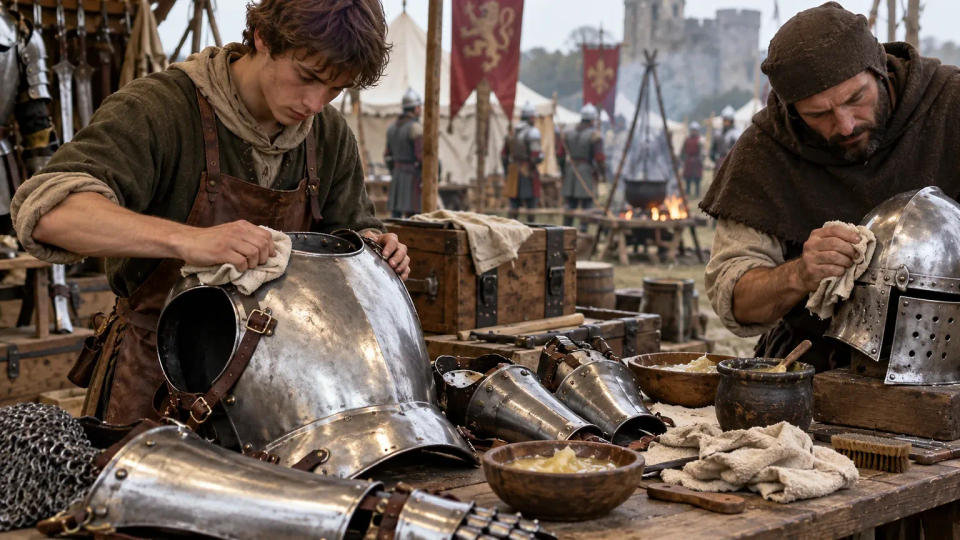
Polishing also had a practical role. Abrasive cleaning could remove early surface oxidation and restore a smoother finish before the metal was protected again. It had to be done with care, however. Too much abrasion removes metal as well as rust, a fact visible on some surviving armor that was aggressively cleaned in later centuries.
Mail Needed a Different Kind of Cleaning
Mail created another problem. A mail shirt could contain tens of thousands of interlinked rings, giving dirt and moisture countless tiny places to hide. Cleaning every link by hand would have been painfully slow.
A Metropolitan Museum of Art publication describes what it calls a medieval method of cleaning a hauberk: tumbling the mail in a barrel with sawdust sprinkled with oil. The moving links rub against the absorbent material, while the sawdust helps pick up grime and the oil leaves protection on the metal. The description comes through the museum's armorer tradition rather than a surviving instruction sheet from every medieval army, so it is safer to treat it as an attested historical method, not a rule followed everywhere.
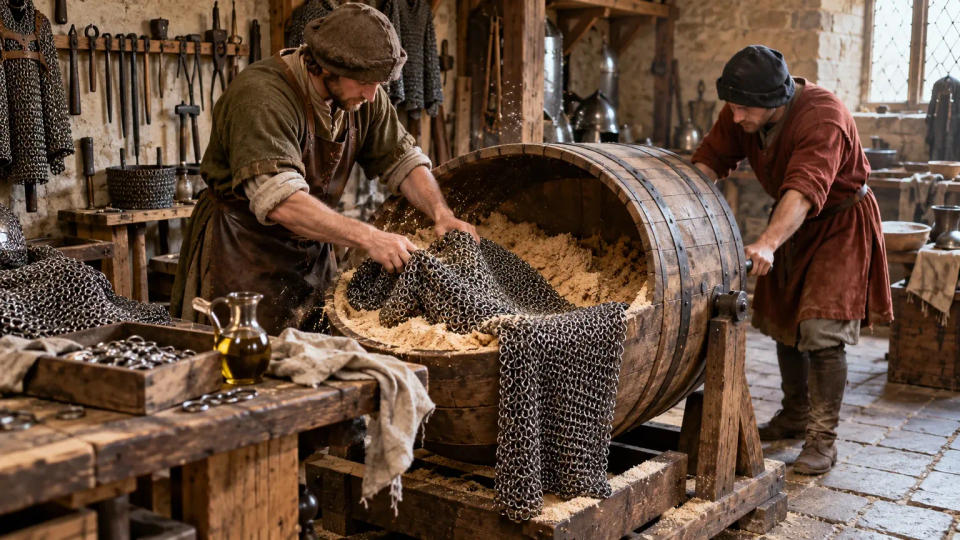
The method makes sense for the structure of mail. Because the rings move against one another, tumbling could clean many surfaces at once. Oil could then remain in the gaps where a cloth could not easily reach. Mail still needed inspection, because broken or opened rings reduced protection even if the metal itself was clean.
Not Every Suit Was Meant to Stay Bright
The familiar phrase “knight in shining armor” can be misleading. Medieval and Renaissance armor was not always left as bright polished steel. The Metropolitan Museum notes that paint, patination, and other surface treatments could inhibit rust. Surviving European examples of heat patination appear from the fifteenth century, although the technique may be older. A darkened, painted, or otherwise treated surface therefore could be both decorative and protective.
Gilding provided another barrier, especially on expensive armor and weapons, but it belonged to the world of wealthy patrons rather than routine protection for ordinary soldiers. The Met points out that durable fire gilding could protect etched steel from corrosion. In practice, decoration and preservation often overlapped: a finish that made armor look richer might also shield some of the steel beneath it.
Who did all this work depended heavily on status. The Met notes that knights on campaign relied on retainers, squires, and attendants who looked after horses, armor, and other equipment. Royal commanders could also travel with specialist armorers. A wealthy man-at-arms therefore did not necessarily spend every evening polishing his own harness. At the other end of the social scale, town militia and less wealthy soldiers might own only a helmet, mail shirt, or breastplate and would have had far fewer helpers. Maintenance was still necessary; the labor simply fell closer to the owner.
Conclusion
Medieval soldiers fought rust with routine rather than a miracle substance. Armor was dried after exposure to rain and sweat, cleaned of mud and early corrosion, polished when necessary, and protected with grease, oil, paint, patination, or more luxurious finishes. Mail could be tumbled with absorbent material and oil to reach its thousands of rings. The result was not perfectly rust-proof armor, but equipment kept serviceable through repeated attention. The famous shine of well-kept armor was therefore partly about appearance—and partly evidence of a great deal of maintenance.
Sources & Further Reading
- Royal Armouries — The Hundred Years' War 1337–1453
- The Metropolitan Museum of Art — Arms and Armor: Common Misconceptions and Frequently Asked Questions
- The Metropolitan Museum of Art Bulletin, Vol. 28, No. 4 (December 1969)
- The Metropolitan Museum of Art — Techniques of Decoration on Arms and Armor
- The Metropolitan Museum of Art — Fire Gilding of Arms and Armor