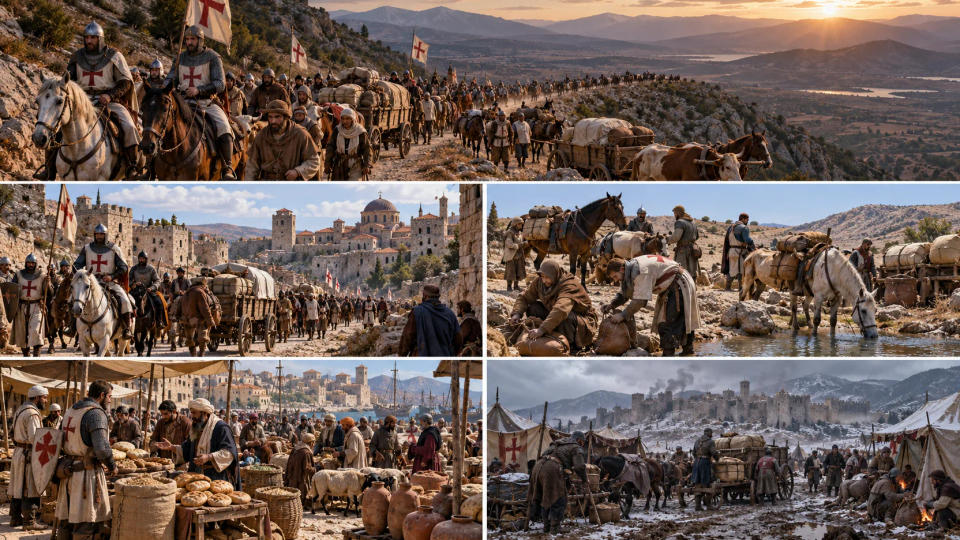
How could an army leave Western Europe and keep moving for thousands of miles when there were no military trucks, canned rations, or modern supply depots? Crusader armies survived the journey to the Holy Land by combining several imperfect methods: they carried what they could, bought food in markets, grazed and watered animals wherever possible, seized supplies when agreements failed, relied on local allies and rulers, and increasingly used ships to bring men and provisions along the Mediterranean coast.
The system was never secure. The First Crusade of 1096–1099 is the clearest example because its forces crossed the Balkans and Anatolia largely overland before reaching Syria and Palestine. Contemporary accounts repeatedly describe hunger, thirst, dead horses, expensive food, and dangerous foraging. The fact that some crusaders reached Jerusalem was not evidence of a smooth supply chain. It was evidence of constant improvisation.
The Journey Was a Chain of Stages, Not One Giant Convoy
The armies of the First Crusade did not leave Europe as a single neatly organized column. Different contingents traveled on separate routes and reached Constantinople at different times. From there, with Byzantine assistance, they crossed into Asia Minor and continued through territory where roads, harvests, water sources, local politics, and enemy activity all shaped the pace of the march.
That mattered because a medieval army could not simply carry enough food for an entire expedition to Jerusalem. Every extra sack required an animal, cart, or person to move it, and the animals themselves needed fodder and water. As supplies were consumed, the army had to replace them from the regions it entered.
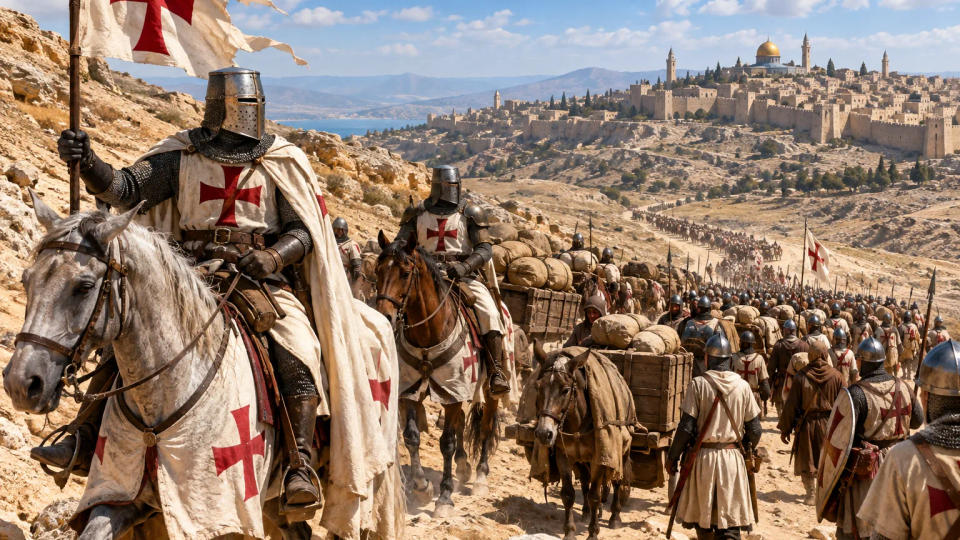
In practice, crusading forces behaved partly like armies and partly like enormous armed pilgrim caravans. Knights and infantry marched alongside clergy, servants, craftsmen, noncombatant pilgrims, horses, mules, oxen, carts, and livestock. This gave the expedition mobility, but it also created a huge daily demand for food and water.
Food, Water, and Animals Decided How Far They Could Move
Grain was especially important because it could be transported and turned into bread or simple meals. Armies also depended on wine, meat, cheese, and whatever local produce or livestock could be obtained. But the hardest problem was often not feeding soldiers. It was keeping the animals alive.
Horses gave mounted warriors their battlefield value, while mules, asses, oxen, and other pack animals carried tents, tools, food, weapons, and personal baggage. When animals died, the problem multiplied: the army lost both transport capacity and military power. One First Crusade account says that during a desperate stretch in Anatolia many cavalrymen lost their horses and had to continue on foot. Oxen were pressed into service, while even smaller animals were used to carry loads in extreme circumstances.
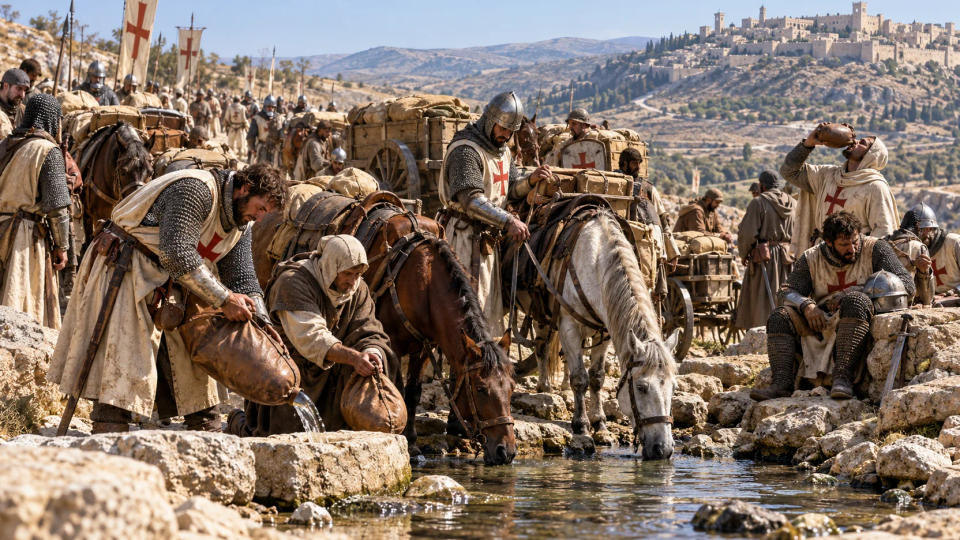
Water could be even more urgent than food. Near Iconium, a contemporary account says local inhabitants warned the crusaders to fill skins because the road ahead lacked water for about a day's march. During the siege of Jerusalem in 1099, water became so scarce that men had to travel several miles to water their animals, while water in camp became extremely expensive. Watering parties were also vulnerable to attack.
Markets, Bargains, and Local Deals Could Keep an Army Alive
Crusader survival did not depend only on taking supplies by force. Buying and bargaining were just as important. A large army arriving near a town could become a market as well as a threat. If political conditions allowed it, merchants and local rulers could sell grain, animals, wine, and other necessities to the newcomers.
The march south in 1099 provides a striking example. Near Tripoli, the crusaders reached an agreement with the local ruler. A contemporary source reports that the army gained access to a large market where horses, asses, and other goods could be obtained. Such arrangements were temporary and political, but they could restore an army that had exhausted its own resources.
Local knowledge mattered too. The crusaders moved through Armenian, Byzantine, Muslim, and other communities whose relationships with neighboring powers were complicated. Guides, traders, negotiated passage, and regional alliances could help an army find roads and provisions. In other places, resistance or scorched resources created the opposite result.
Foraging therefore ranged from ordinary purchasing to organized collection and violent seizure. Medieval chronicles often describe troops leaving camp to search for food, animals, or fodder. These expeditions were dangerous because small groups could be ambushed. A supply problem could quickly become a security problem.
Antioch Showed How Easily the Supply System Could Collapse
The long siege of Antioch in 1097–1098 exposed the limits of this improvised logistics system. As the crusaders remained outside the city through the winter, nearby food resources were consumed. Historian John France notes that sources describe provisions coming from increasingly distant places, including Syria, Cilicia, Cyprus, Rhodes, and other Mediterranean islands. Even then, hunger and cold became severe, and horses disappeared at an alarming rate.
This was the basic weakness of a large medieval expedition: staying in one place could be harder than marching. A moving army might reach fresh pasture, markets, wells, and farmland. A besieging army repeatedly consumed the same surroundings until the local supply zone was stripped bare.
Sea transport became one answer. The First Crusade had no fleet of its own, but once its armies reached Syria they benefited from ships bringing reinforcements and supplies from Byzantine and Western maritime networks. Ports and islands such as Cyprus became increasingly important rear areas, and the crusaders tended to remain near the Mediterranean coast as they advanced south.
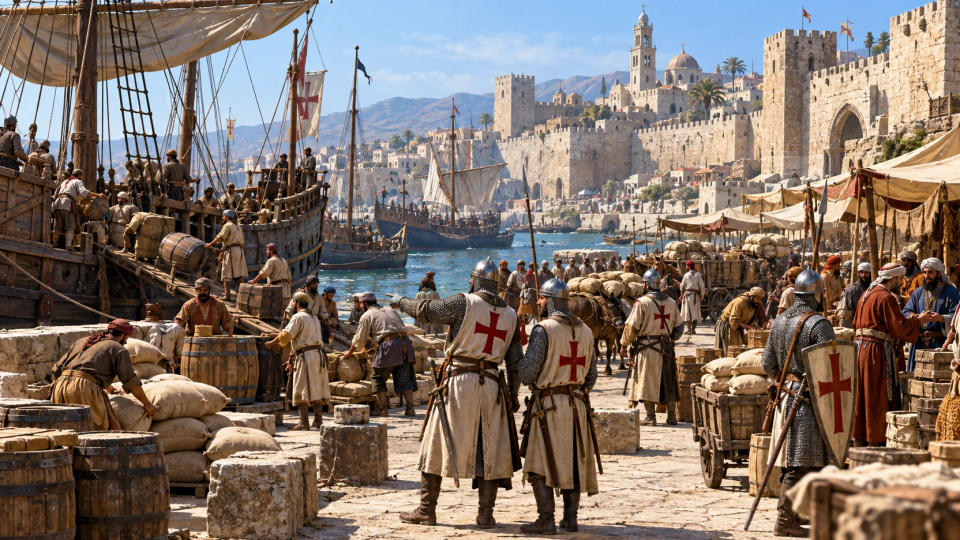
Later crusading expeditions relied even more heavily on maritime transport. Italian seafaring powers such as Genoa, Pisa, and Venice became crucial not only in combat at sea but also in carrying armies, horses, money, equipment, and food. Ships did not remove the danger of shortages, storms, disease, or bad planning, but they could move bulk supplies far more efficiently than an overland baggage train.
Conclusion
Crusader armies survived the road to the Holy Land through a flexible but fragile mixture of carried supplies, pack animals, water planning, local markets, political agreements, foraging, seizure, and sea transport. There was no uninterrupted supply line from Europe to Jerusalem. Every stage depended on finding the next source of food, water, fodder, animals, or shipping—and when that failed, the expedition could come close to collapse.
Sources & Further Reading
- The Metropolitan Museum of Art — The Crusades (1095–1291)
- Cambridge University Press — Victory in the East: The Siege of Antioch
- De Re Militari — Contemporary Sources for the First Crusade
- JSTOR — The First Crusade: The Chronicle of Fulcher of Chartres and Other Source Materials
- Cambridge University Press — The Latin Kingdom of Jerusalem and the Sea