
What happens when a civilization built around a river suddenly gets much less water? Around 2200 BCE, Egypt's Old Kingdom entered a period of crisis at roughly the same time that a major drought affected northeast Africa and other regions. Evidence suggests that lower Nile floods damaged harvests and added severe pressure to an already changing political system, helping push the Old Kingdom toward fragmentation rather than single-handedly destroying Egyptian civilization.
The Disaster Was a Megadrought, Not a Single Bad Flood
The event is commonly called the 4.2 ka climate event, meaning a climatic shift that occurred about 4,200 years before the present. In Egypt, its most important effect was not a spectacular catastrophe such as an earthquake or volcanic eruption. It was prolonged aridity: less rainfall in key parts of the Nile's enormous drainage basin and, in turn, unusually weak river flow.
That distinction matters. The Nile does not depend mainly on rain falling in Egypt. Much of the water and sediment that drove its annual flood came from far to the south, especially the Ethiopian highlands through the Blue Nile system. If monsoon rainfall weakened there, the consequences could travel hundreds of miles downstream into Egyptian fields.
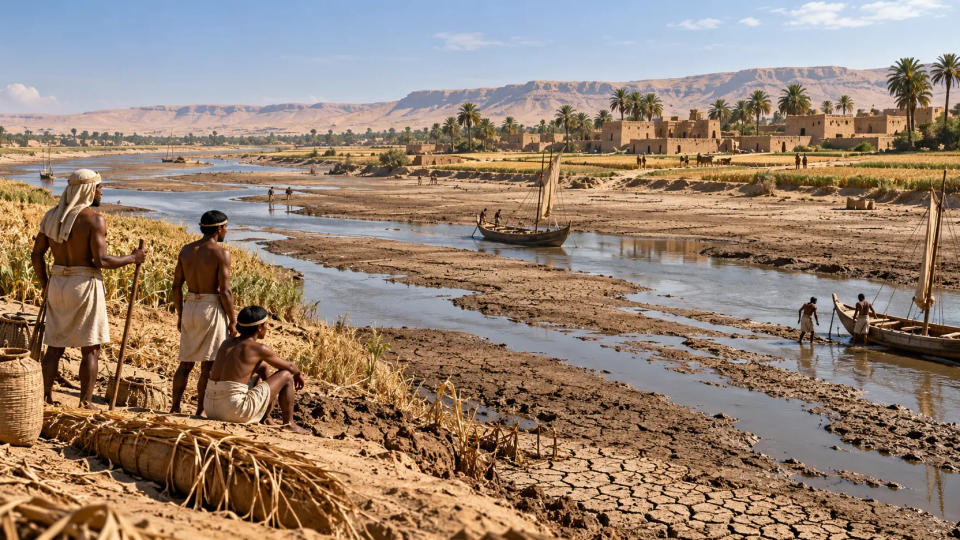
Lake Tana in Ethiopia, one of the major headwater regions of the Blue Nile, preserves evidence of a dry episode around 4,200 years ago. Sediments from the Nile Delta also show substantial changes in river conditions during roughly the same period. These records do not tell us that every year was equally disastrous, but together they point to a prolonged hydroclimatic stress at a very dangerous moment in Egyptian history.
The timing is striking. Egypt's Old Kingdom, the age associated with the great pyramid-building state, ended around 2181 BCE in one widely used chronology. What followed was the First Intermediate Period, when political authority was divided among competing regional centers rather than concentrated under a single powerful royal administration.
Why a Low Nile Could Become a Food Crisis
Ancient Egyptian agriculture depended on the rhythm of the Nile. A useful flood spread water and fertile silt across the floodplain, renewing soils before planting. A flood that rose too little could leave parts of that landscape dry. Repeated weak floods were therefore not simply a transportation problem or an inconvenience for farmers; they could threaten the food supply that supported households, officials, temples, workers, and the state itself.
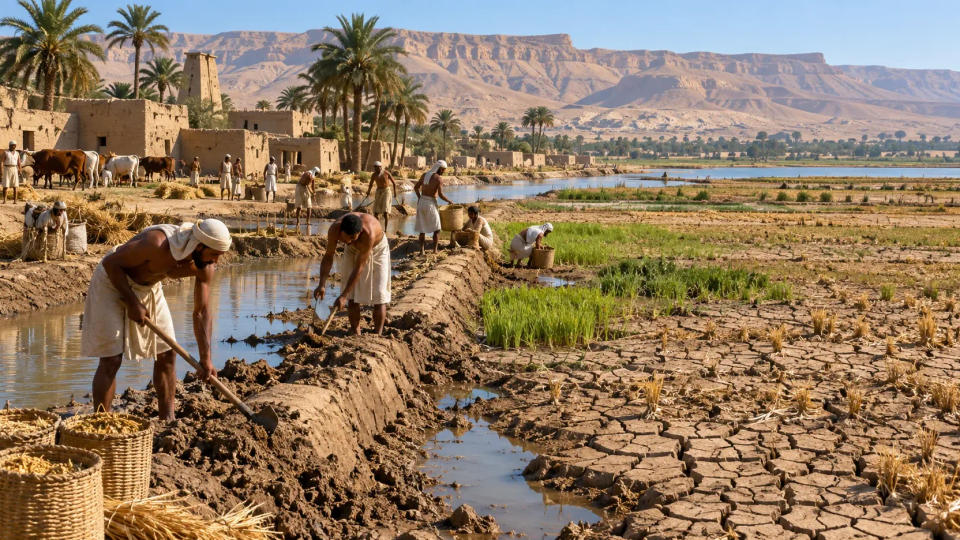
Modern studies of the 4.2 ka event in Egypt combine geological, archaeological, and biological evidence. The pattern they describe includes lower Nile levels, drier conditions, windblown desert sand advancing into parts of the valley, reduced crop production, and episodes of famine. The exact severity almost certainly varied from region to region, which helps explain why the period should not be imagined as one synchronized national disaster.
Food shortages would also have created political problems. The Old Kingdom state relied on agricultural surpluses and a system that moved goods through institutions, estates, and officials. When less grain was available, the ability of central authorities to collect, redistribute, and command resources would have been weakened precisely when communities needed help most.
The Evidence Is Written in Mud, Lakes, and Sand
There is no ancient Egyptian weather station telling us how much rain fell in 2200 BCE. Instead, researchers reconstruct the crisis from environmental records. Sediment cores from the Nile Delta preserve changes in the material carried by the river. Research at Lake Tana uses lake sediments and geophysical evidence to track ancient water levels and rainfall. Other Egyptian sites preserve signs of increasing aridity and desert encroachment.
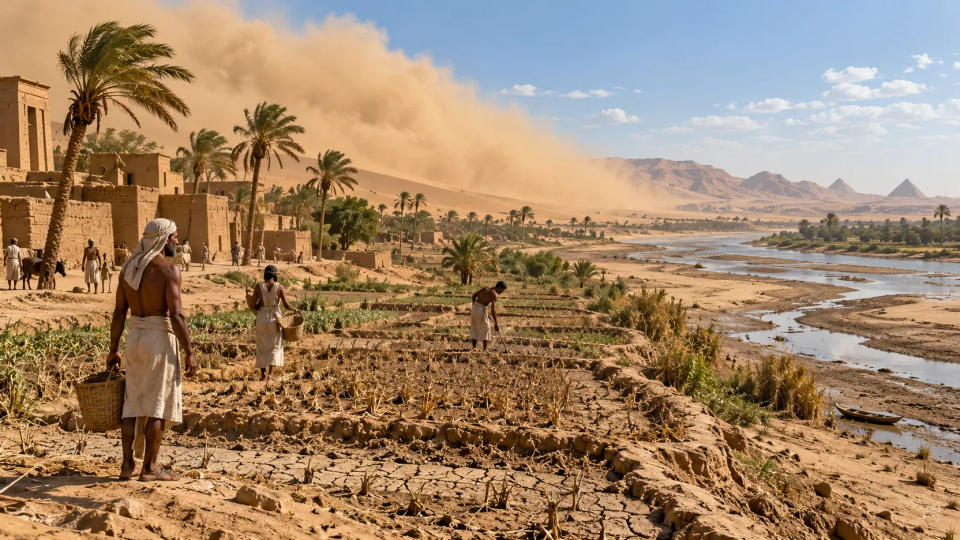
These clues are especially persuasive because they come from different places and different kinds of evidence. A 2003 geoarchaeological study of Nile Delta sediments found major changes in flood and base-flow conditions around 4,200 to 4,000 years ago and concluded that climate-related Nile failures may have contributed to the Old Kingdom's collapse. A later synthesis in African Archaeological Review likewise connected aridification, declining Nile levels, lower crop yields, and famine with the political breakdown of the period.
Written evidence adds another layer, but it must be handled carefully. Inscriptions from the First Intermediate Period sometimes praise local officials for feeding people during famine or supporting their communities in difficult years. Such texts are valuable, yet they were also monuments of self-promotion. They show that scarcity and relief were meaningful themes, not that every dramatic claim should be read as a neutral report of conditions across all Egypt.
Why Drought Alone Does Not Explain the Old Kingdom's End
The simplest version of the story is tempting: the Nile failed, people starved, and the pharaoh's state collapsed. The evidence supports an environmental crisis, but the political history was more complicated. By the late Old Kingdom, provincial administrators and local elites had become increasingly important, while royal authority was weakening. After the central system fractured, distinctive regional styles in pottery, coffins, and art appeared, reflecting a country organized through multiple political centers.
That means drought is best understood as a stress multiplier. Weak floods could reduce harvests, shrink taxable surpluses, disrupt exchange, and make it harder for the royal court to meet expectations. Local leaders who controlled food, irrigation, labor, or regional networks could become more important at the same time. Environmental pressure did not create every political problem, but it could make existing weaknesses much harder to manage.
The First Intermediate Period was also not simply a century of helpless decline. The Metropolitan Museum of Art notes that local leaders responded region by region and developed irrigation measures, while major political centers eventually emerged at Herakleopolis and Thebes. Thebes ultimately became the base from which Egypt was reunified under Mentuhotep II, beginning the Middle Kingdom.
This recovery is a useful reminder of what “collapse” means in archaeology. Ancient Egypt did not disappear. Its centralized Old Kingdom political order broke apart, institutions changed, power shifted toward provincial authorities, and later rulers rebuilt unity in a different form. The drought may have helped end one political system without ending Egyptian civilization itself.
Regional variation is another reason for caution. A weak flood could devastate one district while another retained better access to water, stored grain, or functioning local administration. Archaeology therefore points to a patchwork of hardship, adaptation, and political competition rather than a single moment when the entire country suddenly failed.
Conclusion
The natural disaster behind this story was a long drought that weakened the Nile's life-giving floods around the end of the Old Kingdom. Sediments, lake records, archaeological evidence, and inscriptions all support a period of serious environmental and economic stress. But the strongest explanation is not “climate caused collapse” in isolation: drought struck a state already undergoing political change, and the combination helped transform Egypt from the centralized pyramid age into the fragmented First Intermediate Period.
Sources & Further Reading
- Younes & Bakry, “The 4.2 ka BP Climate Event in Egypt,” African Archaeological Review
- Stanley et al., “Nile flow failure at the end of the Old Kingdom, Egypt,” Geoarchaeology
- Marshall et al., “Late Pleistocene and Holocene drought events at Lake Tana, the source of the Blue Nile”
- The Metropolitan Museum of Art, First Intermediate Period lintel of Mereri
- UCL Digital Egypt, Egypt in the First Intermediate Period