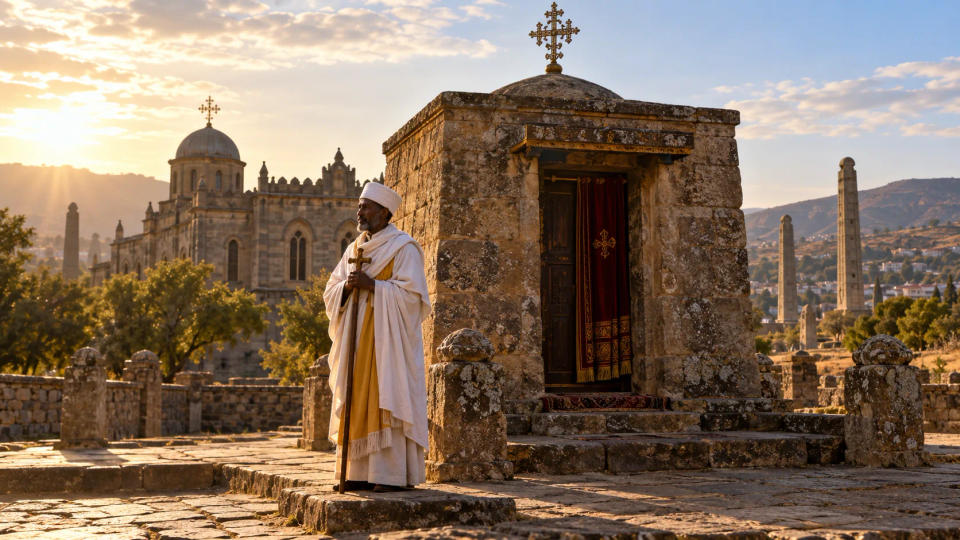
Why would a man accept a religious duty that may keep him beside one small chapel for the rest of his life? In Aksum, Ethiopia, the answer is tied to one of Christianity’s most extraordinary living traditions: the Ethiopian Orthodox Tewahedo Church holds that the biblical Ark of the Covenant is kept in a guarded chapel beside the Church of Our Lady Mary of Zion.
The monk who guards the sanctuary is often described as a lifelong custodian. His task makes sense only when viewed through Ethiopian Orthodox ideas about sacred space, the Ark, and the tabot—a consecrated altar tablet that represents the Ark in every Ethiopian Orthodox church. What is inside the Axum chapel cannot be independently verified, but the guardianship itself reveals how seriously the tradition is treated.
Why Is the Ark Said to Be in Aksum?
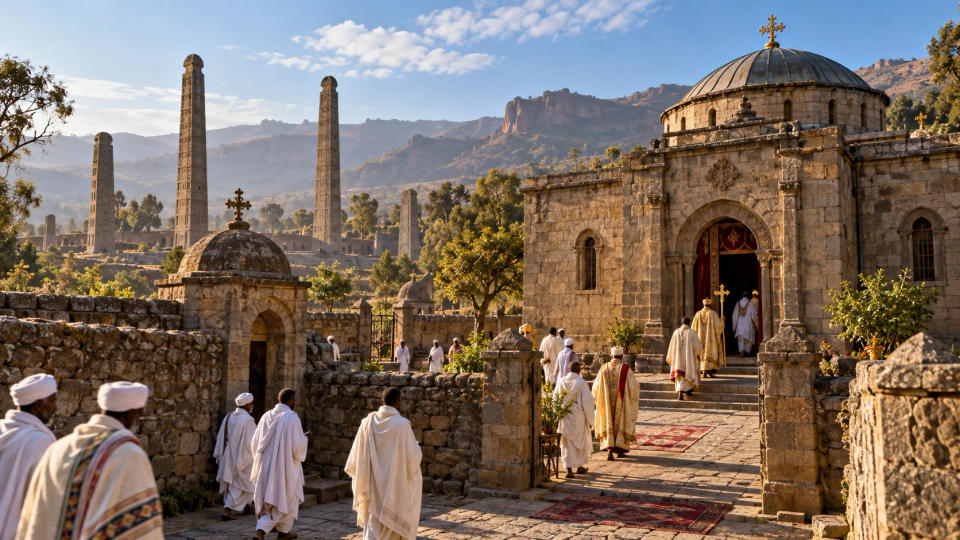
Aksum was the center of a powerful ancient kingdom and became an important Christian center after the conversion of King Ezana in the fourth century. UNESCO notes that Christianity led to the building of churches there, including Saint Mary of Zion, whose later seventeenth-century structure is traditionally associated with the Ark of the Covenant.
The story explaining how the Ark reached Ethiopia comes from the Kebra Nagast, or Glory of Kings, a medieval Ge'ez work. In its account, the Queen of Sheba and King Solomon have a son, Menelik. When Menelik later travels to Jerusalem and returns to Ethiopia, the Ark comes with his party. The details vary in retellings, but this story became deeply connected with Ethiopian ideas of sacred kingship and religious identity.
That does not mean historians can trace the biblical Ark from ancient Jerusalem to Aksum through an unbroken chain of archaeological evidence. The Metropolitan Museum of Art describes the Ark’s arrival as Ethiopian tradition, and a Cambridge University Press history likewise identifies the Kebra Nagast as the medieval source for the claim. The distinction matters: the tradition is old and culturally powerful, but it is not the same thing as independently proven provenance.
Why Does One Guardian Stay With the Chapel?
The rule of restricted access follows a wider Ethiopian Orthodox pattern in which sacred objects are not treated as museum pieces. The Church’s own teaching says that the Axum Ark is kept in a secure chapel and that access is extraordinarily limited. Modern descriptions commonly refer to a single appointed guardian who serves for life and remains within the chapel precinct.
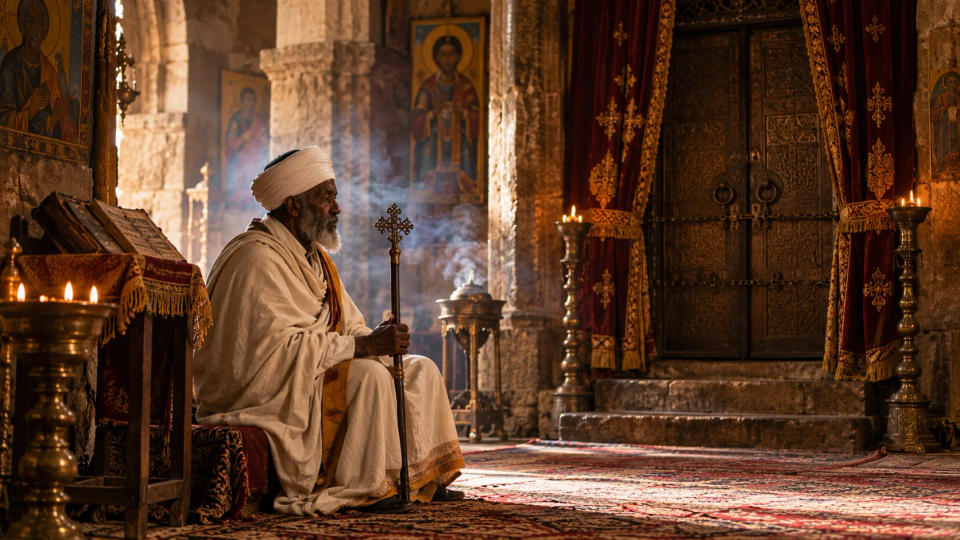
From the outside, that arrangement can sound like a mystery story: one man, one hidden object, one locked sanctuary. Inside the religious tradition, however, the purpose is not to create suspense. The guardian’s role is devotional. He is there because the object is believed to be exceptionally holy, and holiness in this setting is protected through separation, ritual discipline, and controlled access.
This also explains why requests to inspect the object create a conflict of assumptions. Archaeology normally depends on observation, documentation, dating, and comparison. A sacred custodian may instead understand non-access as part of the proper treatment of the object itself. The guardian therefore protects more than a physical container. He protects a boundary between a holy space and the outside world.
The Tabot Explains Why the Ark Matters So Much
The strongest clue to the guardian’s importance is the tabot. The British Museum explains that every Ethiopian Orthodox church has at least one tabot, usually made of wood or stone. It is kept in the church’s Holy of Holies, an area restricted to clergy, and is understood as the foundation that consecrates the church.
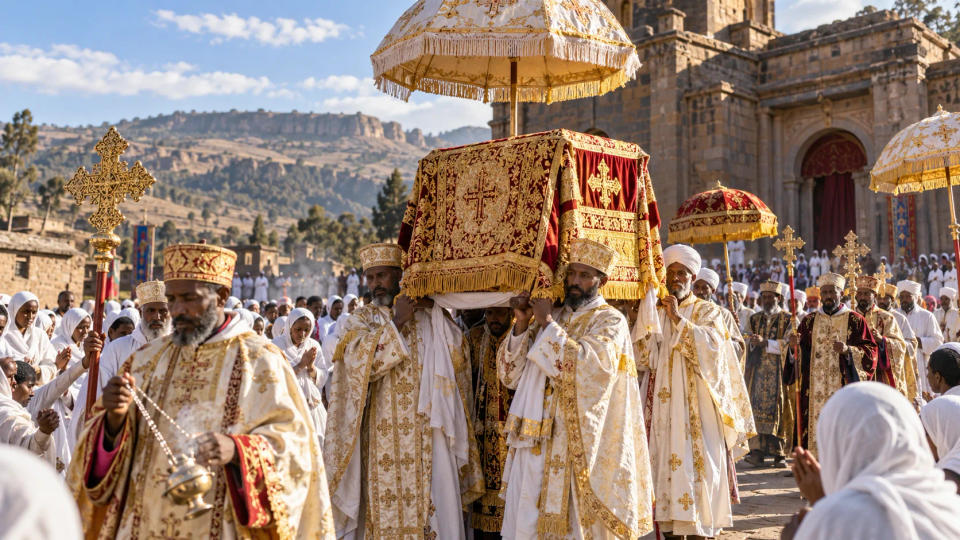
During major festivals, tabots may be carried in procession while covered in rich cloth so that the sacred tablet itself is not exposed to public view. That practice shows that concealment is not unique to the Axum claim. It belongs to a much larger religious system in which the Ark is not merely an ancient chest from a biblical story. It is a model for how divine presence, church space, and ritual authority are understood.
This is why the guardian cannot be reduced to a security guard in the modern sense. The position represents continuity with a religious world in which sacred objects have different rules from ordinary artifacts. The physical act of keeping watch is also a ritual act: the guardian’s restricted life demonstrates the seriousness of what believers say is being protected.
What Can Historians Actually Verify?
Several things are well established. Aksum is an ancient city of major historical importance. The Mary of Zion church complex is a real and long-standing center of Ethiopian Christianity. The Ark tradition is deeply embedded in Ethiopian Orthodox belief, and the Kebra Nagast gives the medieval literary form of the story linking Solomon, the Queen of Sheba, Menelik, and Ethiopia. The tabot tradition is also well documented by museums and scholars.
The central object itself is different. No independent archaeological examination has established that an artifact in the chapel is the Ark described in the Hebrew Bible. Outsiders cannot simply enter, open the sanctuary, photograph the object, sample its materials, or date it. That lack of access means historical certainty stops at the chapel door.
This is also why dramatic claims should be handled cautiously. Stories sometimes describe the guardian as suffering mysterious illnesses or dying because of exposure to the Ark. Reliable historical evidence does not establish such supernatural effects. The remarkable part is already real enough: a living religious office continues to protect an object that millions regard as sacred while historians remain unable to test the central claim directly.
Conclusion
The man guarding Ethiopia’s Ark tradition is not simply protecting a mysterious treasure. He embodies a belief about holiness: some things are not meant to be publicly displayed, handled, or tested. Whether the object in Aksum is the biblical Ark remains unverified, but the lifelong guardianship helps explain why the question has endured. The mystery survives not because nobody cares what is inside, but because the tradition places sacred duty ahead of outside inspection.
Sources & Further Reading
- UNESCO World Heritage Centre — Aksum
- The Metropolitan Museum of Art — Monumental Architecture of the Aksumite Empire
- British Museum — Tabot collection record
- Cambridge University Press — Ethiopian history excerpt discussing the Kebra Nagast tradition
- Ethiopian Orthodox Tewahedo Church Sunday School Department — The Ark of the Covenant