
Why did German tanks acquire such a frightening reputation in World War II? The answer was not that every German tank was bigger or better than its opponents. Especially early in the war, many German vehicles were lightly armed and armored. What made them so alarming was the way Germany combined tanks with radios, mobile infantry, artillery, engineers, reconnaissance, and air support to create fast-moving attacks that were difficult to understand and stop.
Later, tanks such as the Tiger I and Panther added another source of fear: thick armor, powerful guns, and the ability to destroy many Allied tanks at long range. Their reputation became so strong that the psychological effect sometimes exceeded their actual numbers on the battlefield.
Radios, Speed, and Combined Arms Made the Early Panzers Dangerous
The German victories of 1939 and 1940 are often remembered as proof that German tanks were technically superior. That is too simple. During the invasion of France, some French tanks had heavier armor than common German models. Germany's real advantage lay in organization, communication, and the concentration of mobile forces at critical points.
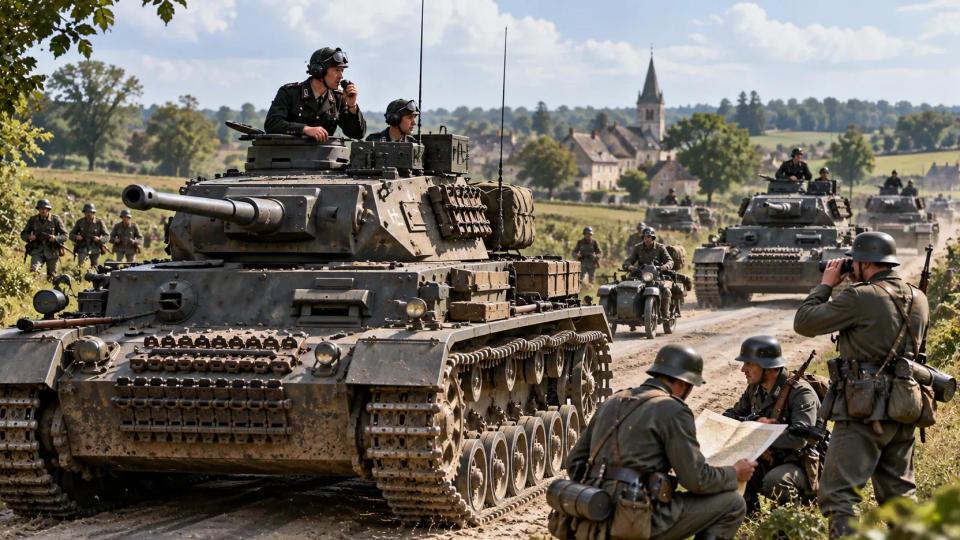
German armored formations made extensive use of radio communication. Tank commanders could receive new orders, report obstacles, and coordinate movement without waiting for messengers or stopping the advance. That mattered because armored warfare depended on tempo. A gap found by reconnaissance could be exploited before defenders reorganized. A blocked road could be bypassed. Artillery or infantry could be called forward while the tanks kept pressure on the enemy.
The tanks also traveled as part of a larger fighting system. Mechanized infantry could clear villages and woods. Engineers dealt with bridges, mines, and obstacles. Reconnaissance units searched for weak points and routes around strong defenses. Artillery suppressed positions that tanks could not safely approach, while aircraft could add reconnaissance and attack targets farther ahead.
This did not mean Germany possessed a magical doctrine called “blitzkrieg” that guaranteed victory. Historians have emphasized that the dramatic early campaigns grew from older German ideas about maneuver warfare combined with new mechanized formations and communications. The result was speed combined with shock. Defenders might face tanks in front of them while learning that another German formation had already crossed a river or reached a road junction behind them. The tank on the road could be only the leading edge of a much larger mobile operation.
The Tiger and Panther Turned Fear Into a Technical Problem
By 1942 and 1943, the character of the threat changed. German designers introduced heavier vehicles intended to fight increasingly capable Soviet and Allied armor. The Tiger I carried an 88 mm gun and heavy armor. The Panther combined sloped frontal armor with a high-velocity 75 mm gun. Both could be extremely dangerous when positioned where they could fire across open ground.
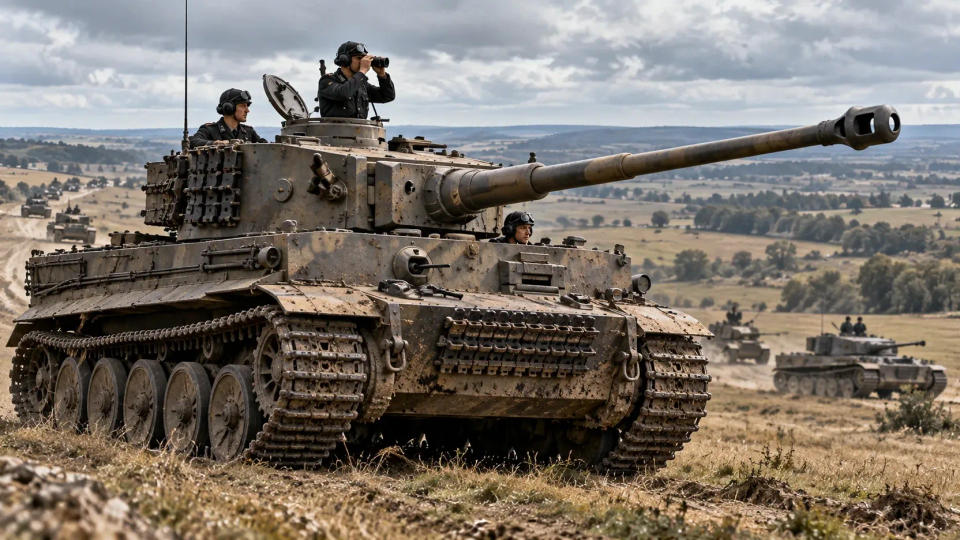
For crews in many Allied tanks, this created a disturbing tactical reality. A Tiger or Panther could sometimes engage effectively at ranges where returning fire against its strongest frontal armor was much less reliable. American wartime and postwar studies noted the strong guns, optics, and protection of these later German designs. The safer answer was often not a simple head-on duel but maneuver, artillery, heavier anti-tank weapons, or attacks against weaker side and rear armor.
Yet the frightening heavy tanks were never the whole German armored force. At the Battle of Kursk in 1943, the Tank Museum notes that Germany committed only 146 Tigers, compared with 668 Panzer IIIs and 702 Panzer IVs. The much less glamorous Panzer III and IV had formed the backbone of German armored strength for much of the war. More than 6,200 Panzer IIIs were built, compared with 1,347 Tigers.
That contrast helps explain why the Tiger became such a powerful symbol. It did not need to be common to influence behavior. If crews knew that a German heavy tank might be able to destroy them before their own gun could penetrate its frontal armor, even the possibility of an encounter demanded caution.
The Most Formidable German Tanks Paid a Price for Their Power
Heavy armor and powerful guns brought disadvantages. The Panther and Tiger were large, mechanically demanding vehicles. Their weight increased stress on engines, transmissions, final drives, tracks, and recovery equipment. Repairs could require specialized parts and skilled maintenance crews, while moving a disabled heavy tank was far more difficult than recovering a lighter vehicle.
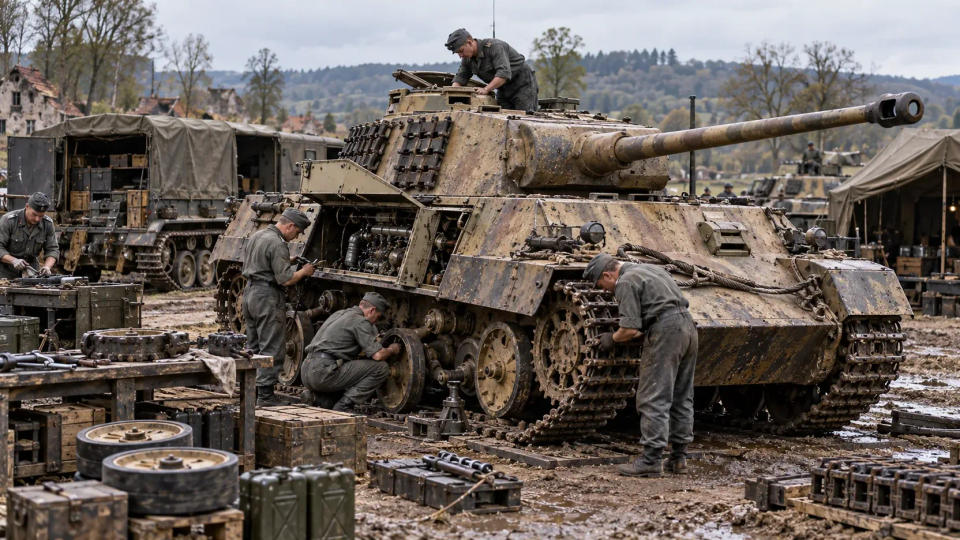
German tank maintenance became a major logistical challenge, especially during long campaigns far from factories and railheads. U.S. Army studies of German armored warfare later emphasized how the pursuit of greater firepower and protection compromised reliability and complicated production. Germany also fielded many models and variants, which made spare-parts supply harder.
The Panther's debut at Kursk showed the risk of introducing sophisticated equipment before its problems were fully solved. It eventually became a formidable fighting vehicle, but technical complexity and limited production meant that Germany could not simply replace its older tanks with Panthers and Tigers everywhere. A superb tank that was broken down, out of fuel, or waiting for a replacement component was not a battlefield advantage.
German designers therefore faced a trade-off that appears throughout armored warfare: a tank can gain protection and firepower, but extra weight and complexity must still be supported by engines, transport, maintenance, fuel, and factories. The strongest vehicle on paper was not always the most useful vehicle available to a commander.
Allied Crews Feared German Tanks, but They Learned How to Fight Them
The reputation of the Tiger in particular became larger than its numerical presence. The Tank Museum describes the morale effect as significant: Allied tank crews could fear an encounter even though Tigers were relatively uncommon. That fear was understandable. A powerful gun hidden behind thick armor could punish a careless approach quickly.
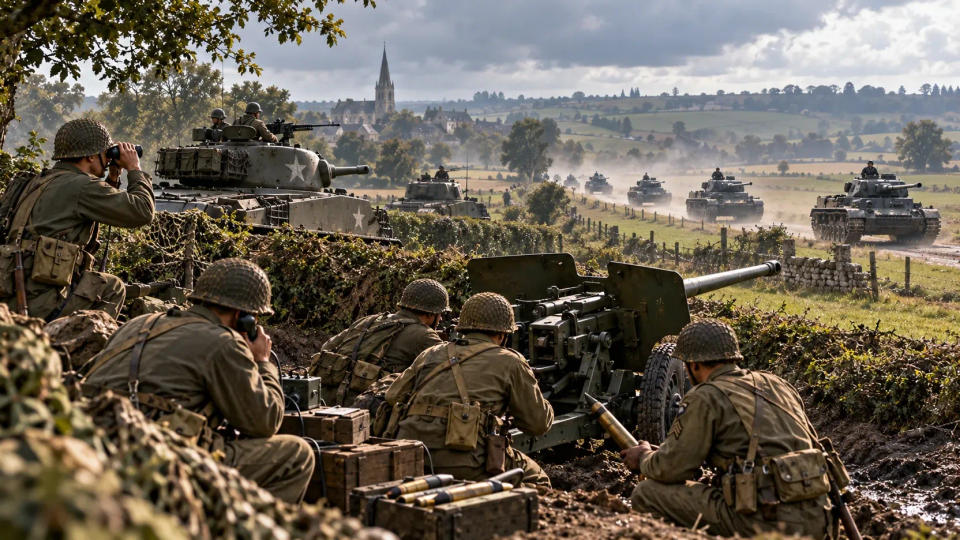
But fear did not mean helplessness. Allied armies adapted. Crews learned to avoid favorable long-range positions when possible, use smoke and terrain, seek flank shots, coordinate with artillery, and employ stronger anti-tank weapons. Infantry anti-tank weapons were most useful against vulnerable areas rather than the strongest frontal armor of the heaviest German vehicles. Tank destroyers and more powerful guns also improved the ability to engage Panthers and Tigers.
Germany's opponents also possessed an advantage that individual tank specifications could not erase: enormous industrial capacity and increasingly effective logistics. By the later war years, German armored units often faced shortages of vehicles, fuel, trained crews, and spare parts while Allied forces could bring more tanks, artillery, aircraft, and replacements into the campaign. Tactical skill could still make a German tank dangerous, but it could not overcome every operational and industrial disadvantage.
Conclusion
German tanks were feared in World War II for two connected reasons. Early in the war, the fear came mainly from how panzer formations were organized and controlled: radios, fast decision-making, concentrated armor, and combined arms turned even ordinary tanks into part of a highly mobile weapon system. Later, the Tiger and Panther added genuine advantages in firepower and protection that made frontal encounters especially intimidating.
The legend, however, can hide the limits. Tigers were scarce, Panthers could be mechanically troublesome, and even the strongest German tank could be defeated by the right weapon, terrain, tactics, or simply by being outnumbered and out-supplied. Their reputation was rooted in real battlefield strengths, but it was amplified by the shock those strengths created.
Sources & Further Reading
- The Tank Museum — Panzer III and the Tiger
- The Tank Museum — German Tanks at Kursk
- The Tank Museum — Panther
- The Tank Museum — The Enduring Appeal of Tiger 131
- U.S. Army Center of Military History — Mobility, Shock, and Firepower
- U.S. Army Center of Military History — German Tank Maintenance in World War II