Viking Age Scandinavians built their lives around farms, while some traveled abroad to trade, raid, or settle.
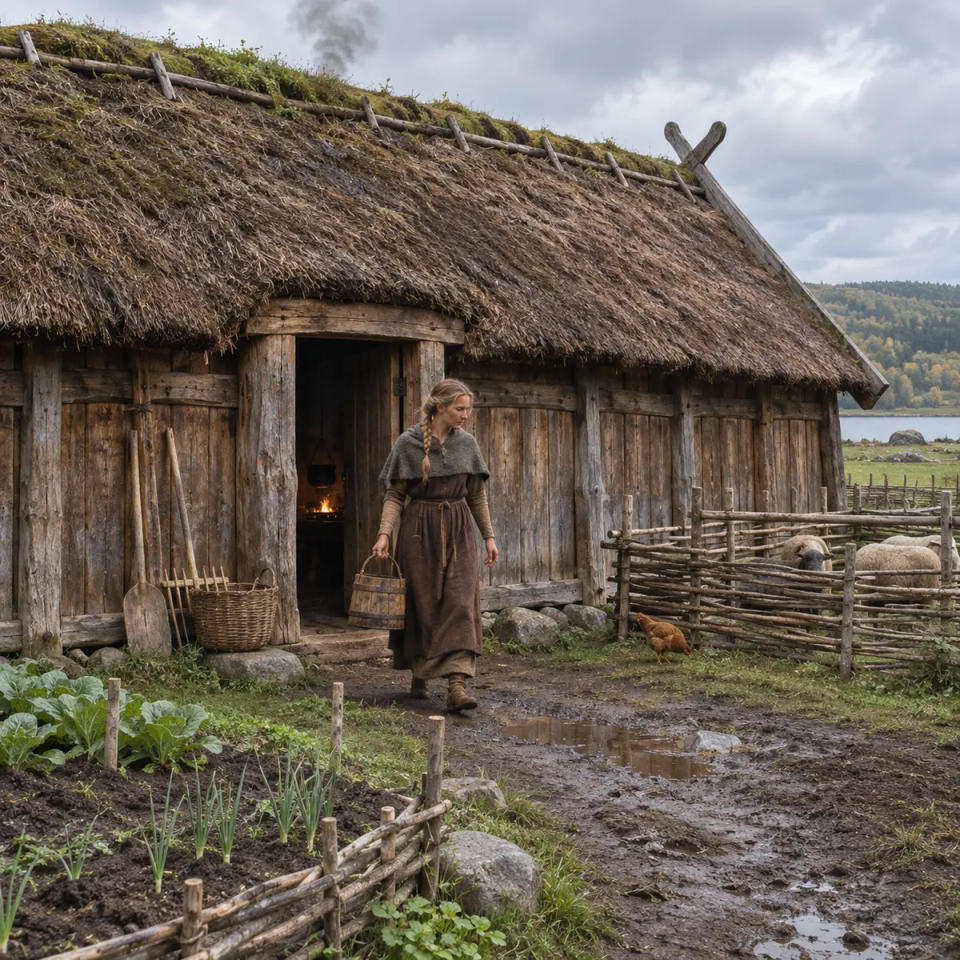
The Vikings came from Scandinavia, including areas that are now Denmark, Norway, and Sweden. They lived in a world of farms, local communities, and shifting political alliances. Some traveled to trade, raid, or settle abroad. Many spent their working lives much closer to home, growing crops, tending animals, or making the things their households needed. The same period produced both the seafarers remembered overseas and the people who kept agricultural communities running.
The word itself can be misleading. The Swedish History Museum notes that a few runestones use a form of the word Viking to refer to an activity, such as going on an expedition. Today we often use it broadly for people and culture associated with the Viking Age. That broader use can be convenient, as long as we remember that people then had many local identities and that a voyage was only one part of their world.
Where Did the Vikings Come From?
Scandinavia gives us a geographical starting point. A modern map helps locate that homeland, but its national borders came later. In eastern Scandinavia, for example, the Swedish History Museum describes agricultural districts made up of villages, farms, fields, and pastures. Aristocratic families could command considerable resources, and some leaders briefly extended their power across larger areas. Those territories could shift as political fortunes changed.
A person's sense of belonging also depended on the situation. At home, family or village ties might matter most. Away from home, a traveler might identify with a larger district. Archaeologists find regional differences in burial customs, another reminder that people living within what we now call Scandinavia did things in different ways. The familiar label is useful for discussing a period, but it groups together communities whose customs and loyalties could differ.
The period also has flexible boundaries. The Swedish History Museum's Viking World exhibition uses roughly AD 750 to 1100. These dates describe a span of historical and archaeological change. They give us a way to discuss developments that took place over generations, including changes in political power, trade connections, and where people settled.
What Was Daily Life Like on a Viking Age Farm?
The farm was a center of work and family life. Its fields and the land farther from the house supplied much of what a household needed. Work therefore extended well beyond the dwelling. The people who lived there had to coordinate their labor, and their ties to neighbors and the wider community mattered. A farm can be understood as a group of people working across a landscape, with the house as one part of it.
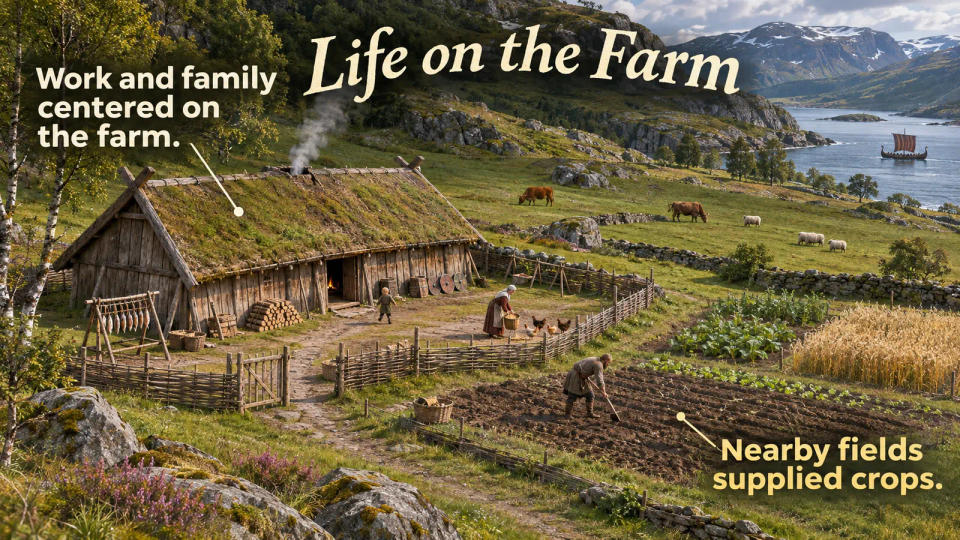
The landscape in the illustration is a reconstruction. Its house, nearby cultivated ground, and more distant terrain help show the range of spaces people could use. The layout is illustrative. Farms varied with local conditions and resources, and the work required by a household would change across the year. Starting with one farm makes the scale of ordinary life easier to imagine without assigning the same routine to everyone in Scandinavia.
Even the idea of a household can hide differences in power. The Swedish History Museum describes powerful families occupying substantial estates. A small farming household and a wealthy estate might both depend on land, yet their ability to mobilize labor and influence their neighbors would differ. Archaeological finds from wealthy settings can show what was possible at the top of society. They need to be read alongside evidence for the everyday work of people with fewer resources.
How Did Household Work Connect to a Wider World?
Making yarn offers a close look at a task that can disappear in a story about ships and rulers. The Museum of the Viking Age in Norway describes how a drop spindle hangs from the fibers. The spinner sets the shaft turning, and its rotation twists the fibers into a strand. Once enough yarn has formed, the spinner winds it onto the shaft and continues. The process turns loose material into something that can be used in textile work.
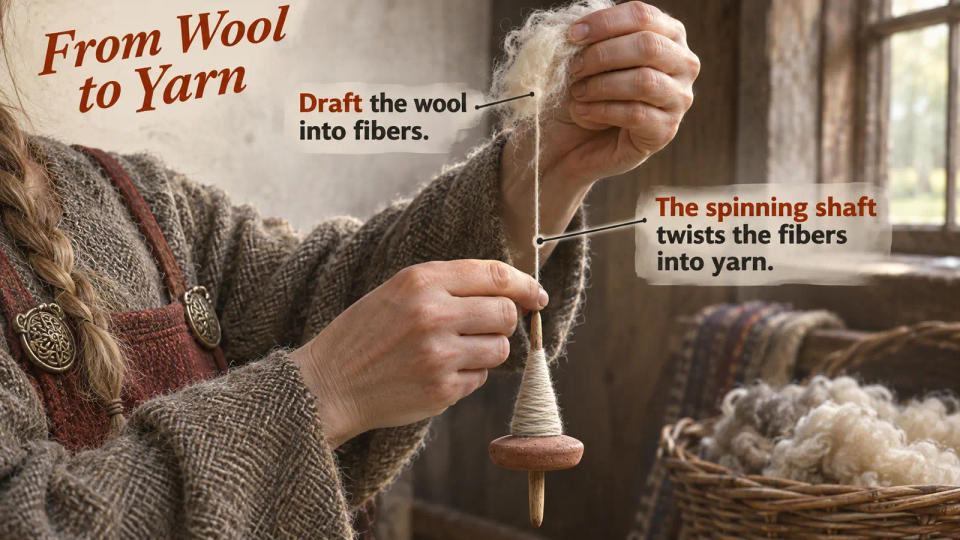
A spindle was among the objects placed with the two women buried in the Oseberg ship in Norway. Its presence in that burial is evidence that textile equipment could be included in an exceptionally elaborate burial setting. The find alone cannot tell us which person used the spindle, how often they used it, or whether either woman personally made the textiles found there. A museum demonstration explains the tool's operation, while the burial tells us where one example was found.
Travel connected Scandinavian communities to places well beyond their farms. Trading and raiding expeditions could take people abroad, and some travelers stayed and built lives elsewhere. The Swedish History Museum points to Normandy as one example of identities changing across generations after Norse settlement. Movement also brought people from other places into Scandinavia. Around the Baltic, contact and migration created communities where practices and objects from different backgrounds came together. These connections help explain why a single label covers such varied lives.
Conclusion
Viking Age people came from varied Scandinavian communities whose everyday lives often revolved around farming and household work. Expeditions connected some of them to distant shores, where trade, violence, and settlement could reshape entire communities. Farm work followed the demands of seasons, while textile work could turn locally available material into a usable household resource. Farms and simple tools such as spindles reveal the labor that sustained life between voyages and the households that rarely took part in them.
Sources & Further Reading
- Swedish History Museum — Who were the Vikings?
- Museum of the Viking Age — Society and Daily Life
- Museum of the Viking Age — This Is How You Use a Drop Spindle