The Cold War grew from a wartime alliance into a rivalry over elections, economic recovery, and control of postwar Europe.
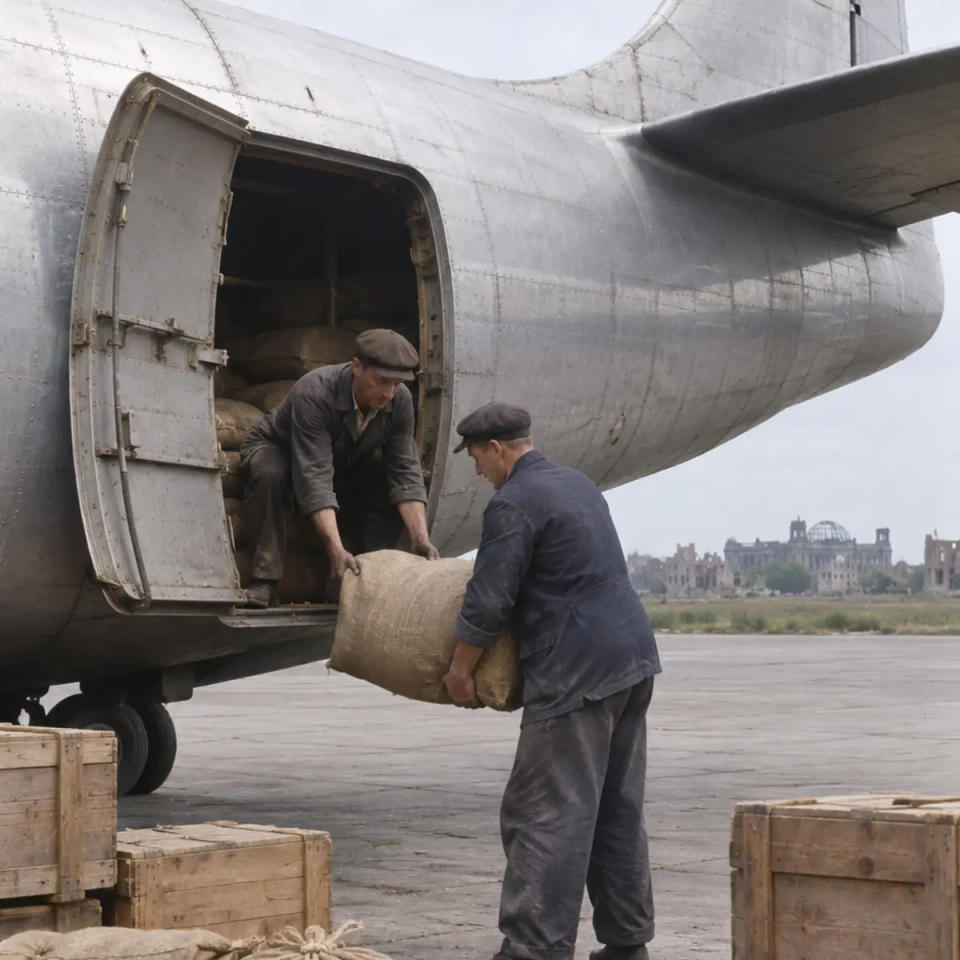
The Cold War was a decades-long rivalry between the United States and the Soviet Union. It grew out of the aftermath of World War II, when the two countries disagreed over who would shape Europe's recovery and how the continent would be governed. Their wartime alliance had helped defeat Nazi Germany. Once that common enemy was gone, cooperation depended on agreements about the future that the allies interpreted very differently.
The word cold describes the relationship between the two superpowers, which avoided a full-scale war directly against each other. The competition still involved military threats, political pressure, and fighting elsewhere. Its beginnings are easiest to see in a series of decisions made between 1945 and 1949. A pledge about elections, an aid program, and a crisis over access to Berlin show how the relationship changed in practice.
Why Did the Wartime Alliance Break Down?
In February 1945, while the fighting in Europe was still underway, Franklin Roosevelt, Winston Churchill, and Joseph Stalin met at Yalta. Their Declaration of Liberated Europe called for cooperation on recovery and for representative governments formed through elections. The text records a commitment that all three leaders accepted. It leaves open the practical question of what each power would do when it disagreed with its allies about conditions on the ground.
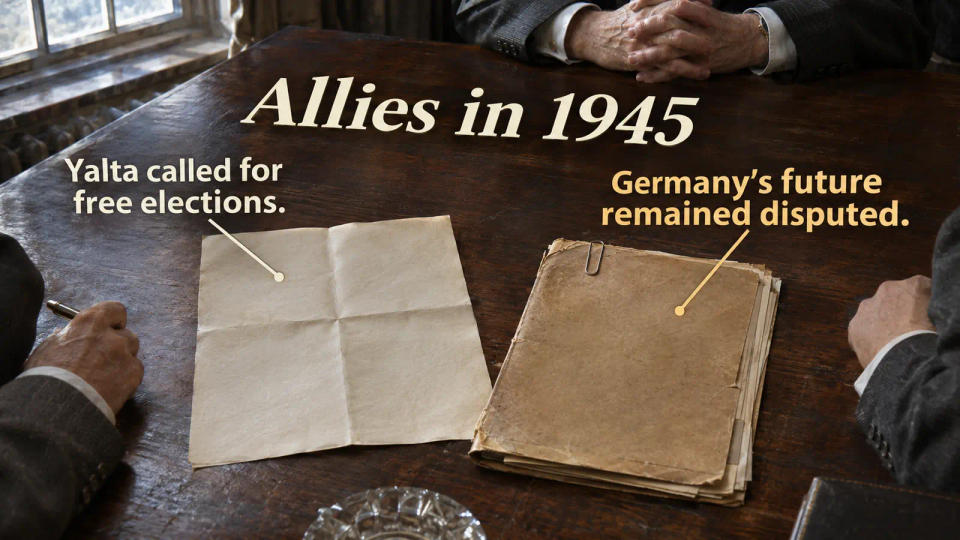
Poland illustrates the stakes. The Yalta agreement called for reorganizing its provisional government on a broader basis and holding elections. For Moscow, political developments in neighboring states affected the security of a country that had just suffered a devastating German invasion. For Washington, Soviet pressure on the political choices of those states called into question the promise of representative government. Eastern Europeans themselves had political aims that could differ sharply from those of the great powers. The presence of Soviet forces gave Moscow leverage over the outcome.
Germany raised a related problem. The allies could agree on administering separate occupation zones while they disagreed over the country's long-term political and economic future. A recovering Germany could help rebuild Europe, but it could also revive fears of German power. Decisions about trade between zones, industrial recovery, and political authority therefore mattered well beyond Germany itself. The division of the occupation gave each power a way to pursue its priorities even when joint decisions proved elusive.
How Did American Aid Become Part of the Rivalry?
In March 1947, President Harry Truman asked Congress to help Greece and Turkey. Britain had announced that it could no longer sustain its assistance to Greece, where the government was fighting a civil war. Truman presented American support as a response to pressure on governments and communities abroad. The policy became known as the Truman Doctrine and helped establish a wider American role in resisting what Washington saw as communist expansion.
The Greek case also shows the gap between American perceptions and Soviet actions. U.S. officials worried that a communist victory in Greece would increase Soviet influence. The State Department's historical account points out that Stalin himself withheld support from the Greek communist fighters. The doctrine reflected how the Truman administration understood the risks, even where local conflicts did not follow a simple pattern of instructions from Moscow.
A second initiative addressed economic recovery. In June 1947, Secretary of State George Marshall proposed a broad European recovery effort. The program that followed helped participating countries obtain resources for rebuilding and linked their recovery more closely to the United States. For American officials, economic distress could create opportunities for communist parties. From Moscow, a program that increased American economic influence in Europe and encouraged recovery in western Germany raised its own concerns. Soviet participation did not materialize, and the program operated in Western Europe. Decisions about economic reconstruction helped divide the continent into increasingly separate spheres.
Why Did Berlin Become a Test of the Cold War?
Berlin lay within the Soviet occupation zone of Germany, while the city itself was divided into sectors administered by the victorious powers. The Western powers therefore held parts of a city surrounded by territory under Soviet control. In 1948, the Western powers moved toward closer coordination of their occupation zones and introduced a new currency. Soviet authorities cut major surface links to West Berlin. Civilians depended on those links for necessities such as food and coal.
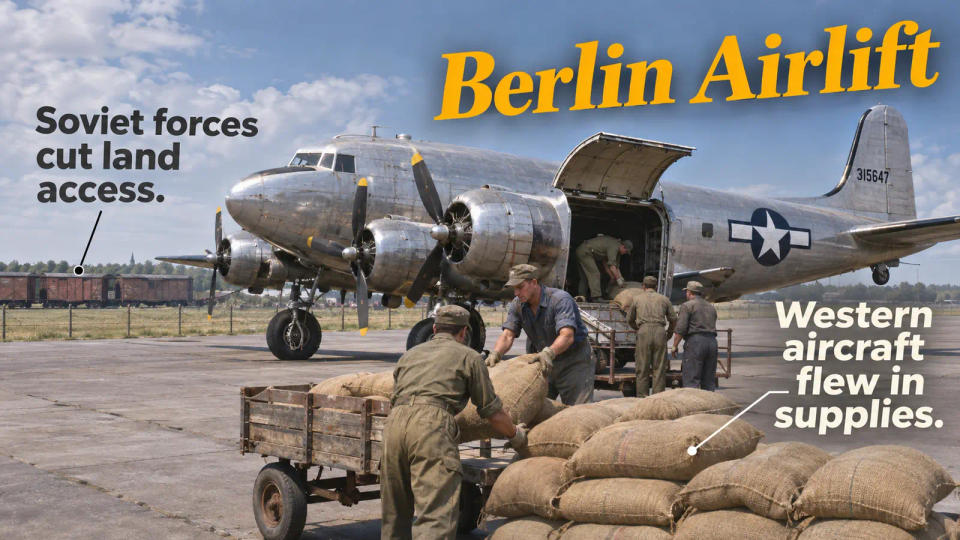
The United States and Britain organized an airlift. Aircraft carried essential supplies into the western sectors while the surface blockade remained in place. This was a way to sustain the city and preserve the Western position while avoiding an armed attempt to force open road or rail access. The Soviet Union lifted the blockade in May 1949. The airlift illustrates how infrastructure and logistics could become instruments of competition, with residents bearing the immediate costs of decisions made by occupation authorities.
That episode also shows why the Cold War cannot be reduced to a single speech or conference. By the time the blockade ended, leaders on both sides had already made choices about alliances, economic recovery, and military presence in response to what they believed the other side was doing. The pattern continued long after the first Berlin crisis. The rivalry shaped international politics for decades and ended as the Soviet Union dissolved in 1991.
Conclusion
The wartime allies became rivals as their plans for the peace collided. Moscow sought influence over neighboring states and feared a revival of hostile power near its borders. Washington backed economic recovery and pushed back against what it saw as Soviet expansion. The crises over elections, aid, and access to Berlin made these competing goals concrete. Their consequences reached far beyond the leaders who made the decisions, especially for people living in the countries and cities where those policies met.
Sources & Further Reading
- Yale Avalon Project — Yalta (Crimea) Conference
- Office of the Historian — The Truman Doctrine, 1947
- Office of the Historian — Marshall Plan, 1948
- Office of the Historian — The Berlin Airlift, 1948–1949
- Office of the Historian — The Collapse of the Soviet Union