The Silk Road was not one road: it was a network where goods, people, ideas, and beliefs connected civilizations.

Imagine a bolt of silk made in China eventually reaching a buyer many regions away. That journey did not necessarily require one determined merchant to cross Asia from end to end. A series of traders, markets, desert oases, roads and ports could move it onward, with new people joining the exchange at every stage.
That is the essential meaning of the Silk Road—more accurately, the Silk Roads. These shifting networks linked parts of East Asia, Central Asia, South Asia, West Asia and the Mediterranean world across many centuries. They carried valuable commodities, but their greater historical significance lies in the connections they created between communities that might otherwise rarely meet. As UNESCO explains, the networks included routes by both land and sea.
How Did Goods Travel Across the Silk Roads?
Trade paths existed long before anyone called them the Silk Road. Exchange increased substantially between China and lands farther west from around the second century BCE, during the Han period. The official Zhang Qian's missions were diplomatic rather than commercial journeys, but the knowledge and contacts associated with them helped expand connections toward Central Asia. It would be misleading to describe him as the inventor of a single highway.
The geography was difficult and varied. Merchants encountered dry basins, mountains, steppe and fertile river valleys. They followed routes that could change with political control, water supplies, demand and the security of particular crossings. UNESCO's Chang'an–Tianshan Corridor preserves evidence of one major section, including trading settlements, passes, posthouses and places of worship. It is a corridor within the larger system, not a map of every historical route.
For much overland trade, pack animals such as camels and horses carried merchandise between settlements. Caravans moved in stages, stopping where people could obtain food, water, shelter and information. In a market town, a trader might sell cargo to another merchant, buy different goods, or join a new group traveling in another direction. Most merchants did not need to complete the entire distance between China and the Mediterranean.
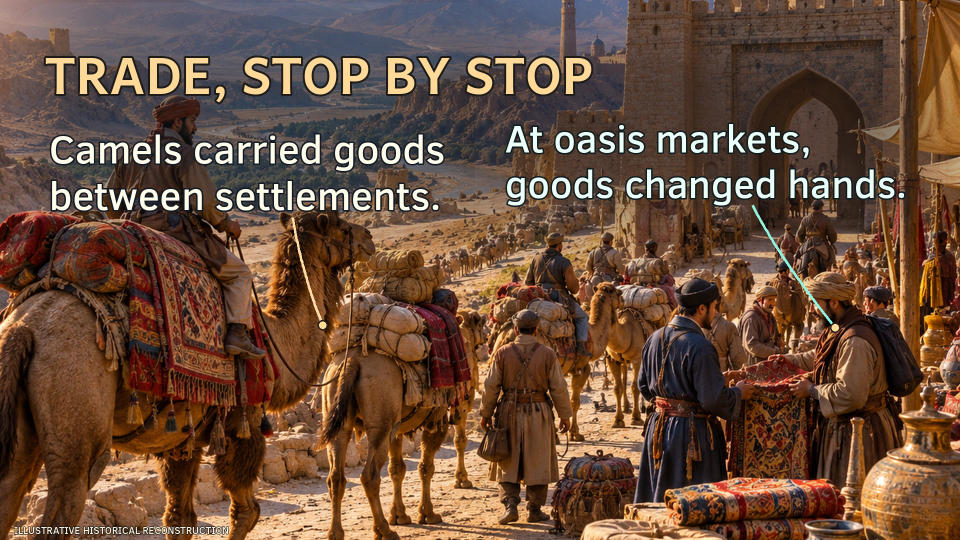
Oases were therefore more than convenient places to rest. They connected distant landscapes to local economies, and their inhabitants could earn a living from transport, storage, crafts and hospitality. The surviving Zarafshan–Karakum Corridor demonstrates how routes interacted with towns, forts, water resources and fertile valleys. This was not a smooth or uniform transport system; its success depended on many local communities.
Who Traded, and What Passed From Hand to Hand?
Silk became a famous symbol because it was light, valuable and associated with Chinese production. Han-era Chinese silk circulated far beyond its place of manufacture, often passing through intermediaries. Yet merchants also handled fine textiles, spices, precious stones, glassware, metal objects, horses, furs and many everyday supplies. The balance changed according to time and region, so no single cargo list describes every Silk Roads marketplace.
Among the best-documented intermediaries were the Sogdians, a people associated with the oasis regions of present-day Uzbekistan and Tajikistan. Between roughly the fourth and eighth centuries CE, Sogdian trading communities developed far-reaching commercial and cultural connections. Their merchants worked with silk, horses, gemstones, furs, metalwork and fabrics. They could also act as translators and diplomats, bringing knowledge of different places into negotiations.
The Smithsonian National Museum of Asian Art describes Sogdian traders as important carriers of artistic styles, music and religious traditions. Their example shows why the Silk Roads should not be imagined simply as Chinese merchants selling to Roman customers. Traders from numerous regions shaped the network, while local buyers, craftspeople and guides made individual exchanges possible.
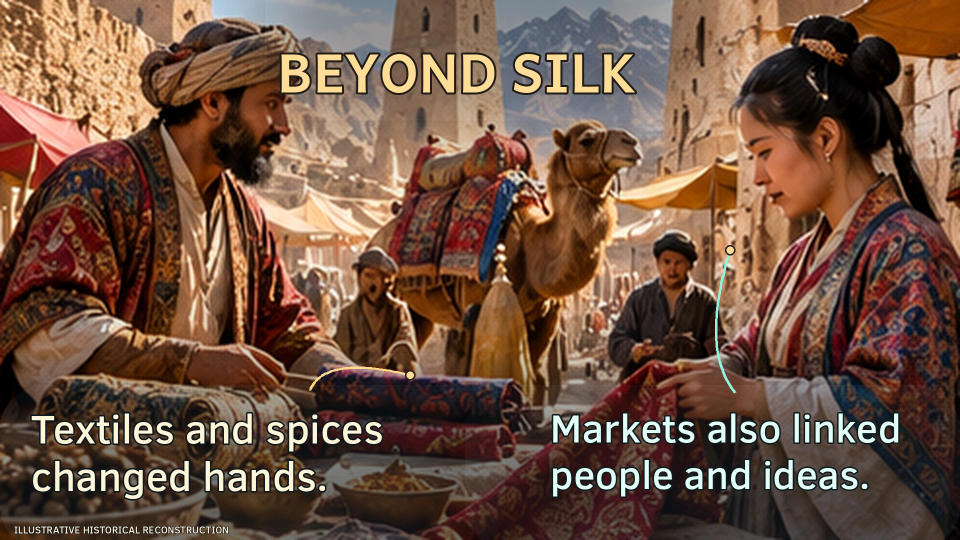
The image is a reconstruction of a possible market encounter, not a record of identifiable historical individuals or a specific transaction. Its point is the economic relationship: goods could change hands, and travelers also met people with different languages, skills and beliefs. The connections were uneven, sometimes competitive, and affected by political tensions. They were not an uninterrupted story of peaceful globalization.
What Evidence Shows That Ideas Traveled Too?
Objects and sites provide particularly strong clues. Along the Chang'an–Tianshan Corridor, archaeologists and heritage specialists have identified Buddhist cave temples, religious buildings, settlements and transport infrastructure. Such places reveal communities who moved, worshipped and built institutions within a wider landscape of exchange. Buddhist monks traveling between India and China also helped transmit texts and teachings, although religious movement had many causes beyond commerce.
Art adds a different kind of evidence. The Smithsonian describes Tang-dynasty ceramic sculpture depicting a camel with musicians, as well as Sogdian-related wall paintings, textiles and metalwork. These artifacts illuminate the movement and representation of people, performances and tastes across regions. A figurine does not document a precise journey or prove that every merchant carried musical instruments. It does show how connected cultures could appear in material culture.
Knowledge, techniques and religions traveled by different paths and at different speeds. UNESCO notes that paper-making knowledge and various artistic and intellectual traditions spread through these long-distance contacts. Maritime links were important as well: ships operating through the Indian Ocean helped connect Asian ports and, increasingly, other trading centers. The network's extent and activity changed across the centuries rather than ending on a single dramatic date.
There are important limits to what historians can reconstruct. A modern map usually combines evidence from different centuries, whereas actual travelers chose among routes available to them at a particular moment. Likewise, a modern scene depicting a merchant, camel or market is an interpretation informed by historical evidence, not a photograph of an event. Distinguishing surviving evidence from reconstruction helps make the story more accurate.
Conclusion
The Silk Road was never one road or one continuous caravan crossing the entire continent. It was a changing set of connected routes supported by merchants, settlements, carriers, ports and political powers. Silk gave the network its modern name, but textiles, foods, animals, technologies, artistic traditions and religious ideas all helped shape its history. Understanding the Silk Roads means looking not only at distant destinations but also at the people and places that connected them.
Sources & Further Reading
- UNESCO — About the Silk Roads
- UNESCO World Heritage Centre — Chang'an–Tianshan Corridor
- UNESCO World Heritage Centre — Zarafshan–Karakum Corridor
- Smithsonian National Museum of Asian Art — The Sogdians: Influencers on the Silk Roads