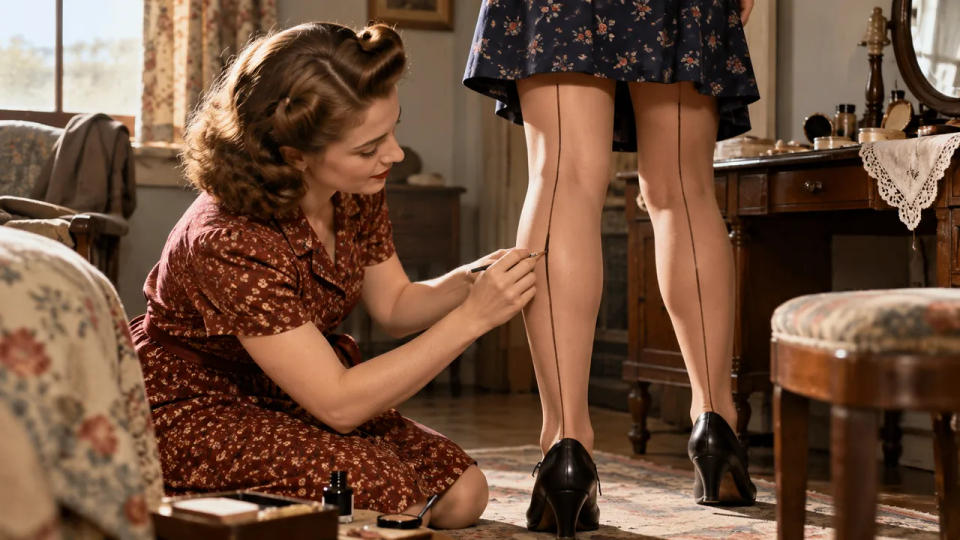
Why would a woman carefully draw a dark line down the back of her bare leg before going out? During World War II, that line could create the illusion of something suddenly difficult to buy: a pair of stockings.
Silk and nylon were redirected toward military needs, while civilian clothing was restricted by wartime shortages and production controls. Many women responded with “liquid stockings” or leg makeup, then added a straight line up the calf to imitate the seam found on real hosiery. It was a small beauty trick, but it says a great deal about wartime fashion, scarcity, and the pressure to remain conventionally well dressed even during a global conflict.
Stockings Became Scarce When Nylon Went to War
Before the war, stockings were not an occasional accessory for many women. They were a normal part of a respectable public outfit. In the 1930s, silk and rayon hosiery were common, and the arrival of nylon made stockings even more desirable.
DuPont introduced nylon stockings to the American public at the 1939 New York World’s Fair. When they reached stores nationally in May 1940, demand was enormous. Nylon was strong, smooth, and easier to care for than delicate silk, so it quickly became closely associated with modern women’s hosiery.
Then the war changed the material’s purpose. After the United States entered World War II, nylon was diverted from civilian products to military uses, including parachutes, ropes, tire cords, mosquito netting, and other equipment. The Smithsonian’s National Museum of American History notes that manufacturers stopped making nylon stockings as war production consumed materials needed for civilian clothing.
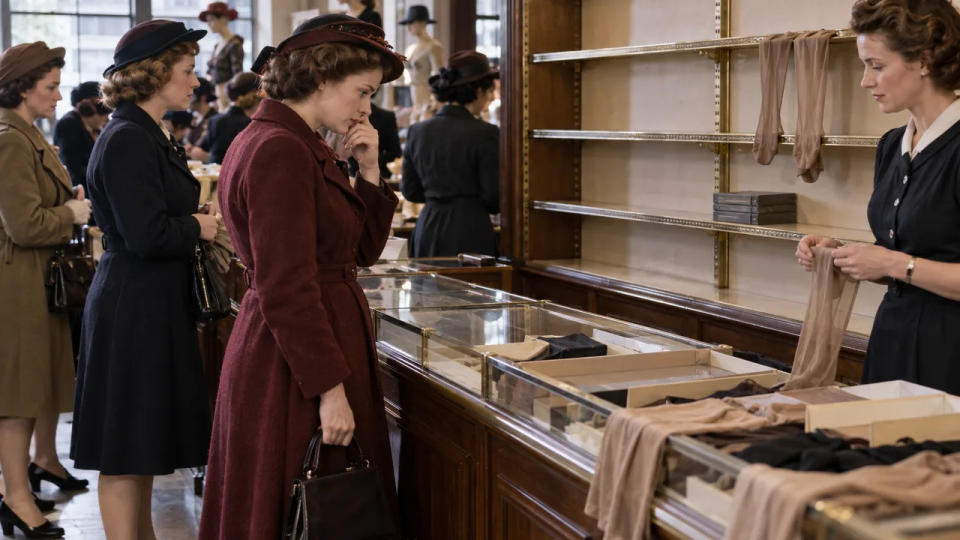
Silk was also strategically important and increasingly unavailable for ordinary stockings. The result was simple: women who had recently been encouraged to buy modern, sheer hosiery suddenly found that the familiar product was scarce, expensive, or unavailable.
How Painted Stockings and Fake Seams Worked
The solution was not always to go completely bare-legged. Cosmetic companies sold leg makeup designed to tint the skin so that bare legs looked more like they were covered by sheer stockings. The Smithsonian preserves a bottle of Leg Silque Liquid Stockings, made around 1943, and describes such products as increasingly important when women could not obtain silk or nylon hose.
Women applied the liquid color over the legs to create an even, slightly tinted appearance. But there was one obvious detail missing: the seam.
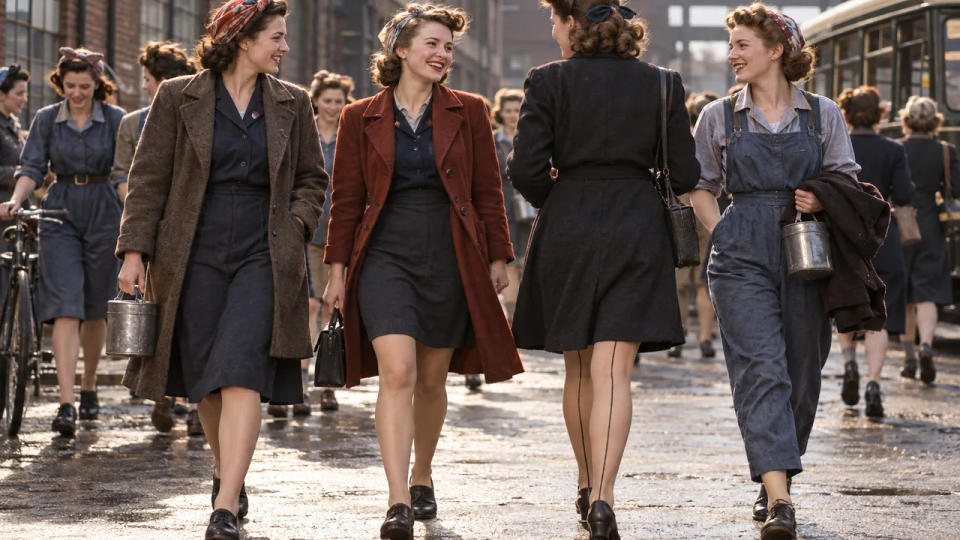
Stockings of the period were commonly made with a visible seam running vertically up the back of the leg. A smooth line therefore helped complete the illusion. Some women drew that line themselves; others could have it applied more carefully at beauty counters or “leg makeup” services. Hagley Museum and Library records that wartime demand even encouraged department-store leg makeup bars.
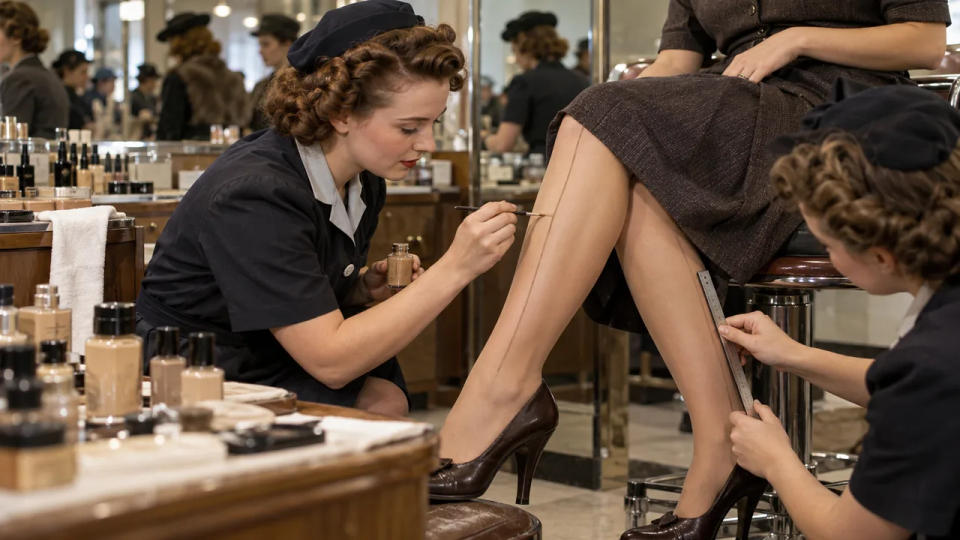
The effect did not create actual hosiery, of course. It reproduced the visual cues people expected to see: a more even skin tone and the narrow vertical seam associated with stockings. From a short distance, especially as part of a carefully dressed outfit, the trick could be convincing enough.
Why the Seam Mattered So Much
To modern eyes, the line itself can look strange because most contemporary hosiery is seamless. In the early 1940s, however, the back seam was an ordinary feature of many stockings. It came from the way hosiery was manufactured and sewn, so people recognized it immediately.
That made the seam a useful visual shortcut. Bare skin might reveal that stockings were absent, while tinted legs with a straight dark line suggested that a woman was wearing the real thing. The line did not need to reproduce every detail of a stocking; it only needed to reinforce an appearance that was already familiar.
Getting the line straight mattered. A crooked seam on real stockings was considered untidy, so a painted seam that wandered sideways could spoil the effect. This helps explain why photographs and wartime accounts often focus on the careful act of drawing the line itself. The labor involved was part cosmetics, part imitation, and part everyday problem-solving.
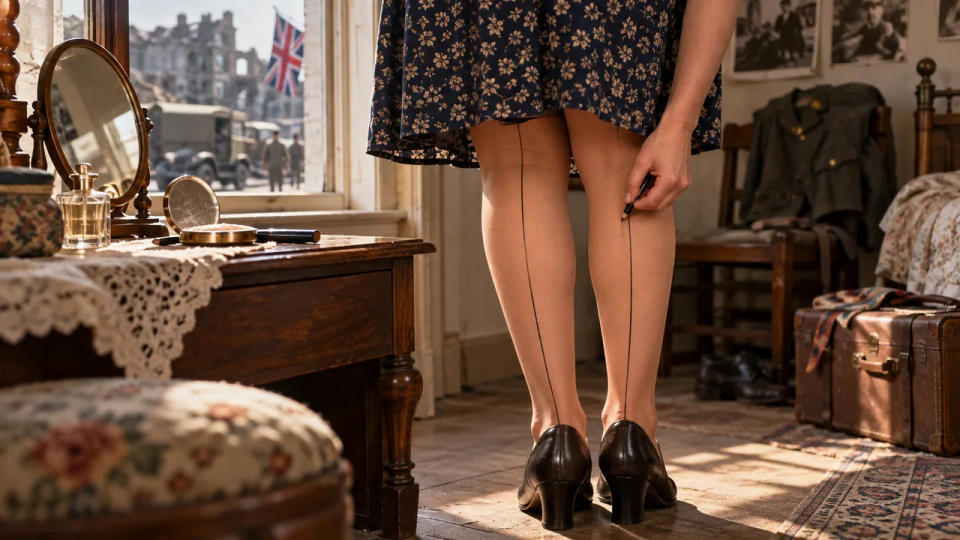
It is important not to turn this into a story in which every woman did the same thing. Wartime experiences varied by country, class, occupation, income, access to goods, and personal taste. Some women wore older stockings, repaired damaged pairs, used rayon when available, bought substitutes, went bare-legged, or simply ignored the convention. Painted seams were one documented response to shortage, not a universal wartime ritual.
More Than Fashion: Respectability, Work, and Wartime Expectations
The painted seam also reflects a contradiction in wartime life. Women entered factories, offices, government agencies, farms, transport services, and military auxiliary organizations in huge numbers. Their work could be physically demanding and very different from prewar expectations. Yet they were still often encouraged to look conventionally feminine.
The Smithsonian’s exhibition on wartime women notes that female government workers could face expectations about skirts, curled hair, and lipstick even while rationing forced them to improvise. Leg makeup fit neatly into that tension. A woman could conserve scarce material—or simply cope with its disappearance—while still presenting the polished appearance expected in many workplaces and social settings.
There was also a patriotic dimension to civilian consumption. Materials such as nylon were more valuable to the military than to fashion, so doing without stockings could be framed as part of the home-front contribution. Cosmetics offered a way to adapt without abandoning established standards of dress.
That does not mean the practice was purely patriotic. Fashion, social pressure, personal preference, workplace rules, advertising, and scarcity all overlapped. The painted seam survived in popular memory because it compressed those forces into one unforgettable image: a woman using a pencil or cosmetic applicator to recreate, directly on her skin, an item that war had removed from the shops.
Conclusion
Women drew lines on their legs during World War II mainly to imitate the back seams of stockings that had become difficult to obtain. With nylon and silk redirected toward wartime production, leg makeup and painted seams offered a practical visual substitute. The habit was small, but it reveals how deeply war reached into ordinary routines—even something as simple as getting dressed.
Sources & Further Reading
- National Museum of American History — Leg Silque Liquid Stockings, Shade P244 Suntan
- National Museum of American History — Dressing for War
- National Museum of American History — Rosie, Wendy, and Government Girls
- Hagley Museum and Library — The Nylon Craze: A Style Trend of the 1940s
- Smithsonian Magazine — How Nylon Stockings Changed the World