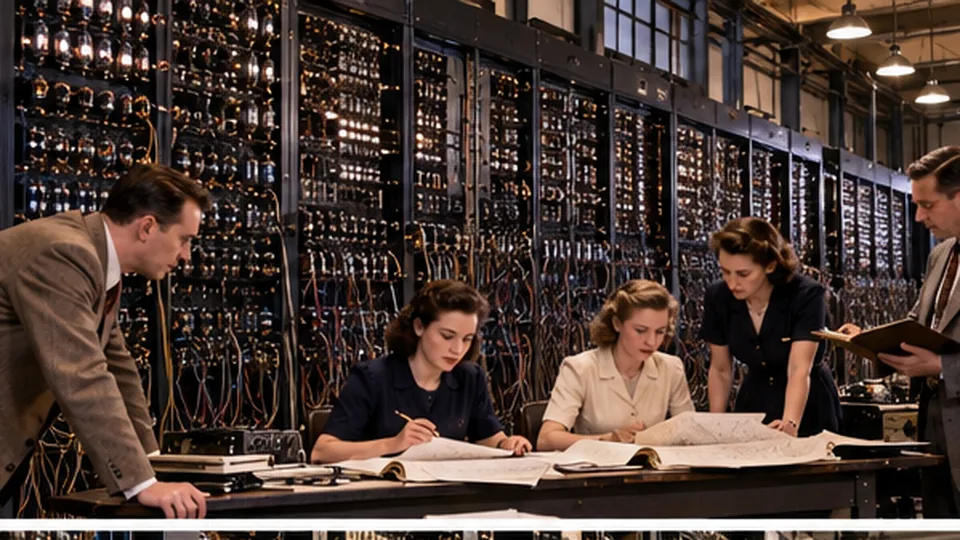
What does a battlefield artillery table have to do with the computer on your desk or in your pocket? During World War II, the U.S. Army needed faster ways to calculate how shells would travel under different conditions, and that pressure helped fund ENIAC, one of the landmark machines of early electronic computing.
ENIAC did not single-handedly invent the digital age, and it was not the only wartime computer. Britain’s Colossus, for example, was already performing electronic digital codebreaking work. But the American push to automate artillery calculations brought together electronic engineering, mathematical methods, and a new kind of programming in a way that strongly influenced postwar computing.
Why Artillery Needed So Much Mathematics
Firing an artillery shell was not simply a matter of pointing a gun at a target. Gunners needed tables that related range and elevation to a shell’s expected path. Those calculations could also depend on variables such as air density, temperature, wind, and the characteristics of a particular weapon and projectile.
Before electronic machines took over, much of this work was done by people. At the University of Pennsylvania’s Moore School of Electrical Engineering, teams of “computers” performed numerical calculations for the U.S. Army. Many were women recruited for wartime mathematical work. They used desk calculators, printed tables, and other tools to work through the differential equations behind ballistic trajectories.
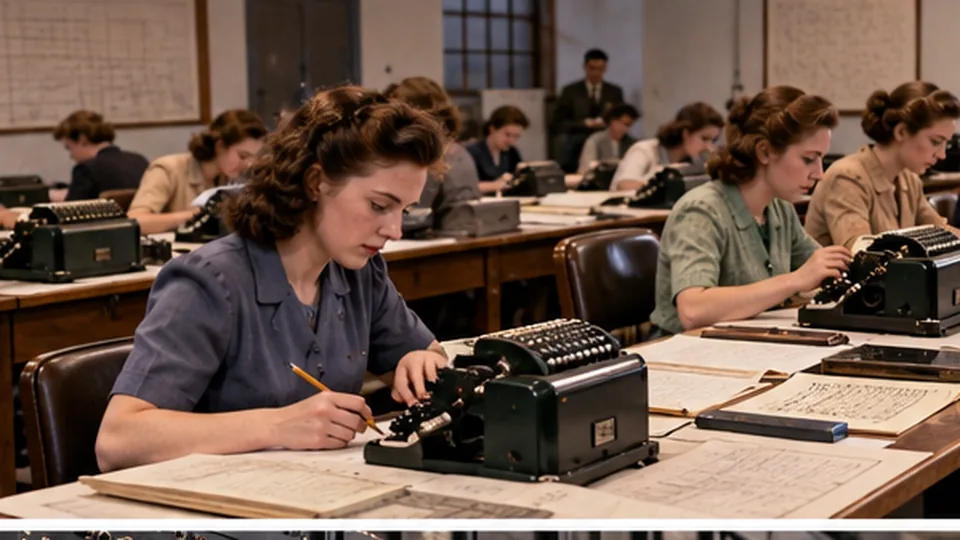
Mechanical and electromechanical equipment could help. Differential analyzers, for example, were built to solve certain kinds of differential equations. Yet these machines were cumbersome to set up and difficult to reconfigure. Wartime demand kept growing, while new weapons and new conditions meant more tables had to be prepared.
The Army therefore had a practical reason to support something radically faster: a calculating machine that relied on electronics rather than moving gears and relays for its main arithmetic work.
From Human Computers to ENIAC
In 1943, the U.S. Army backed work at the Moore School on the Electronic Numerical Integrator and Computer, better known as ENIAC. John W. Mauchly and J. Presper Eckert led its design. The project remained secret during the war because its intended role was military calculation.
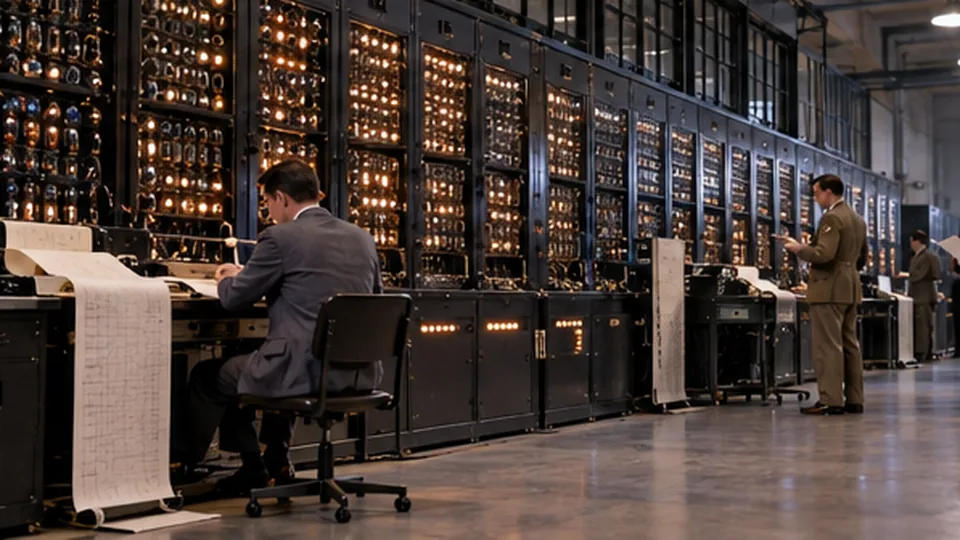
ENIAC used thousands of vacuum tubes and filled a large room. According to the University of Pennsylvania, it could perform about 5,000 additions per second, an astonishing rate for the period. That speed came from using electronic circuits instead of depending mainly on slower mechanical motion.
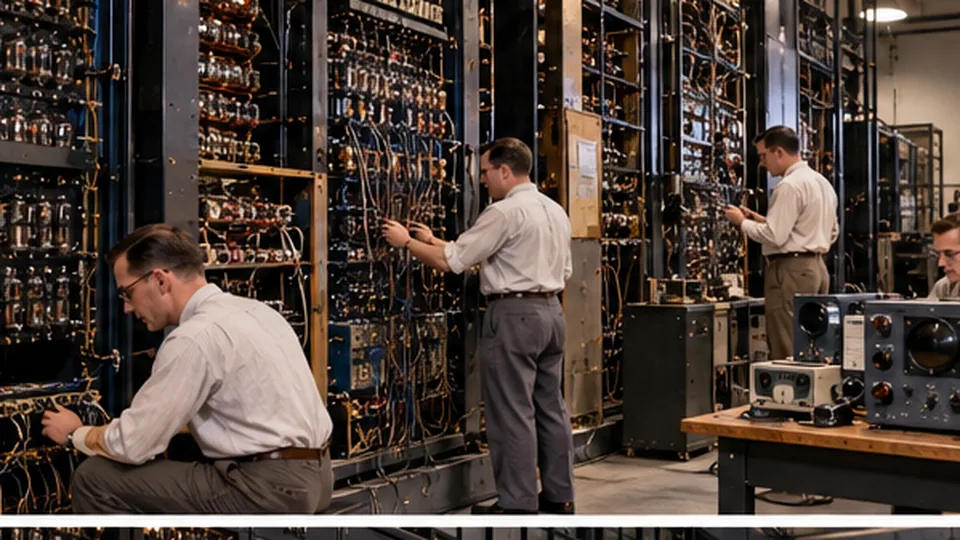
There was one important twist in the story. ENIAC was created because of an urgent wartime need, but it was not publicly unveiled until February 1946, after World War II had ended. So it did not transform battlefield artillery fire during the war in the way its sponsors originally hoped.
Its significance instead became broader. The project demonstrated that a large electronic machine could carry out complex numerical work at a speed far beyond previous general-purpose calculating equipment. It also gave engineers and mathematicians practical experience with the problems of building, operating, and reconfiguring an electronic computer.
Programming Before Programming Was a Profession
ENIAC’s hardware was only part of the breakthrough. The machine had no modern stored program in its original form. To prepare it for a new problem, operators had to configure switches and connect cables across plugboards. A new calculation could require careful planning before the machine ever started running.
Six women who had already worked as human computers became ENIAC’s original programming team: Kathleen Antonelli, Jean Bartik, Frances “Betty” Holberton, Marlyn Meltzer, Frances Spence, and Ruth Teitelbaum. They had to translate mathematical procedures into sequences the machine could execute.
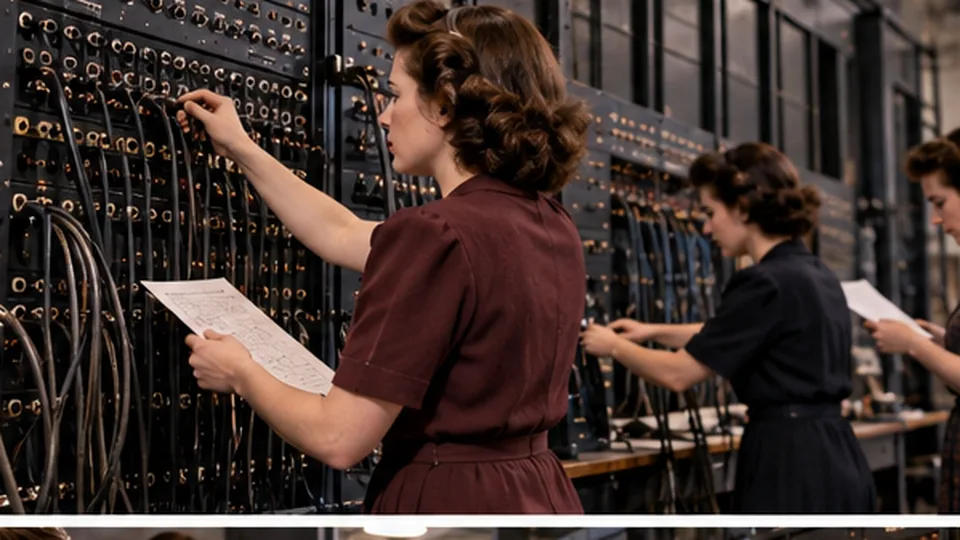
This work involved far more than plugging in cables. The programmers studied diagrams, broke problems into steps, planned how data would move through the machine, and debugged errors. Much of what we now recognize as programming practice was still being worked out while they were doing the job.
Their role was underappreciated for decades. Later historical research brought much greater attention to their contribution, showing that the story of early computing was not only about inventing hardware. It was also about learning how to make a programmable machine solve real problems.
How Wartime Calculation Helped Shape the Digital Age
ENIAC was part of a wider wartime transformation in computing. In Britain, Colossus used electronic digital techniques for codebreaking. Other machines, including electromechanical systems such as the Harvard Mark I, also showed how governments and research institutions were investing heavily in automatic calculation.
What made ENIAC especially influential was the way it connected high-speed electronics with broad numerical problem-solving. Although it had been designed around artillery work, it was capable of tackling other scientific and military calculations. Its builders and users carried their experience into later projects, and the discussions surrounding ENIAC helped feed the development of stored-program computer designs after the war.
The shift to stored programs was crucial. Instead of physically rewiring a machine for every new task, later computers increasingly kept instructions in memory, making them far easier to repurpose. ENIAC itself was eventually modified to use a form of stored programming, but the broader idea became central to the computers that followed.
That is why the artillery connection matters. The military did not set out to create laptops, smartphones, or the internet. It wanted firing tables faster. Yet the funding, urgency, engineering work, and mathematical expertise gathered around that problem helped prove that large-scale electronic computation was practical.
Conclusion
World War II artillery calculations did not create the digital age by themselves, but they helped push electronic computing from theory toward working machinery. ENIAC emerged from that wartime pressure, and its hardware, programmers, and successors became part of the foundation on which modern computing was built.
Sources & Further Reading
- University of Pennsylvania Almanac — 75th Anniversary of ENIAC
- Computer History Museum — ENIAC Contract Signed
- Smithsonian National Museum of American History — Interview with J. Presper Eckert
- The National Museum of Computing — Colossus