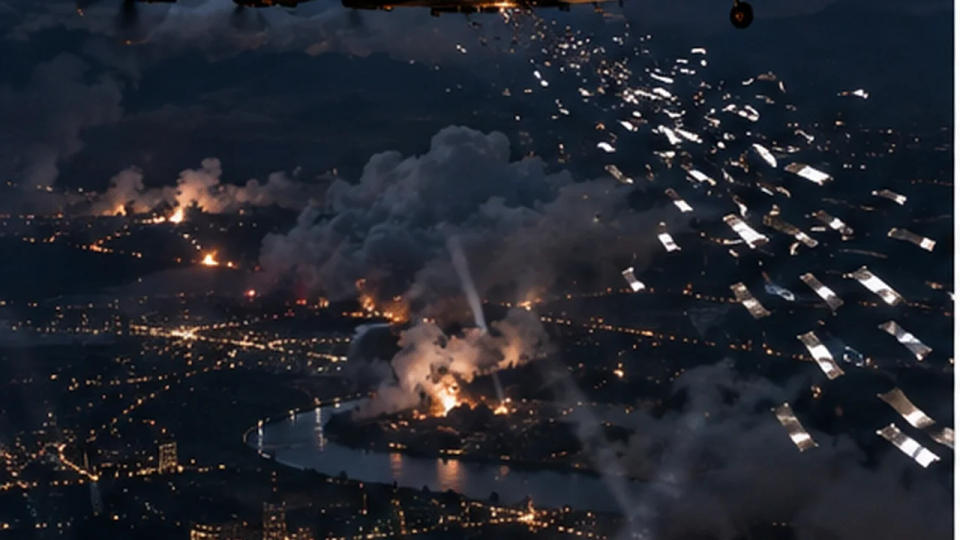
Why would a World War II bomber scatter bundles of shiny foil while flying over enemy territory? The strips were a defense against radar, not a strange kind of ammunition. Known to the Royal Air Force as Window and later widely called chaff, they flooded enemy radar displays with misleading reflections and made bombers harder to locate or follow.
The tactic looks deceptively simple: release carefully cut metal strips into the airstream. But their dimensions, timing and sheer quantity made them an important part of the electronic struggle over Europe. It was also a technology used during destructive bombing campaigns, so its success for aircrews must be understood alongside the suffering those raids caused on the ground.
Why Thin Foil Could Confuse a Radar
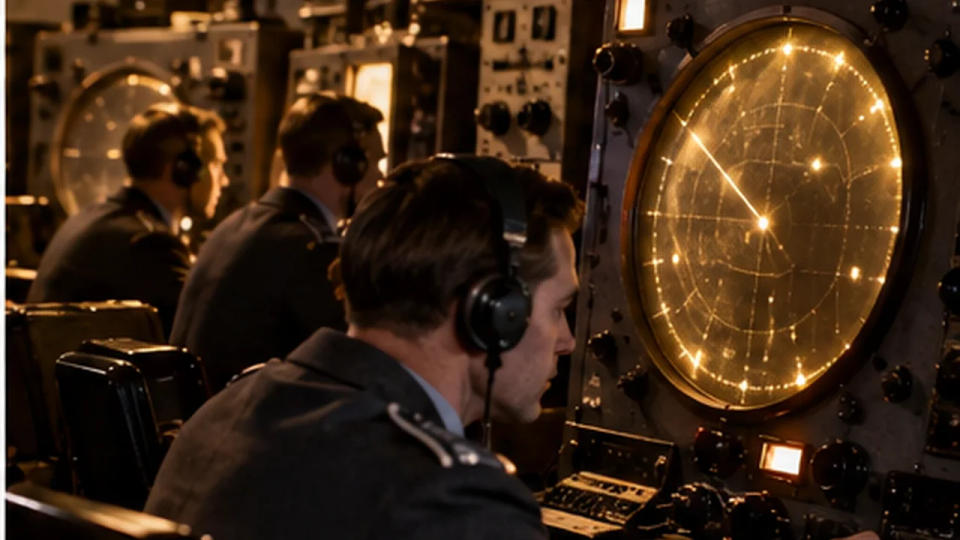
Radar works by transmitting radio waves and interpreting energy reflected back from objects. A radar operator might normally see a contact corresponding to an aircraft, estimate its position and help direct searchlights, guns or night fighters toward it. Conductive metal can also reflect radio energy. Thousands of narrow strips falling through the air therefore created additional echoes that did not correspond to actual aircraft.
The strips were not cut at random. For an especially strong response, their length was chosen in relation to the wavelength of the radar being targeted, commonly about half that wavelength. The Science Museum Group describes surviving wartime Window as metallic reflectors tuned to enemy radar wavelengths. Different equipment required different countermeasure designs, so there was no universal strip size suitable for every radar.
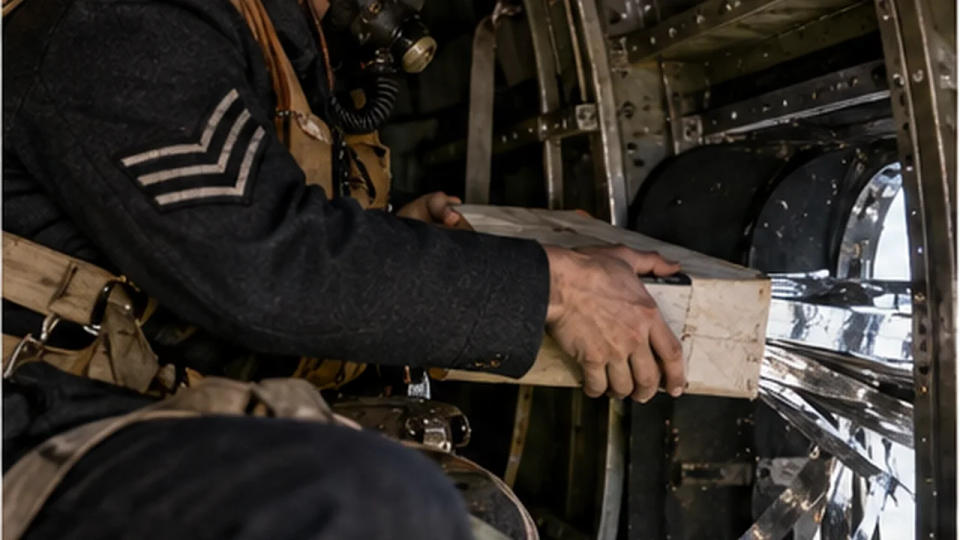
As the bundles opened, their contents spread and drifted rather than staying in one compact lump. On a period radar display, multiple echoes could confuse the identification and tracking of individual aircraft. The effect was closer to filling a conversation with competing voices than turning the radar off. Operators could still see signals, but distinguishing meaningful contacts from decoys became difficult.
This mattered particularly during night attacks, when Germany relied on coordinated ground radar, searchlights, anti-aircraft defenses and fighters. Foil could interfere with that coordination. It did not make bombers literally invisible, protect them from bullets or guarantee a safe return. It worked by attacking the information on which defenders depended.
The Secret Weapon Finally Used Over Hamburg
British scientists had examined radar-reflecting strips before they were deployed. One reason for delaying operational use was fear of revealing the method to Germany, which might then employ it against Allied radar. The Science Museum Group notes that both sides understood the underlying possibility and hesitated because neither knew how much the other already knew.
That deadlock ended during the RAF attack on Hamburg on the night of July 24–25, 1943. Crews released Window in quantity, and the resulting false radar returns disrupted German defenses. This was not merely a laboratory curiosity: the foil accompanied a large operational bombing force in a major raid.
One Science Museum collection account, citing historian Alfred Price, estimates that some 92 million foil strips were dropped during the operation and suggests that the resulting reduction in aircraft losses was substantial. Such retrospective estimates describe an unusually complex battle, however; they should not be read as proof that each individual crew survived because of Window alone. Weather, routes, tactics and the state of German defenses also shaped outcomes.
Hamburg also reveals a moral dimension easy to lose in a story about clever engineering. Operation Gomorrah inflicted devastating destruction and killed large numbers of civilians. The radar trick helped attacking air forces overcome defenses, but the larger bombing campaign had consequences far beyond aircraft survival statistics. A technological advance can be effective without making every use of it morally uncomplicated.
How Chaff Became a Mass-Produced Countermeasure
American researchers developed their own forms of the technique. At Harvard University’s Radio Research Laboratory, astronomer Fred Whipple worked with other specialists to make chaff practical for large bomber forces. The Smithsonian National Air and Space Museum explains that spreading thousands of strips rather than a mere few hundred was much more effective at confusing a radar operator.
Packaging mattered as much as physics. Crews flying hostile missions needed a way to release the foil quickly and repeatedly without complicated procedures. American packets intended for German radar could hold 1,000 strands, later 3,000, roughly 12 inches long. According to the Smithsonian, the radar response of a single packet could resemble that of a B-17 bomber, inspiring the nickname “dehydrated bombers.” This is a description of radar appearance, not of an actual aircraft-shaped object in the sky.

Production became an industrial undertaking. The National Air and Space Museum preserves the story of an early American cutter capable of producing 8,000 strips per minute. More than 500 such cutters were employed at American air bases in Britain before demand pushed production further into industry. The objective was not elaborate machinery in the sky: it was inexpensive material, cut consistently, prepared in vast quantities and distributed to crews.
The Pacific theater required another form because Japanese radar wavelengths differed. Whipple’s team developed long aluminum “rope” strips that unspooled from small parachute-supported packets carried by B-29s. That adaptation is an important reminder that chaff was an engineered response to particular radar characteristics rather than a magic substance that automatically defeated all detection equipment.
American use expanded after the British introduction. The Smithsonian reports wartime United States production of nearly 13 million pounds of chaff plus more than eight million pounds of aluminum rope. The numbers convey the logistical scale behind an invention whose essential ingredient was familiar household-like metal foil.
Conclusion
The falling foil strips were an early and influential form of electronic warfare. They produced false radar reflections at the moments when defending forces most needed reliable information. Window and chaff did not eliminate radar, and the opposing side could adapt, but they demonstrated that disrupting an enemy’s sensors could matter as much as improving one’s own aircraft. The principle remains part of the history of military countermeasures, even though modern systems and tactics have changed enormously.
Sources & Further Reading
- Science Museum Group — Packet containing sheets of uncut radar-jamming foil
- RAF Museum — Window Bundle
- Smithsonian National Air and Space Museum — Fred Whipple Figured Out How to Hide Airplanes From Enemy Radar
- Smithsonian National Air and Space Museum — Prototype Chaff Cutter
- Air & Space Forces Magazine — Operation Gomorrah