How did ancient Romans survive a hot summer without air conditioning? In well-designed houses, they relied on shade, courtyards, moving air, water, and choosing the right rooms at the right time. These methods could make a home more comfortable, but they did not provide the controlled temperatures of a modern cooling system.
Pompeii offers unusually detailed evidence of domestic architecture, while the architect Vitruvius explains how builders considered sunlight and seasons. The important catch is that the most elaborate solutions belonged mainly to people who could afford large houses and gardens.
Courtyards Brought Light and Air Into the House
Many prosperous Roman townhouses, called domus, opened inward rather than toward a row of large street windows. A narrow entrance led to an atrium, the central hall. Above it was a roof opening called the compluvium; below it sat the impluvium, a shallow basin that collected falling rain. Water could drain into a cistern beneath the floor for later use.
These were practical features, not ancient refrigerating machines. The opening admitted daylight and fresh air to a building whose adjoining rooms often had limited exterior exposure. Depending on the weather and other open doors, warm air could rise toward the opening while air entered elsewhere. That airflow is a physical possibility, not proof that every surviving atrium functioned as an efficient chimney.
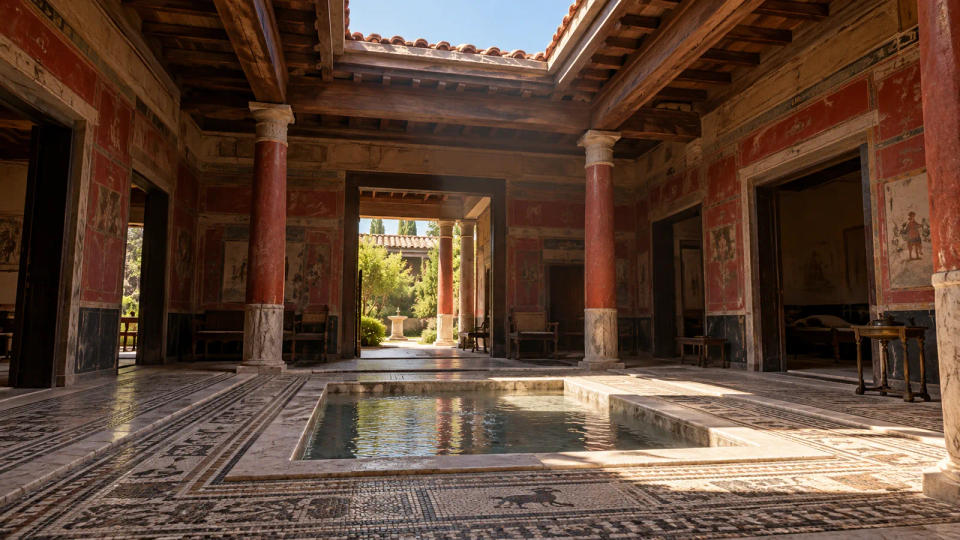
Pompeii's archaeological authorities describe atria with a central rainwater basin and a back room called the tablinum. In larger houses, the sequence of spaces frequently continued into a second open area. A central courtyard was therefore both a social center and a source of daylight and air.
Yet an open roof could also admit direct sunlight and summer heat. Whether a room felt cool depended on the hour, its orientation, surrounding walls, and the available breeze. A courtyard was a way to manage an indoor environment, not a guarantee of comfort.
Shade, Gardens, and Fountains Created Relief
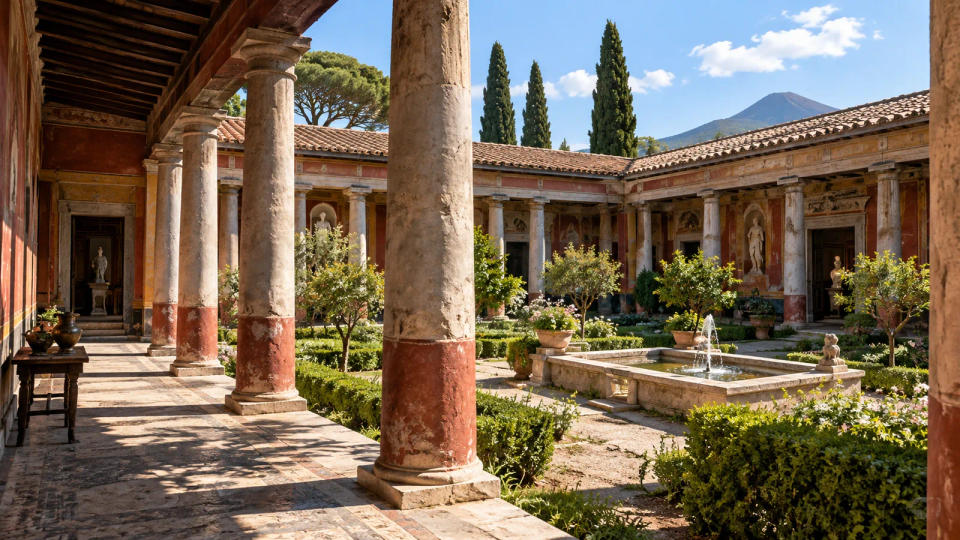
Beyond the atrium, wealthy households might have a peristyle: a planted courtyard surrounded by roofed walkways supported by columns. The portico shaded people, floors, and nearby walls while still allowing access to garden air. Some villas added trees, fountains, and pools, making the space more inviting when sunlit streets were oppressive.
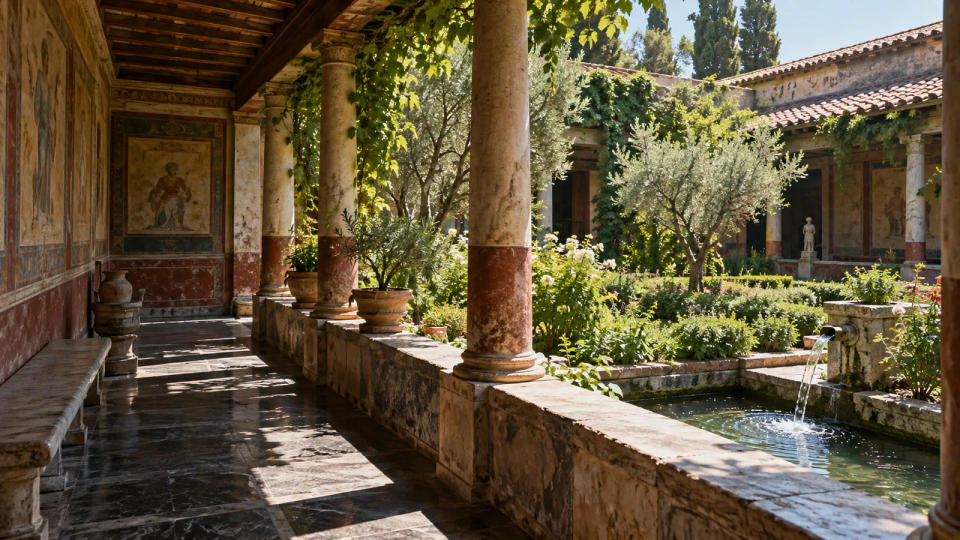
Water helped in a limited but real way. Evaporation consumes heat, so moving water can provide local cooling under suitable conditions, particularly where air is relatively dry. Leaves and soil also affect the immediate microclimate, while shade prevents direct solar heating in the first place. The sound and appearance of a fountain could make a garden seem even more refreshing.
The Getty Museum's discussion of Roman summer comfort highlights the combined value of breezes, covered walkways, water, and greenery. But a fountain was not a whole-house air conditioner. Its effect varied with humidity, airflow, water supply, and distance from the water. Large planted courts and running fountains were also expensive luxuries.
Room Direction and Daily Habits Mattered—And So Did Wealth
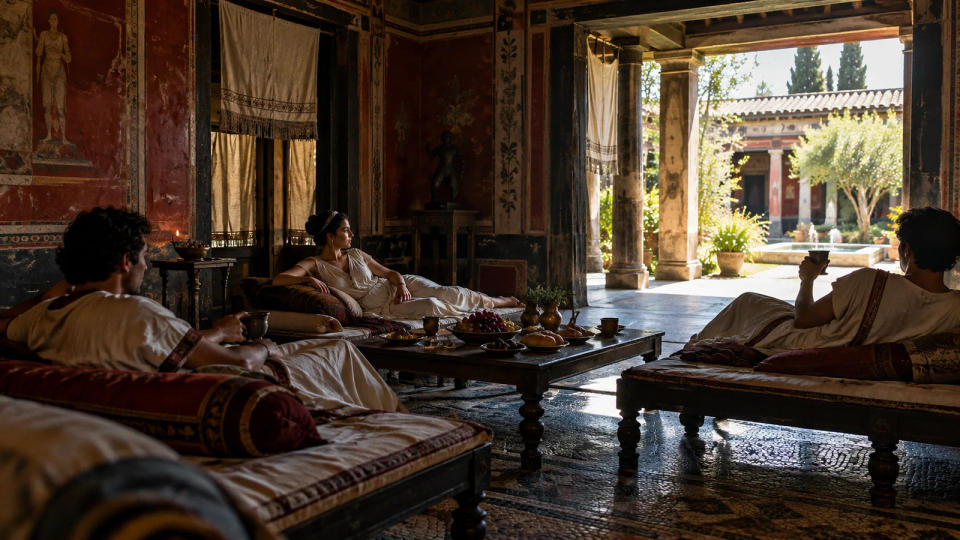
One of the clearest written clues comes from the Roman architect Vitruvius. In his first-century-BCE treatise De architectura, he recommended placing summer dining rooms toward the north because they avoided the strongest direct summer sunshine. He also argued that houses should respond to the climate of their region. His advice describes an architectural ideal rather than proving that every Roman builder followed it.
A household with several rooms could select a different place to eat, work, or rest as the sun moved. Deeply recessed openings and wooden closures could reduce sun and glare; shaded doors opening toward a garden might admit a breeze. As a general principle of building physics, masonry and stone floors also change temperature more slowly than light materials, especially when protected from direct sun. They do not create cold air, however: after a long hot spell, a massive wall can store heat and release it later.
Modern designers might call the combination passive cooling. The term is modern, and we should not read modern temperature calculations into ancient sources. The basic choices still make sense: block unwanted sun, leave space for airflow when conditions permit, and occupy the most comfortable parts of the building.
Archaeology also reveals the limits of the familiar luxury-villa picture. The Metropolitan Museum of Art describes crowded urban rental buildings, or insulae, alongside lavish townhouses and country retreats. The residents of small rented rooms could not simply move to a garden pavilion or choose among several seasonal dining rooms. Upper-storey spaces might have very different exposure from a sheltered ground-floor room.
Even in a large household, comfort came through labor. Someone needed to manage openings, water, shade, meals, and room use. Household servants and enslaved people often performed work that made elite living arrangements possible. A beautiful villa is therefore evidence not only of clever construction but also of unequal access to resources and domestic labor.
There is no reliable single number for how many degrees a typical Roman house stayed below outside air. Pompeii preserves architecture unusually well, not a complete log of summer indoor temperatures. Moreover, the Roman Empire stretched across many climates, and houses changed with local materials, income, and custom. Claims that all Romans stayed comfortably cool indoors flatten that enormous variation.
Conclusion
Ancient Romans did not defeat summer heat; they worked around it. Courtyards allowed light and potential airflow, colonnades cast shade, gardens and water offered local relief, and well-placed rooms avoided some of the day's strongest sunshine. The most important qualification is social: those advantages were most available in larger, wealthier homes. For many others, a hot Roman summer remained hot.
Sources & Further Reading
- Archaeological Park of Pompeii — Roman Housing (Houses and Villas)
- J. Paul Getty Trust — How Ancient Romans Kept Their Cool
- Western Australian Museum — Daily Life in Pompeii: Residences
- Metropolitan Museum of Art — Roman Housing
- Dominic Perring (UCL) — Domestic Architecture, Roman