
Why could a wooden machine inspire terror in a castle built to withstand an army? The counterweight trebuchet could send heavy stone missiles against walls, towers, and the space behind them, but its greatest advantage was often the pressure it placed on defenders who knew that another impact might come. In medieval warfare, fear grew from a combination of engineering, persistence, and the visible resources an attacker could afford to bring to a siege.
It did not fire rapidly or guarantee that a strong fortress would collapse. Its reputation becomes more interesting when we separate what the machines actually did from the extraordinary stories told about them.
How a Falling Weight Became a Siege Weapon
A trebuchet was a throwing engine built around a long wooden beam rotating on an axle. The earliest type, generally called a traction trebuchet, relied on teams of people pulling ropes to swing the beam. Later counterweight machines used gravity: a large mass descended at the short end, accelerating the longer arm. A sling attached to the long end released the stone at a calculated point in the arc.
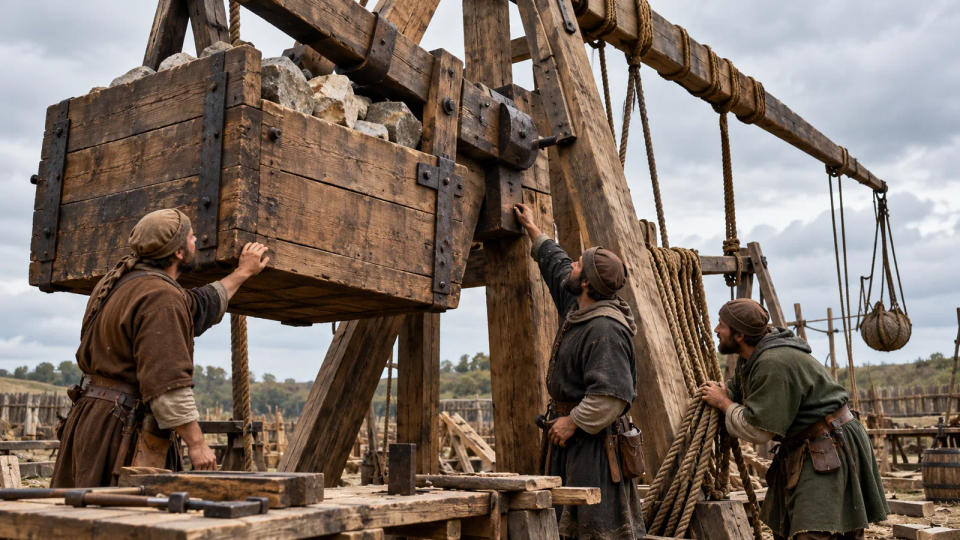
This simple description hides difficult engineering. A heavy wooden frame had to withstand repeated loads. Carpenters needed sound timber, secure joints, ropes, and metal fittings. A winch lowered the long arm to raise the counterweight before every shot. The crew then secured the mechanism, placed a missile in the sling, cleared the dangerous area, and released it. The counterweight itself was not a projectile; it was the machine's stored source of energy.
Different designs changed how smoothly that energy reached the stone. On many large machines, a hinged counterweight box could fall more freely than a rigidly attached weight, reducing jolts to the frame. The sling length and release mechanism also affected the trajectory. A trebuchet was therefore neither an oversized slingshot nor a device that simply hurled anything placed on its arm. It was a carefully assembled system of timber, ropes, leverage, and timing.
Castelnaud Castle's medieval warfare museum describes a reconstructed articulated-counterweight trebuchet throwing stone balls of about 100 kilograms to around 200 metres. Its stated firing rate is only one or two shots per hour. These are figures for a reconstruction, not universal specifications for all medieval machines. By contrast, the museum's reconstructed human-powered perrière throws much smaller stones but can fire several times per minute. Size and power came at the cost of speed.
Constructing such an engine was expensive in materials, labour, transport, and time. Its appearance outside a fortress signalled an attacker prepared for a lengthy campaign rather than a quick raid. That signal alone could change the calculations inside the walls.
How Much Damage Could a Trebuchet Actually Cause?
Stone ammunition was its most familiar weapon. A heavy projectile could strike battlements, damage masonry, endanger defenders, or smash structures inside the enclosure. The danger did not depend on every shot bringing down an entire curtain wall. Repeated bombardment could make a defended position difficult and exhausting to hold, especially alongside mining, blockade, infantry assaults, and shortages of supplies.
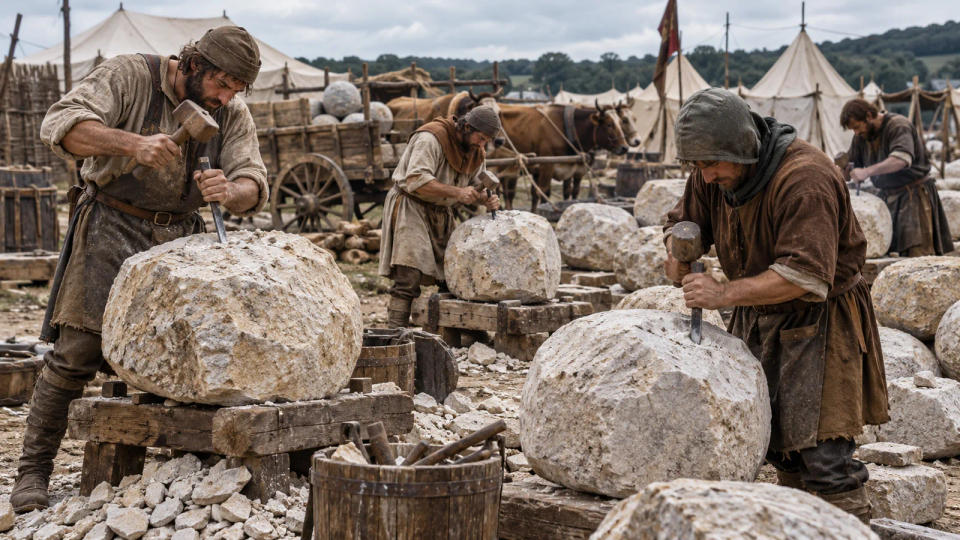
Archaeology gives this story a physical dimension. In 2024, English Heritage reported the discovery of eight medieval stone shots outside Kenilworth Castle, ranging from about one kilogram to 105 kilograms. The finds are associated with the long siege of 1266, when royal forces and defenders both used projectile engines. The siege lasted 172 days. Even with an arsenal that included nine siege engines, the castle did not surrender immediately: its resistance is a warning against imagining a trebuchet as an instant castle-destroyer.
Another stone ball, weighing about 14.5 kilograms, was found at Edinburgh Castle and may be connected with the English siege of 1296. Historic Environment Scotland explicitly treats that identification as probable rather than certain. Such artifacts establish that stone-throwing engines were used in real conflicts, while leaving open the precise trajectory, machine, and effect of an individual shot.
The popular picture of trebuchets effortlessly punching vast breaches through any fortification needs qualification. Historian Michael S. Fulton has argued that later comparisons with gunpowder artillery exaggerated their destructive capacity. His study stresses the weapons' psychological influence and status as well as their physical force. Castle construction, projectile size, the condition of the target, and the length of a siege all affected the outcome.
Some medieval accounts also describe incendiary material or offensive refuse being launched, but the practical consequences of such attacks varied, and stories about spreading disease must not be treated as demonstrated battlefield science. Heavy stones remain the clearest basis for understanding the weapon's mechanical role.
The Warwolf: When Fear Became a Weapon
The most famous example comes from the English siege of Stirling Castle in 1304. Edward I assembled siege engines against a Scottish garrison commanded by William Oliphant. According to Historic Environment Scotland's account, the king's engineers used five master carpenters and about fifty other workers to build an enormous counterweight machine later known as Warwolf. Material and labour had been gathered on a scale that made the siege a demonstration of royal power.
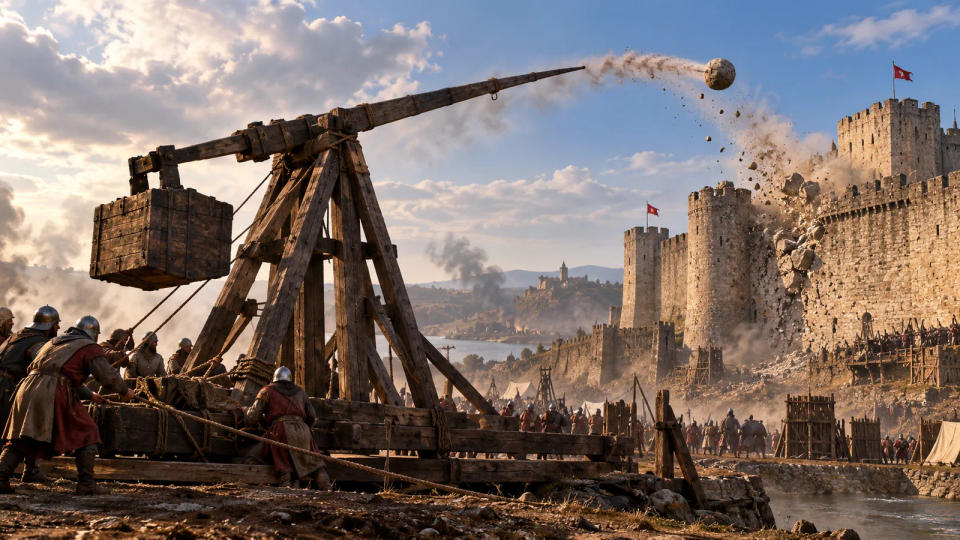
Stirling's defenders reportedly offered to surrender while the great engine was nearing completion. Edward insisted on displaying its power anyway. The heritage account describes a roughly 140-kilogram shot damaging the castle wall, but the precise structure and appearance of Warwolf cannot be recovered from an intact surviving machine. Any modern image of it is a reconstruction, not a contemporary photograph or a verified engineering drawing.
Why make such a spectacle after surrender was already within reach? Destroying masonry was only part of the message. A king who could mobilize carpenters, metal, timber, transport, and vast supplies could tell other garrisons what prolonged resistance might cost. The machine worked as intimidation directed at people inside one castle and at observers beyond it.
Yet not every besieged garrison yielded at the sight of a trebuchet. Kenilworth's long defence shows that fortifications, provisions, commanders, and political circumstances mattered. Military engineers could put a wall under pressure, but they could not replace all the other work of a siege. The threat was real precisely because it operated within that larger struggle of endurance.
Conclusion
The trebuchet was feared not because it was magically accurate or could flatten any castle in minutes, but because it transformed gravity and skilled labour into a sustained threat. Its stone shots, imposing structure, and symbolic weight made it a formidable part of medieval siege warfare. Warwolf illustrates the psychological force of the weapon; Kenilworth reminds us that fear and firepower did not always deliver a quick victory.
Sources & Further Reading
- Château de Castelnaud — The Medieval Warfare Museum
- English Heritage — Giant Catapult Shots from 1266 Attack Discovered at Kenilworth Castle
- Historic Environment Scotland — Trebuchet Ball
- Historic Environment Scotland — The War Wolf at Stirling Castle
- Michael S. Fulton — Trebuchets Were Not Siege Guns, So Why Use Them?