
Why would an army build a fighter plane that had no engine, no weapons, and no chance of taking off? During World War II, these dummy aircraft were weapons of deception: they made airfields look more heavily defended, attracted enemy attention away from valuable aircraft, and sometimes encouraged bombers to attack an empty field instead of a working base.
The illusion did not have to survive a mechanic’s inspection. It had to survive a hurried glance from an enemy pilot or a reconnaissance photograph taken high above the ground. That difference turned wood, canvas, paint, and carefully arranged shadows into inexpensive military assets.
Why a Fighter That Could Not Fly Was Still Useful
A wartime aircraft was valuable not only because of its metal and engine, but because it represented trained crews, maintenance equipment, fuel, and the ability to conduct another mission. Destroying machines parked on the ground could be easier than defeating them in the air. A false target offered commanders the possibility of protecting those resources without risking a pilot.
Dummy fighters were therefore built to resemble real aircraft from the viewpoint that mattered most: above. Their general wingspan, tail shape, camouflage colors, and ground shadows could suggest a squadron awaiting orders. Close inspection might reveal fabric stretched over timber rather than a working airframe. At several thousand feet, however, the purpose was not perfect engineering accuracy but a believable silhouette.
The Imperial War Museums preserves an especially revealing historical record: an RAF instructional film produced around 1946 in cooperation with the Air Ministry’s deception specialists. It shows dummy aircraft made with wood and canvas and explains how film-industry techniques helped create convincing wartime targets. This was deliberately theatrical construction, but for a potentially life-saving military purpose.
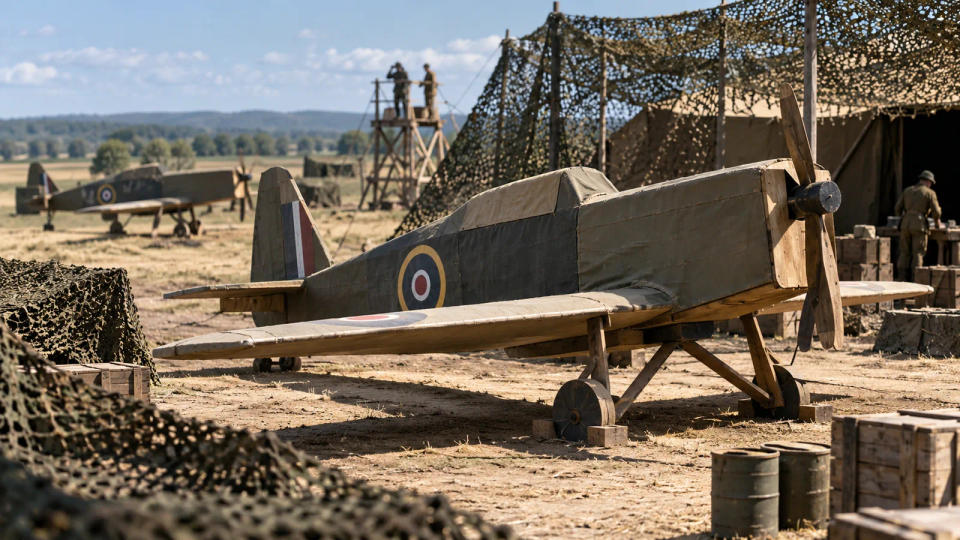
A convincing decoy also needed a credible setting. An isolated dummy fighter in the wrong place might look suspicious. Placing it near false dispersal areas, hangars, tracks, or other signs of activity could make the scene read as an operational airfield. This was an attempt to manipulate the enemy’s interpretation of evidence, not an effort to create a flyable machine.
How Britain Built Entire Airfields to Mislead Bombers
Britain organized its decoys on a much larger scale. The Royal Air Force Museum identifies the wartime K and Q sites as false airfields intended to draw bombing away from genuine targets. They performed related but different jobs. K sites were daytime imitations, while Q sites used lighting to impersonate airfields after dark.
According to Historic England, a typical daytime K site imitated a modest RAF satellite landing ground. It could include a grass landing area, dummy aircraft, a windsock, trenches, and simulated stores or fuel facilities. The official programme allocated ten dummy aircraft to each K site, with models selected to suit the parent airfield. Historic England records 42 English decoys containing a K-site component; this is a count for that category, not a total of all British deception sites.
Nazeing, northeast of London, is a particularly concrete example. Its decoy installation was associated with RAF North Weald and included dummy Hurricane fighters. The same location also operated a nighttime Q component. Such arrangements attempted to make an enemy aircraft identify the wrong patch of ground as a worthwhile target.
Q sites did not depend mainly on rows of wooden fighters visible in darkness. Operators could imitate runway flare paths, obstruction lights, and an aircraft moving across the field using a swinging or moving headlamp. The surviving description of the Hambleton decoy, which protected RAF Church Fenton, documents a remotely operated lighting arrangement and a shelter with communications and power equipment.
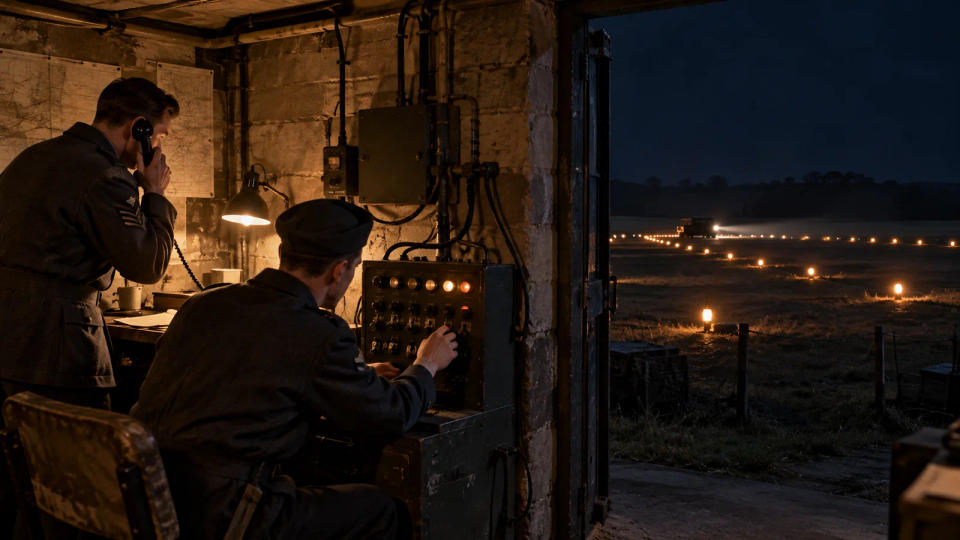
The intention was to divert bombs away from aircraft, runways, workshops, and the people working there. Britain also employed dummy fires and imitated town lighting to protect civilian and industrial locations. Historic England says decoys diverted many attacks, but a broad judgement about the programme cannot establish that every dummy fighter fooled a specific bomber. A fake could be discovered, ignored, or destroyed without changing the enemy’s larger plans.
From Flying Tigers in China to a Fake American Airfield
The same idea travelled far beyond British airfields. The Smithsonian National Air and Space Museum describes wooden Curtiss P-40 decoys built for the American Volunteer Group, better known as the Flying Tigers, in China. Operating over great distances with relatively few serviceable aircraft, the group had good reason to disguise both its strength and where its aircraft were based.
Ground crews improvised aircraft shapes from wood, fabric, and paint. A painted dummy with the outline of a P-40 might suggest one more fighter waiting on the ground. These constructions could not taxi or fly, but an enemy intelligence officer counting aircraft from the air did not necessarily have that information. The museum’s surviving images document the decoys; they do not prove that every Japanese reconnaissance mission accepted the deception.
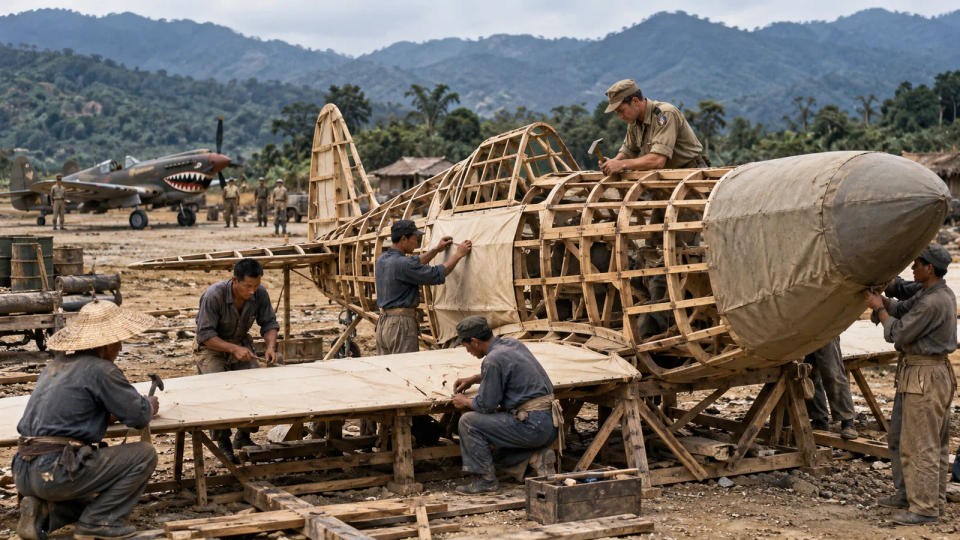
In the United States, the Army went further by building a complete counterfeit airfield on the Elko Tract near Richmond, Virginia, in late 1942. A Smithsonian account describes dummy runways patterned on Byrd Field, along with imitation aircraft, hangars, trucks, and other structures. Some planes were built from plywood and supported on simple timber landing gear; vegetation was even cut into aircraft-shaped silhouettes.
Elko reveals a crucial limitation of deception history: constructing a clever trap does not mean it was sprung. Its purpose was to lure a feared Luftwaffe attack away from important facilities, but the expected long-range German bombing threat to Richmond never materialized. It is thus a well-documented example of preparation, not proof of an enemy raid successfully redirected.
These examples also show why decoys could be worth the effort even when no battle followed. They complicated an adversary’s understanding of where aircraft were stationed and how strong a defending force might be. A commander could move real fighters or hide them better while leaving a persuasive false picture behind. Military deception worked best as part of a larger system of camouflage, dispersal, and intelligence protection rather than as a stand-alone wooden trick.
Conclusion
World War II armies built unflyable fighters because the intended audience was not a pilot looking for an aircraft to fly; it was an enemy trying to identify targets. The dummies were cheap stand-ins for scarce operational machines, and whole false airfields could invite costly mistakes. Surviving records establish their widespread use, while the success of any individual ruse must be judged from evidence rather than assumed from how realistic the props looked.
Sources & Further Reading
- Imperial War Museums — Curator’s Choice: Visual Deception
- Historic England — World War II Bombing Decoy Nazeing
- Historic England — WWII Decoy Control Building near Scalm Park
- Royal Air Force Museum — British Defences
- Smithsonian National Air and Space Museum — Hiding in Plane Sight
- Smithsonian Air & Space — In 1942, the Army Built a Decoy Airfield in Virginia