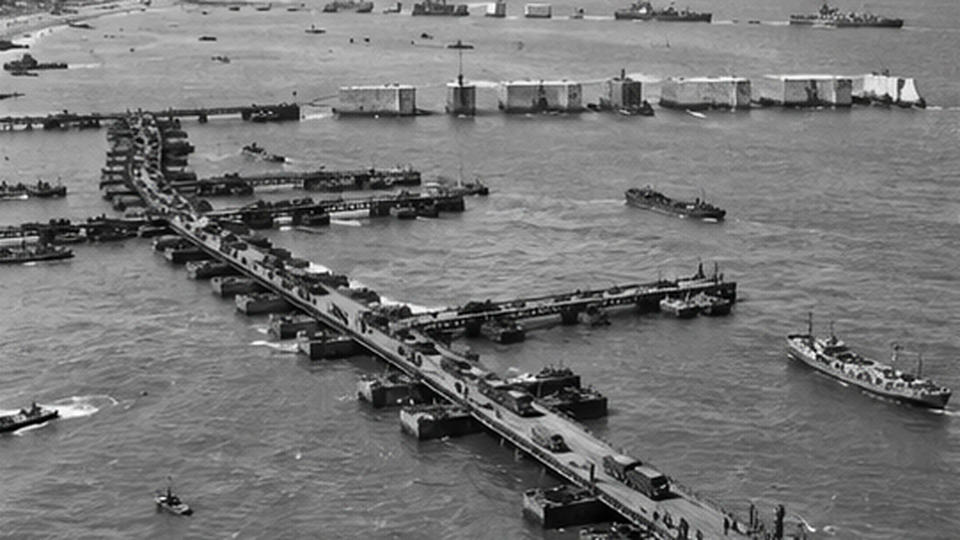
How do you unload an army when the coastline has no working port? For the Normandy invasion in June 1944, the Allies answered by taking parts of a harbor across the English Channel and assembling them off the beaches. These temporary installations, called the Mulberry harbors, combined concrete breakwaters, floating roads, and adjustable piers.
They were not fully operating on D-Day itself. Their parts followed the first assault waves, allowing troops fighting inland to receive more vehicles, fuel, ammunition, food, and replacement equipment. The engineering achievement was remarkable, but the story also includes a severe storm and a crucial lesson about getting supplies ashore.
Why D-Day Needed Harbors That Did Not Exist
An invasion does not end when soldiers reach the beach. Infantry, tanks, artillery, and transport vehicles rapidly consume enormous quantities of supplies. A major army normally depends on a deep-water port with docks, cranes, storage areas, and roads or railways leading inland. Normandy's designated landing beaches offered no such ready-made system.
The Allies hoped to capture Cherbourg, a major port on the Cotentin Peninsula, and eventually use other French harbors. But German defenders could resist the advance and destroy port installations before withdrawing. In fact, Cherbourg fell at the end of June with its facilities extensively demolished; restoring useful capacity took additional time. Relying entirely on a captured port would have been an enormous risk.
British planners therefore pursued an unusual solution: manufacture a harbor in modular sections, then tow the sections to France. Rather than constructing permanent quays from the seabed upward, the scheme would create protected water and temporary routes between ships and land. Two harbors were planned: Mulberry A near Omaha Beach for American forces and Mulberry B at Arromanches, near Gold Beach, for British forces.
This was one part of a much wider supply plan. Landing ships, smaller craft, amphibious DUKW trucks, and direct unloading onto open beaches would still be needed. The Mulberries were intended to supplement those methods, especially when rough water or the tides made unloading difficult.
Building a Harbor in Pieces Across Britain
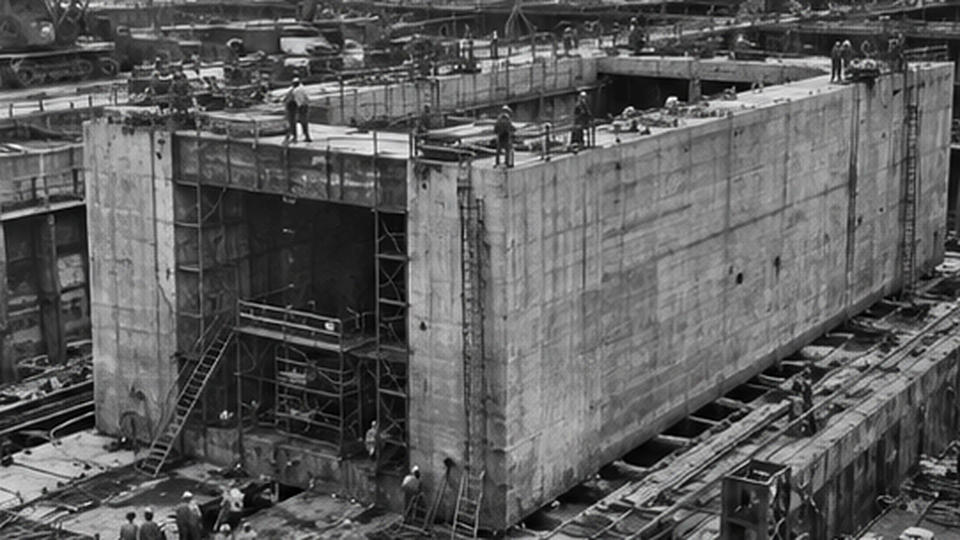
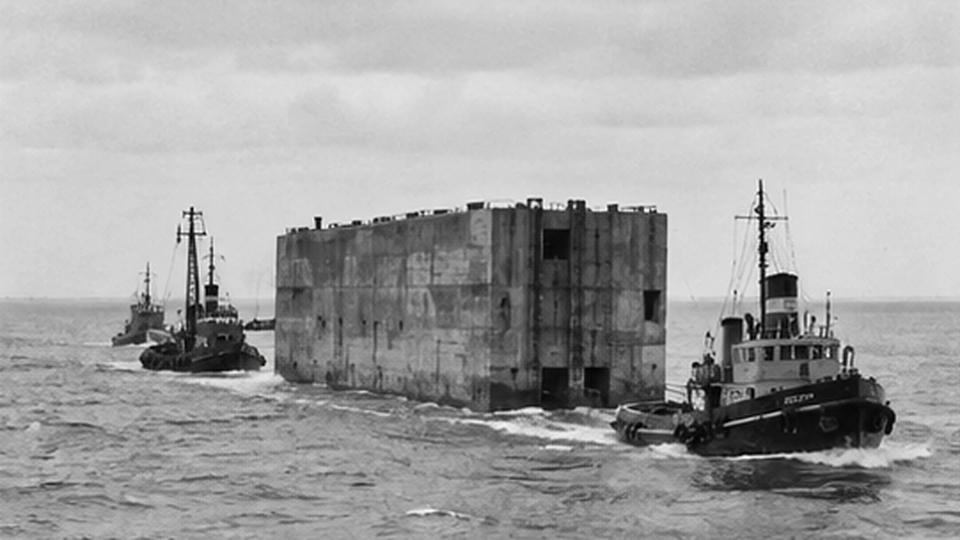
The largest components were Phoenix caissons: vast hollow reinforced-concrete boxes built by civilian contractors at sites around the British coastline. Their chambers allowed them to float during movement. Once positioned off Normandy, engineers deliberately flooded them so that they settled on the seabed as a protective wall. The concrete wall itself was not a wharf; it was part of the shelter needed to make unloading safer.
Other defenses strengthened the sheltered anchorage. Old vessels, code-named Corncobs, were deliberately sunk in lines known as Gooseberries. Floating steel barriers called Bombardons provided further protection against waves. These were different structures with different jobs, not interchangeable names for a single sort of pontoon.
Inside the protected water, the Allies planned unloading piers with tall adjustable legs, called Spuds, to deal with the large rise and fall of the Channel tide. Steel Whale roadway sections linked the offshore pierheads to shore. They rested on floating supports, often called Beetles, and used joints that could accommodate movement as waves lifted the individual sections.
The modular design demanded coordination between concrete builders, steel fabricators, naval crews, tug operators, and military engineers. Some prefabricated sections had to be stored or temporarily sunk in British waters before they were needed. The parts were enormous, yet every connection still had to work when assembled in salt water under the pressure of an active invasion.
Unlike a conventional fixed bridge, the floating roadway had to move without breaking apart. Unlike an ordinary sea wall, the barrier had to be transported first. Both problems shaped what was built and explain why the final harbor looked like a collection of different machines rather than a single continuous structure.
Towing, Assembling, and Using the Mulberries
After the landings began on June 6, 1944, tugboats hauled the fabricated sections across the Channel. Assembling the harbors offshore began around June 9. Engineers positioned the Phoenix units, flooded them in place, brought in the blockships and other wave barriers, and connected floating roadways from offshore pierheads toward the beaches.
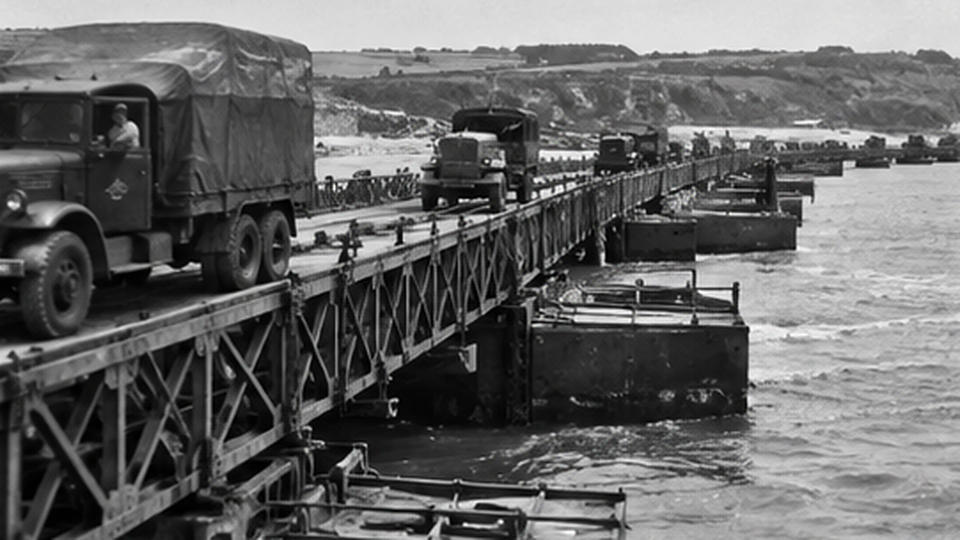
Once the routes were usable, ships could unload vehicles or other cargo onto the pierheads, and traffic could proceed along the floating causeways. Adjustable spud legs and hinged roadway sections helped the piers and causeways respond to tide and swell. By June 16, unloading was taking place through the Mulberry system, though the two harbors were still being completed and improved.
Then the Channel delivered a violent test. A major storm beginning June 19 battered both sites. The less sheltered American Mulberry A off Omaha was so badly damaged that it was abandoned. Equipment that could be recovered was used to support repairs elsewhere. Mulberry B at Arromanches was also damaged, but its more protected location helped it survive and remain in service.
That distinction matters. It would be misleading to claim that the entire invasion depended on a pair of perfectly functioning artificial ports. American forces continued to deliver very large quantities of equipment directly across the beaches with landing craft, trucks, and other methods. The surviving British harbor, meanwhile, provided a valuable unloading facility for months.
Historic England records that Mulberry B remained in service for about ten months. Its surviving concrete caissons, along with other remnants in British and French waters, provide physical evidence of how an improvised supply network was built at extraordinary speed. The broken American harbor is part of the same history: even ingenious structures remained vulnerable to the English Channel.
Conclusion
The Allies did not float a complete port to Normandy. They prefabricated its essential pieces in Britain, towed them separately, and assembled protected anchorages, offshore piers, and flexible roads after the troops landed. One harbor failed in a storm, while the other kept working. Together with the less glamorous business of unloading directly over the beaches, the Mulberries helped turn an initial assault into a sustained campaign.
Sources & Further Reading
- The National WWII Museum — Over-the-Shore Logistics of D-Day
- Historic England — Mulberry Harbour Phoenix Caissons at Portland Harbour
- Historic England — Phoenix Caisson off Littlestone-on-Sea
- The National WWII Museum — History Through the Viewfinder