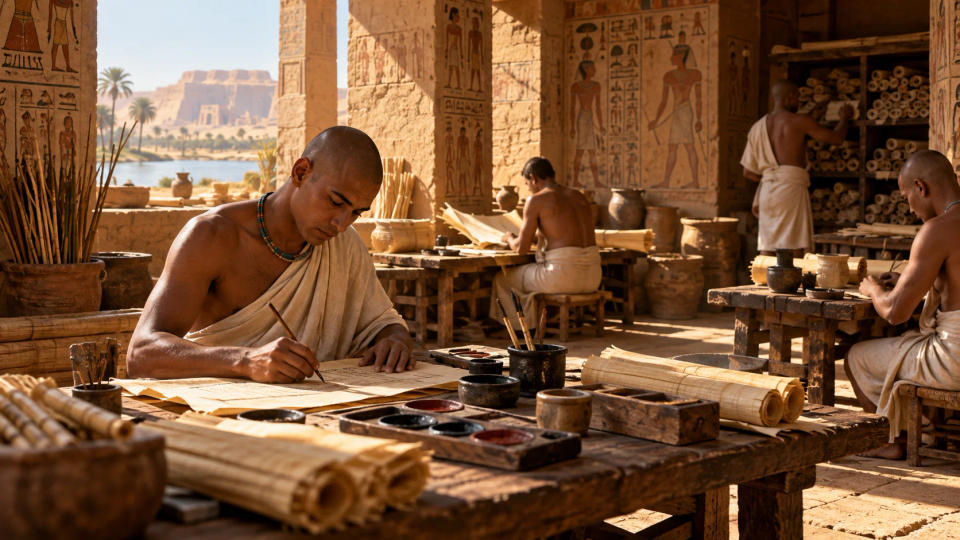
How could ink brushed onto fragile papyrus remain legible thousands of years later? Ancient Egyptian scribes generally used black carbon pigment and red mineral pigment, combined with a binder and water. Their writing survived not because of a single miraculous formula, but through a fortunate partnership between resilient pigments, careful writing practices, durable papyrus, and exceptionally dry burial environments.
The surviving evidence includes real palettes with pigment residues, manuscripts whose letters can still be examined, and modern chemical studies of tiny areas of ink. Together, they let us distinguish a plausible reconstruction of the craft from ingredients that researchers have actually detected.
What Was Ancient Egyptian Ink Made From?
The everyday black writing material was commonly based on carbon: soot collected from burning fuel or other finely divided charred matter. Unlike many plant-based colorants, the blackness of carbon does not depend on a fragile organic dye molecule. The particles are physically dark and can remain recognizable in very old manuscripts, although their adhesion and the condition of the sheet still matter.
For red writing, Egyptians usually turned to iron-rich earth pigments, especially red ochre. Its coloring components include iron oxides, such as hematite. A scribe could write the main text in black and mark headings, important passages, or instructions in red. This was a practical visual system, not merely decoration: readers could locate a new section quickly on a dense roll.
A powder by itself would make a poor everyday writing medium. Egyptian black and red pigments were commonly mixed with a plant gum binder, often described as gum arabic, and water. The gum helped the particles form a usable ink and remain associated with the writing surface after drying. Historical recipes were not necessarily identical across periods, regions, or workshops, so a single modern mixture should not be presented as the universal ancient recipe.
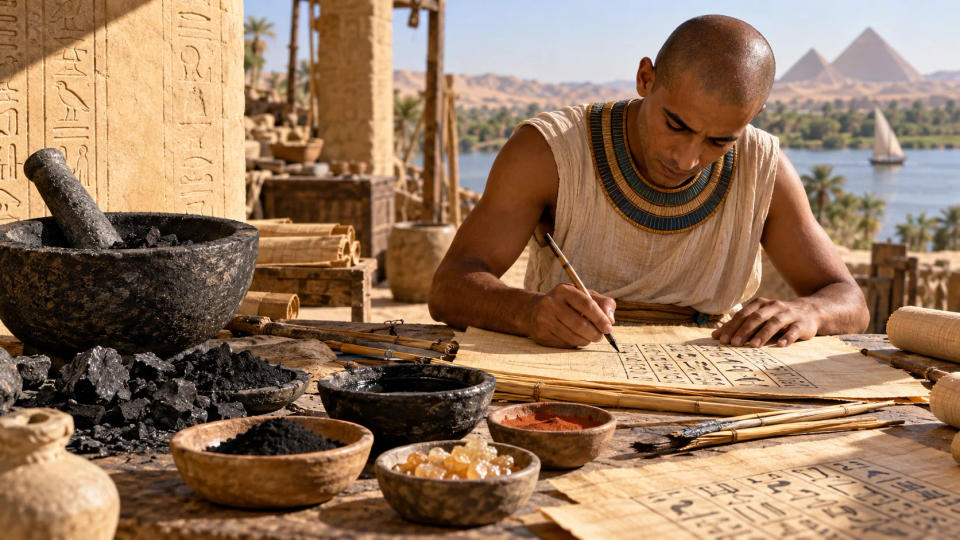
Researchers describe a particularly convenient form of the mixture: dried cakes or pellets. Pigment and binder could be combined with some water, dried into a compact solid, and later reactivated with fresh water when needed. This was rather like using a watercolor cake. It reduced the need for a scribe to transport a fragile vessel of ready-mixed liquid ink on every journey.
The familiar rectangular palette makes this practical technology tangible. Excavated examples preserve places for red and black material and a long slot for writing tools. Some brushes or rush pens retain pigment at their ends. Such objects show that the colors and writing implements were part of an integrated kit, rather than separate inventions imagined from surviving manuscripts alone.
How Did Scribes Prepare and Apply the Ink?
A reasonable reconstruction starts with prepared pigment and binder, then adds water in a shallow well until the mixture can be picked up by a plant-fiber writing implement. The scribe would adjust the flow by wetting the tip and returning to the palette. Evidence supports the broad method, but it cannot tell us exactly how much water every workshop used or the precise order of every mixing step.
Egyptian writers often worked with rushes whose ends were treated to separate their fibers into brushlike tips. Reed pens became more common in later periods. The distinction matters because people sometimes picture every pharaonic scribe using the sharply cut reed pen familiar from Greco-Roman manuscripts. Writing technology changed over Egypt's long history.
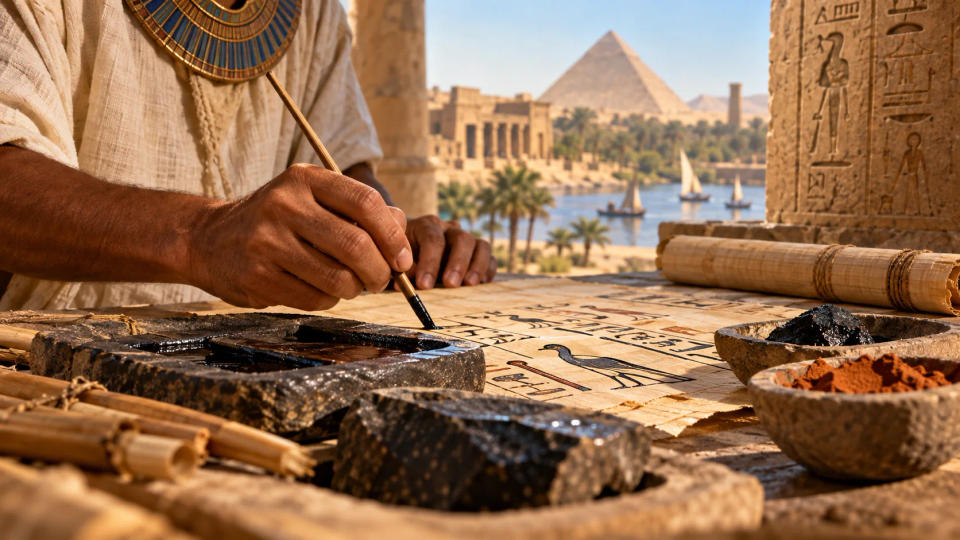
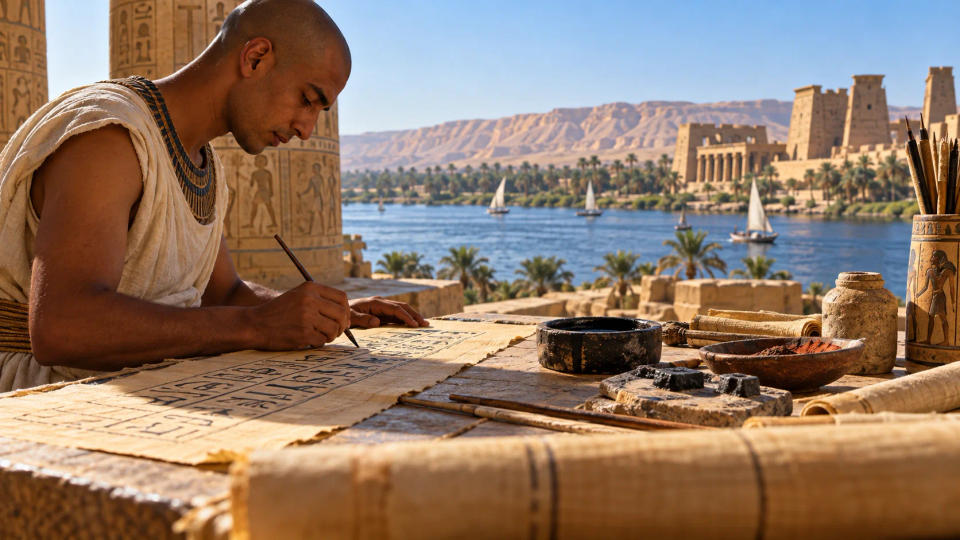
Most daily manuscript writing was not a row of elaborately painted monumental hieroglyphs. Hieratic, a flowing script suited to ink on papyrus, was widely used; demotic and other scripts appeared later. The familiar carved hieroglyphs of monuments and the quicker ink scripts of administrators belonged to overlapping but distinct writing practices.
Papyrus itself was carefully manufactured from the inner pith of the papyrus plant. Thin strips were laid in crossing directions, pressed, and dried into sheets. The crossed fibers gave the surface its recognizable texture. Rolls could then hold administrative accounts, letters, religious compositions, medical instructions, and other records. Yet the exact manufacturing procedure was not described in a complete Egyptian technical manual, so conservators rely partly on later descriptions and experiments.
What Modern Science Found Inside Ancient Ink
The most intriguing result is that some Egyptian inks were more chemically elaborate than a simple mixture of soot, ochre, and gum. In research published in 2020, scientists used powerful synchrotron X-ray methods to examine twelve papyrus fragments from the Tebtunis temple library. Those particular fragments date to roughly 100–200 CE, within Roman-period Egypt. They do not represent every millennium of Egyptian history.
The team identified iron-based particles in red letters, consistent with ochre. They also found lead compounds in many red passages and in some black writing. The spatial patterns were particularly interesting: lead-related materials were distributed differently from the larger red pigment grains and could be detected around and within papyrus fibers.
The researchers proposed that some lead ingredients were used to influence drying rather than to supply the color. This interpretation is supported by the absence of certain lead pigments that might otherwise explain the result, but it remains a scientific interpretation, not an ancient recipe preserved in the scribes' own words. We should not conclude that all Egyptian ink contained lead, that every scribe knew its chemistry, or that lead alone made the writing survive for millennia.
Another possible implication concerns production. Complex and relatively standardized ingredients in a major temple library could indicate specialist preparation or workshops. That is a hypothesis arising from the chemical findings and the scale of demand, not proof that every temple purchased ink from the same kind of supplier.
These analyses also demonstrate the value of non-destructive or minimally invasive scientific techniques. A letter can appear uniformly black to the naked eye while elemental maps reveal ingredients invisible in ordinary photography. Material evidence sometimes corrects the simplifying stories told about ancient crafts.
Why Can We Still Read the Writing Thousands of Years Later?
The strongest answer begins outside the inkpot. The dry conditions in parts of Egypt preserved papyrus that would have decayed much faster in damp environments. Documents survived buried in sand, in tombs, or in other relatively sheltered settings. The Metropolitan Museum of Art emphasizes that Egypt's desert climate was a major factor in the survival of written papyri.
Carbon black and iron-rich earth pigments contributed by providing relatively persistent visible particles. The gum helped hold the initial writing together. But the condition of the plant-based sheet was critical: if papyrus fibers degraded, split, or were repeatedly soaked, the letters could be lost regardless of their pigment. Survival is therefore a property of an entire object and its environment, not just the colorant.
Nor was ancient ink indestructible. Conservation studies document brittle papyrus, deterioration linked to light and changing humidity, and occasional flaking of paint as its binder ages or the underlying sheet becomes unstable. Today's conservators must protect manuscripts from excessive light, fluctuating moisture, and damaging handling. A manuscript that survived in a dry tomb is not automatically safe under modern display conditions.
One further caution is worth remembering: surviving material is a selected fraction of what Egyptians wrote. Countless sheets probably disappeared. The legible examples show what worked under favorable circumstances, not that every ancient note enjoyed a guaranteed multi-thousand-year lifespan.
Conclusion
Ancient Egyptian ink endured through a sensible combination of carbon black or mineral red pigments, a binder, water, skilled application, and a supportive papyrus surface. Later chemical analysis reveals that some recipes included surprisingly sophisticated additives. Above all, the desert preserved the written objects. The enduring achievement was not an immortal liquid, but a writing technology that helped a civilization's words outlast the civilization itself.
Sources & Further Reading
- The Metropolitan Museum of Art — Papyrus in Ancient Egypt
- The Metropolitan Museum of Art — Papyrus-Making in Egypt
- ESRF — Red and Black Ink from Egyptian Papyri Unveil Ancient Writing Practices
- PNAS — Insights into the Composition of Ancient Egyptian Red and Black Inks on Papyri
- npj Heritage Science — Shine a Light on Papyrus: Monitoring the Aging Process