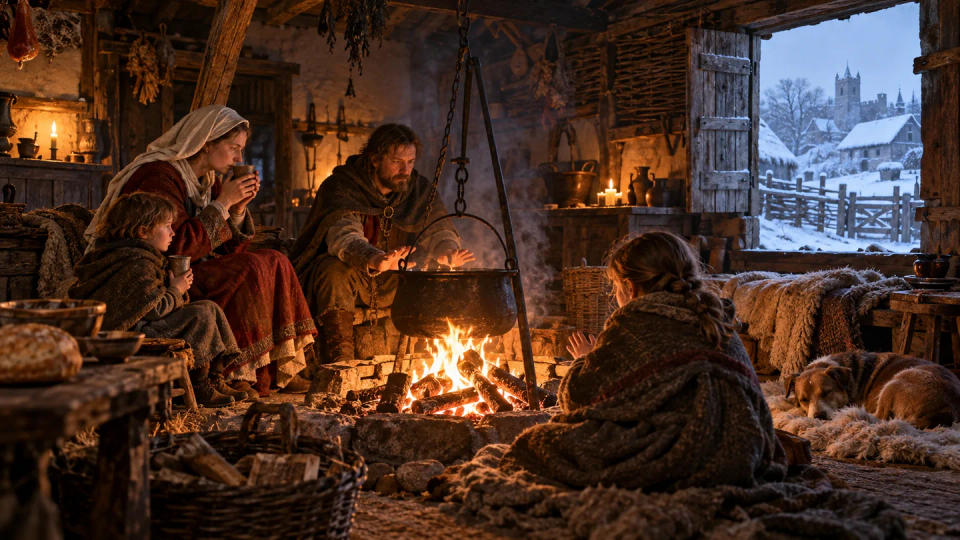
How did people survive a bitter medieval winter when there was no central heating, no insulated glass, and often no chimney? In much of medieval Europe, the answer was not to make an entire building warm. People concentrated heat around the hearth, wore insulating layers, blocked drafts where they could, and gathered in the rooms that were easiest to heat.
There was no single medieval winter experience. A peasant household in England, a merchant family in a town, monks in an abbey, and nobles in a stone castle lived in very different surroundings. But the surviving buildings, textiles, artworks, and household evidence reveal a practical strategy: conserve body heat, keep a fire going, and accept that many indoor spaces would still feel cold by modern standards.
The Hearth Was the Center of Winter Life
For many households, the hearth did several jobs at once. It cooked food, provided light after sunset, dried damp clothing, and created the warmest spot in the house. In medieval English open-hall houses, a large fire often burned on a hearth near the center of the main room. Before chimneys became widespread in ordinary domestic buildings, smoke could rise into the roof space and escape through openings, gaps, or roof vents.
That arrangement sounds uncomfortable, and it often was. A smoky room was the price of keeping a substantial fire indoors. Yet the central hearth also meant that people could sit or work close to the heat rather than trying to warm every corner of the building. The fire created a small zone of relative comfort in an otherwise chilly interior.
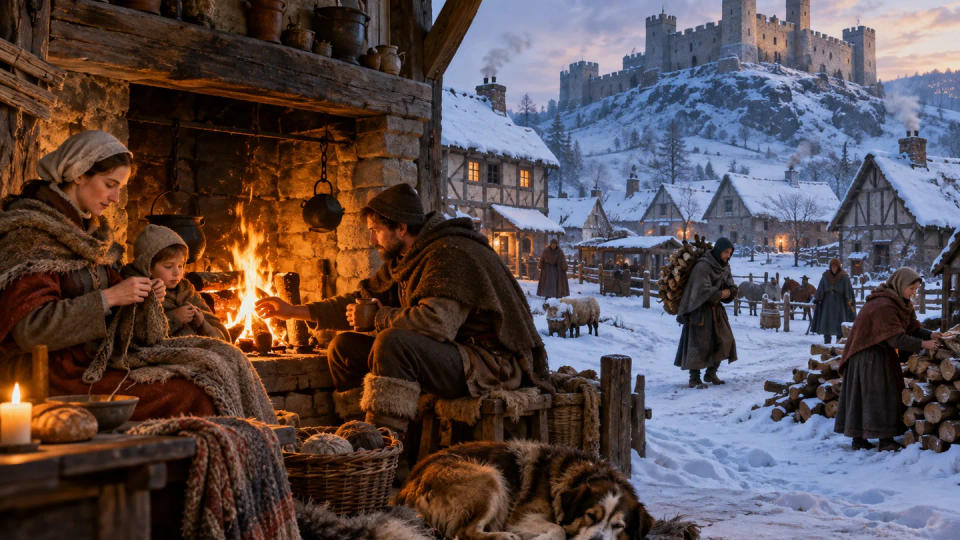
Fuel mattered, too. Wood had to be cut, carried, and stored, and medieval winter imagery often shows people gathering or transporting firewood. Keeping warm was therefore not simply a matter of lighting a fire when snow arrived. It depended on regular labor and access to fuel.
Homes Kept Heat Close Instead of Heating Every Room
Medieval houses were not sealed buildings in the modern sense. Many had shutters rather than glazed windows, and cracks around doors, roofs, and timber framing allowed heat to escape. Even where thick walls reduced wind, they did not automatically make interiors comfortable. Heating was local: the area near the fire was warmest, while corridors, upper spaces, and rooms without a hearth could remain cold.
In wealthier stone buildings, fireplaces became increasingly important. English Heritage notes that the fireplaces at Rochester Castle heated both the chamber and the surrounding stone, improving comfort. At the same time, heavy wall hangings and tapestries helped reduce the chill of bare masonry. A wool tapestry now at The Metropolitan Museum of Art is described as both decorative and practical, helping make stone interiors warmer during colder months.
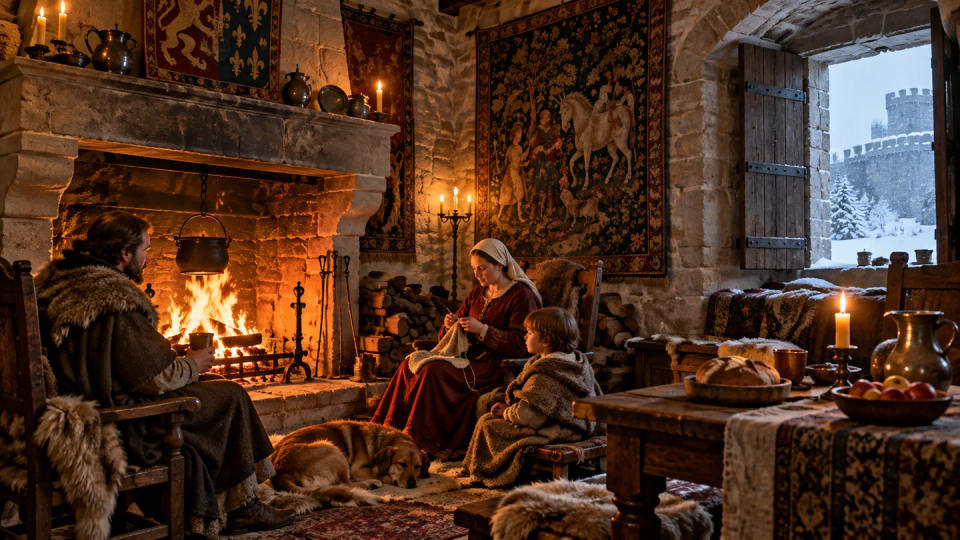
Such furnishings were mainly a solution for households that could afford them. The key point is that medieval people generally tried to make occupied spaces more comfortable rather than maintain an even temperature throughout a whole building. Warmth was concentrated where people ate, worked, rested, and slept.
Wool, Cloaks, and Fur Kept Heat Close to the Body
Because rooms could remain cold, clothing was part of the heating system. Wool was especially valuable because thick woven cloth traps air and continues to provide insulation even when conditions are damp. Medieval people could combine an underlayer with heavier wool garments, hoods, cloaks, hose, and head coverings. The exact cut and quality depended on place, period, occupation, and wealth.
Archaeology gives unusually direct evidence. Finds from early medieval York include thick wool textiles, and York Archaeology describes a cloak-like textile made from two layers of piled wool as well as a wool sock produced with a dense needle-binding technique. These finds come from the Viking-age city of Jorvik, but they illustrate a broader medieval principle: warmth often came from layered textiles worn on the body rather than from a uniformly heated room.
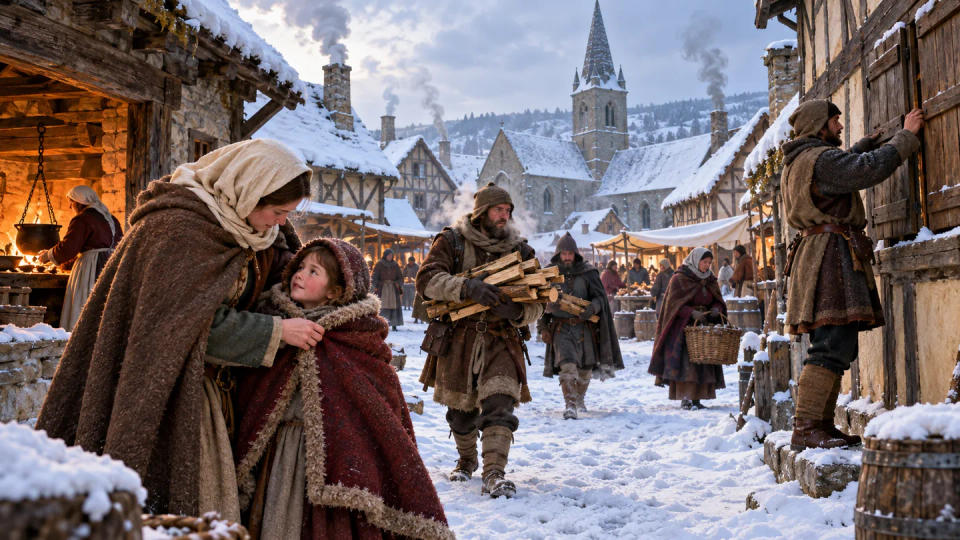
Fur added another level of insulation, especially for people who could afford it. The Victoria and Albert Museum notes that squirrel fur, known as vair, could line rich cloaks, while fourteenth-century English images show elite figures in fur-lined outer garments. Fur was therefore both a practical cold-weather material and, in expensive forms, a visible sign of status.
Castles, Abbeys, and Households Adapted in Different Ways
A medieval castle may look solid enough to defeat winter, but stone keeps could be difficult to heat. English Heritage describes classic castles as challenging winter environments because of stone walls, small or unglazed windows, and inefficient open fires. Large rooms demanded a great deal of fuel, and warmth could vary dramatically within a single chamber.
Monastic communities sometimes treated heated space as a controlled resource. At Rievaulx Abbey, the warming house contained a large double fireplace and was the designated place where monks could seek warmth during the colder season. That detail is a useful reminder that even institutions with substantial buildings did not necessarily heat every room.

Daily routine also shifted with the season. People stayed nearer the fire, worked indoors when possible, used daylight efficiently, and relied more heavily on lamps, candles, and hearth light during long winter evenings. Medieval art repeatedly places winter scenes indoors beside a fire, often showing people warming their hands or feet while food cooks nearby. The image is not merely artistic convention; it reflects how central the hearth was to winter comfort.
Wealth changed the details, but not the basic problem. Rich households could afford more fuel, better rooms, glazed windows in some settings, heavier hangings, and fur-lined clothing. Poorer families had fewer options. For them, warmth depended even more on a working fire, durable wool clothing, and staying close to other people in the most usable part of the house.
Conclusion
Medieval people did not defeat winter by making their homes uniformly warm. They survived it by creating pockets of warmth: a hearth in the hall, wool and fur around the body, shutters and textiles against drafts, and communal spaces where heat was concentrated. Winter indoors could still be smoky, uneven, and cold, but medieval households developed practical ways to make it bearable.
Sources & Further Reading
- English Heritage — 10 Ways of Keeping Warm Through History
- Historic England — Open Fires, Chimneys and Flues
- The Metropolitan Museum of Art — King Arthur (from the Heroes Tapestries)
- Victoria and Albert Museum — An A–Z of Opus Anglicanum
- York Archaeology — Winter in Jorvik