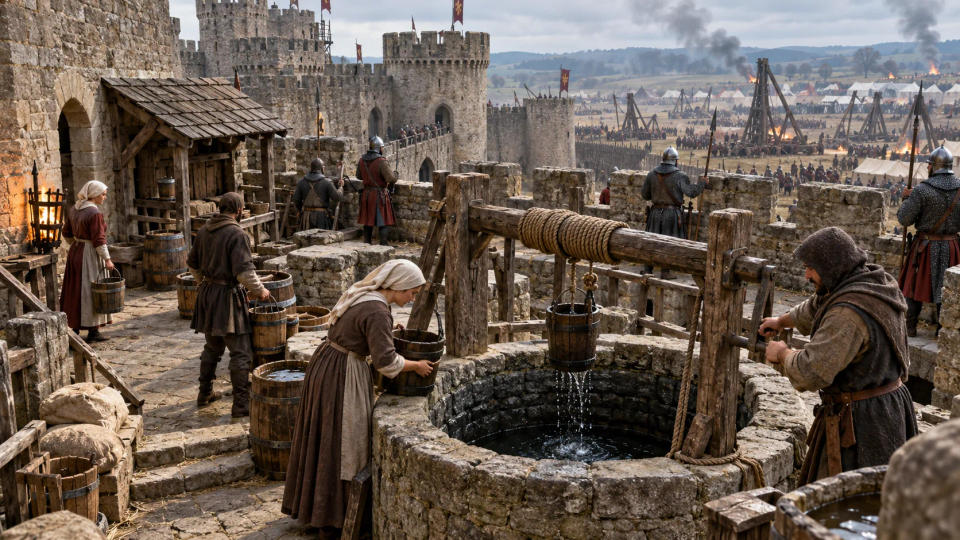
What mattered more during a long siege: thicker walls or a reliable drink of water? For a castle expected to hold out for weeks or months, water could be just as important as stone. Medieval defenders survived by combining deep wells, rainwater cisterns, protected springs or conduits, stored liquids, and strict control of consumption—but these systems could still fail.
That is why water supply was often built into the fortress itself. Attackers could blockade roads, burn crops, foul streams, or cut pipes outside the walls. A castle that depended on a single exposed source might surrender even when its towers were still standing.
The Safest Water Source Was Usually Inside the Walls
The ideal solution was a well inside the defended enclosure. It gave the garrison access to groundwater without sending people outside the gates, where they could be captured or killed. At Eynsford Castle in Kent, English Heritage identifies the surviving well as the castle’s main water supply. Similar wells existed in many fortified sites.
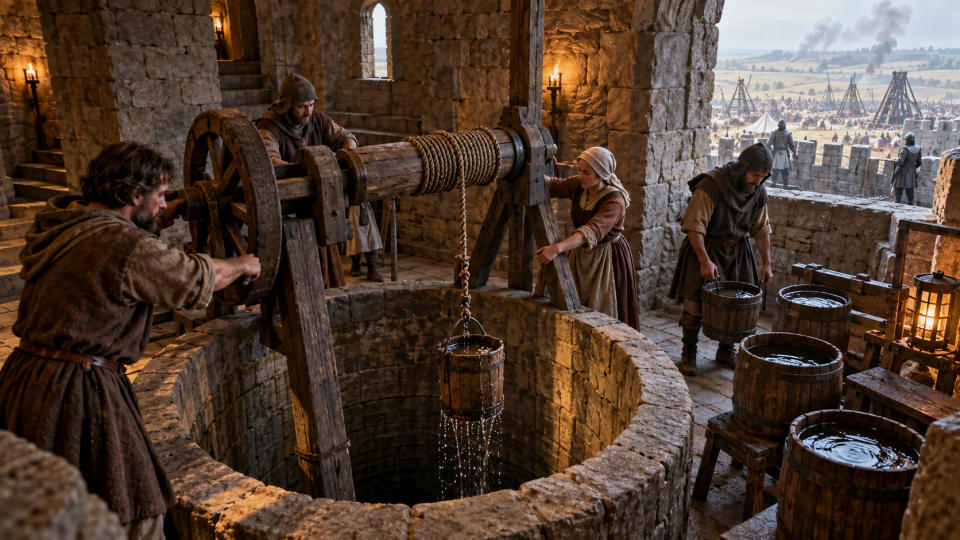
Some wells were engineering projects in their own right. Dover Castle’s great tower contains a well chamber built into the thickness of the wall. English Heritage notes that the shaft descends more than 90 metres to reach the water table below the chalk cliffs. That depth shows the extraordinary effort builders could invest in keeping water accessible inside a major royal fortress.
Dover is especially useful because it was not merely designed for war—it endured it. In 1216, during the First Barons’ War, the castle resisted a siege that continued for roughly four months. We cannot say the well alone saved Dover, because strong defenses, repairs, leadership, supplies, and the attackers’ own difficulties all mattered. Still, a protected water source was exactly the kind of infrastructure a garrison needed if a blockade dragged on.
Where Wells Were Difficult, Castles Collected the Rain
Not every castle stood above an easy supply of groundwater. Hilltop fortresses could be particularly difficult. In those places, builders often turned roofs, courtyards, channels, and plastered tanks into a water-catching system. Rain falling on a large roof could be directed through gutters or drains into underground cisterns, where it was stored for later use.
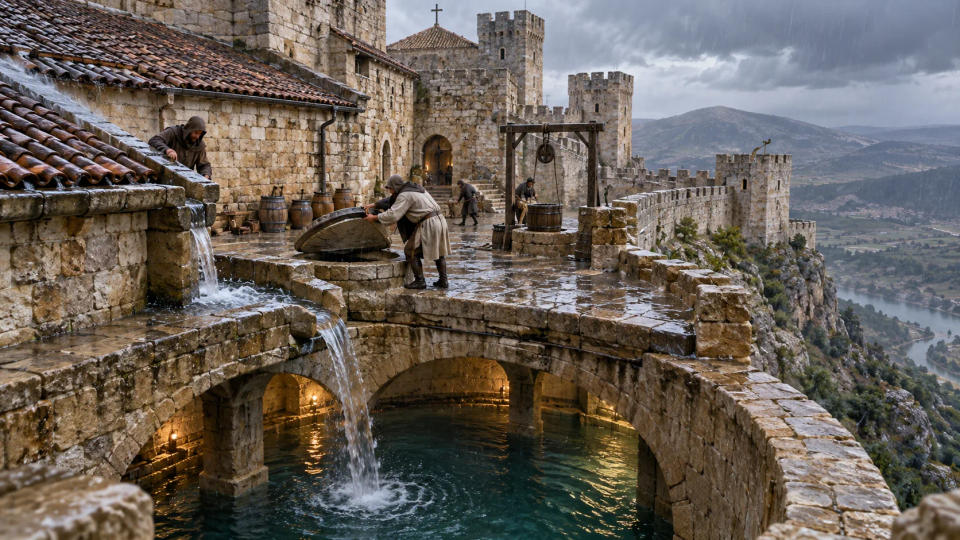
Archaeological research at medieval Safed in the Levant describes cisterns supplied by gutters carrying seasonal rainwater from roofs. Safed had no natural spring within the settlement, so water management was a serious problem as the stronghold grew. Researchers have also identified more ambitious systems in the region, including channels and tunnels connected to spring water.
Crac des Chevaliers, one of the best-preserved Crusader castles, has likewise been the subject of detailed research into its medieval water-management network. The important point is that a cistern was not simply a barrel on a larger scale. It could be integrated into the architecture, lined to reduce leakage, connected to drainage channels, and positioned where stored water remained inside the defended zone.
Castles Tried Not to Depend on Just One Supply
A strong fortress benefited from redundancy. A well could provide groundwater; cisterns could hold rainwater; a protected spring or conduit could add another source. If one system failed, another might keep the garrison alive. This mattered because besiegers understood the value of water just as clearly as defenders did.
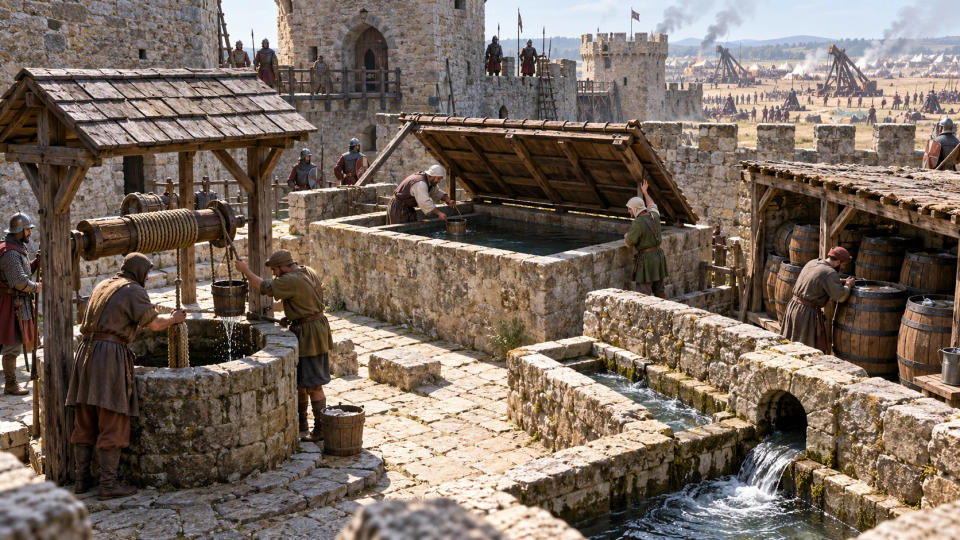
English Heritage’s overview of medieval siege warfare notes that attackers sometimes poisoned or tainted water supplies. Defenders therefore tried to prepare in advance by stockpiling food and water and, where possible, beer and wine as additional drink supplies. The same guidance notes that most castles had wells and cisterns for rainwater.
External pipes and springs were more vulnerable. They could be cut, diverted, contaminated, or brought within reach of an attacking force. Even centuries after the classic age of castle building, the same weakness remained obvious: during the 1646 siege of Goodrich Castle, artillery cut the external spring supply and destroyed water tanks, forcing the defenders to rely on the castle well. The episode is later than the Middle Ages, but it illustrates why medieval designers valued an internal backup so highly.
Water Still Had to Be Managed Once the Gates Closed
Having water inside the walls did not mean unlimited water. A peacetime household could suddenly become a crowded wartime refuge filled with soldiers, servants, animals, and sometimes local civilians. Every additional person or horse increased demand, while washing, cooking, brewing, firefighting, and medical care also consumed water.
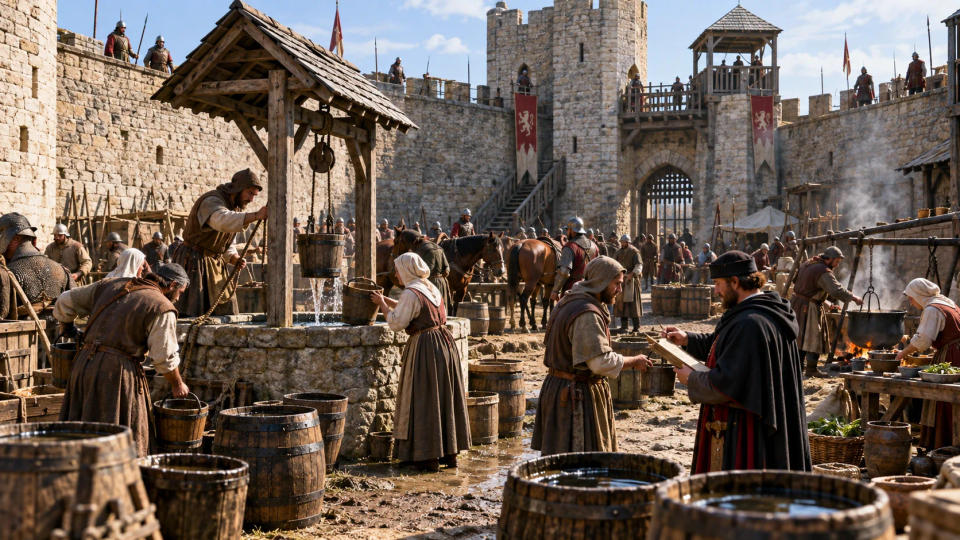
So preparation mattered. Garrison commanders could reduce the number of non-combatants, fill containers before the enemy completed the blockade, protect wells from contamination, and ration stored supplies. Water also had to be kept reasonably clean. Cisterns required maintenance, and channels could carry dirt along with rain. Archaeological work on medieval cisterns shows that waterproof linings and upkeep were part of making storage systems useful over long periods.
Even then, there was no guarantee of survival. A dry season could leave cisterns low. A well might yield too little for an enlarged garrison. Attackers might destroy an aqueduct or capture the area around a spring. Disease could spread if sanitation broke down. In other words, castles did not possess a magical solution to thirst; they survived because their builders tried to make water difficult for an enemy to reach and difficult for a blockade to interrupt.
Why Water Could Decide a Siege Before the Walls Fell
Long sieges are often imagined as contests of trebuchets, towers, and stone walls, but the quieter struggle was logistical. A castle could repair a damaged gate or survive weeks of bombardment, yet a failing water supply created a deadline that masonry could not extend.
The most resilient strongholds therefore treated water as part of the defensive system. Deep wells protected access to groundwater. Roofs and drains fed cisterns. Springs and conduits added capacity when geography allowed. Stored drink and rationing bought time. Together, these measures explain how some medieval garrisons could remain behind closed gates for months while an army waited outside.
Conclusion
Medieval castles survived long sieges by protecting water as carefully as they protected gates and walls. Internal wells, rain-fed cisterns, multiple supply routes, storage, and rationing could keep a garrison going—but if those systems failed, surrender could follow even before an attacker broke through the stone.
Sources & Further Reading
- English Heritage — Medieval Siege Warfare
- English Heritage — Dover Castle Medieval and Early Modern Teachers’ Kit
- English Heritage — Description of Eynsford Castle
- Hebrew University of Jerusalem — Mitigating Water Scarcity in the Medieval and Islamic Periods: The Example of Safed, Israel
- Zsolt Vágner and Zsófia E. Csóka — New Research on the Medieval Water-Management System of Crac des Chevaliers