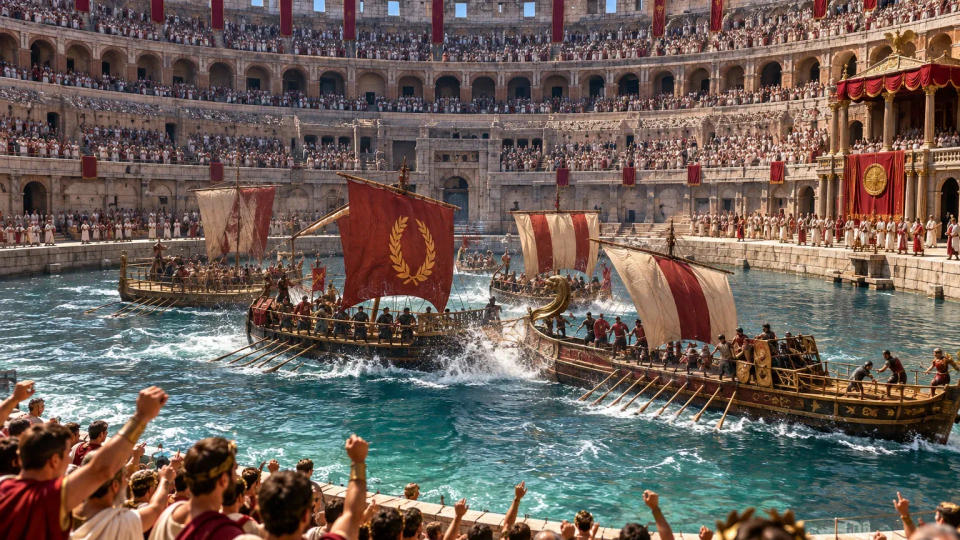
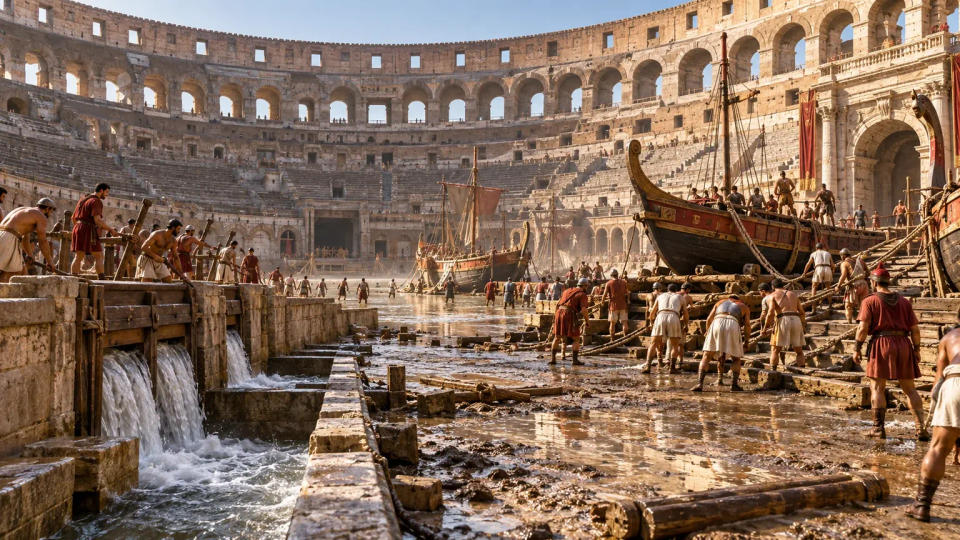
Could Rome’s most famous amphitheater really become a lake? Ancient writers say that during the early years of the Colosseum, spectators saw water spectacles and even staged naval combat inside the arena. The basic claim is well grounded in literary evidence, but the engineering details are still debated.
The most likely picture is not a miniature Mediterranean Sea packed with full-size warships. Instead, the early Colosseum probably used a temporary, relatively shallow flooded arena for specially adapted vessels and aquatic performances before Emperor Domitian rebuilt the underground spaces in masonry. Once the permanent hypogeum filled the area beneath the floor, large-scale flooding of the arena was no longer practical.
What the Ancient Sources Actually Say
The Colosseum, or Flavian Amphitheater, was inaugurated under Emperor Titus in AD 80. The celebrations were famous for their variety, and several ancient authors connect them with water displays. The poet Martial, writing about the inaugural spectacles, described a place where land seemed to turn into sea and then back again. His poems are literary works rather than engineering reports, but they strongly suggest that spectators associated the new amphitheater with dramatic aquatic performances.
Naval spectacles were not invented for the Colosseum. Julius Caesar, Augustus, Claudius, and Nero had all sponsored water-based entertainments before the Flavian amphitheater opened. Some took place in enormous purpose-built basins or lakes, where there was room for large crews and elaborate historical reenactments. That tradition matters because the Colosseum show was part of an existing Roman taste for transforming engineered spaces into temporary worlds.
Cassius Dio, writing much later, gives the clearest account. He says Titus filled the same theater with water and brought in people on ships who fought while impersonating Corcyreans and Corinthians. Suetonius also records naval spectacles under the Flavian emperors, including one presented by Domitian in an amphitheater. The sources are not perfectly simple: Titus also used the older naumachia basin of Augustus for part of his celebrations, so scholars must separate events held there from those held inside the amphitheater. Even so, the combined testimony keeps the flooded-Colosseum tradition firmly in the historical discussion.
How Could the Arena Have Been Flooded?
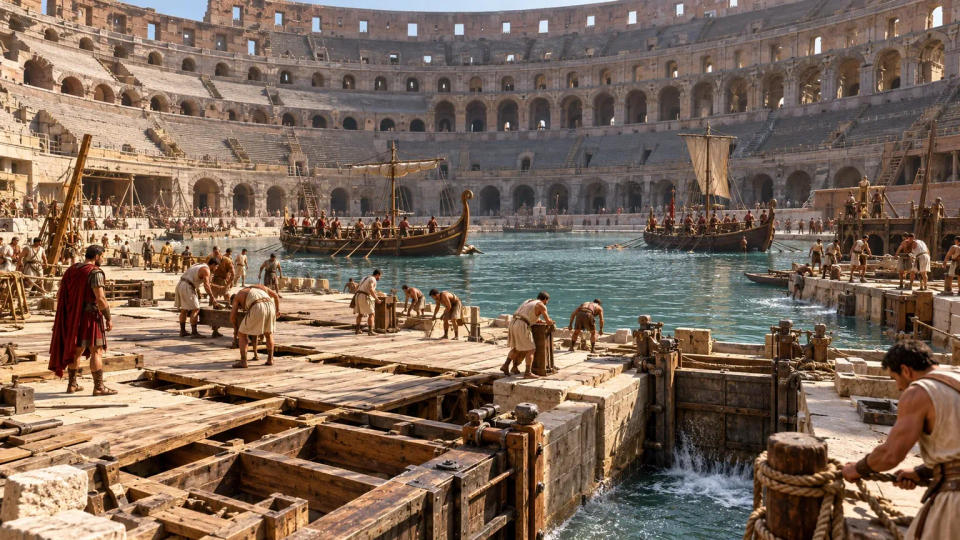
This is where certainty ends. Rome possessed extraordinary water infrastructure, and the Colosseum stood in a low valley that had already contained the artificial lake of Nero’s Domus Aurea. The area was therefore no stranger to water management. Archaeological work has also documented drains, sewers, channels, and service spaces around the monument.
Even so, historians cannot point to one surviving pipe and say, “This is the system that filled the naval arena.” The Archaeological Park of the Colosseum has explicitly described the hydraulic question as unresolved. Researchers continue to compare literary evidence with the remains of drains and underground structures, but later rebuilding destroyed or altered much of the earliest arrangement.
The simplest reconstruction is that the arena floor of the inaugural phase differed significantly from the one visitors imagine today. The earliest underground structures were largely wooden. That would have made it easier to create temporary spaces, basins, platforms, or channels and later remove or rebuild them. Water could then be admitted into a sealed or partly sealed arena and drained after the show. Exactly how fast this happened, and which water source supplied it, remain open questions.
What Did a Colosseum Naval Battle Look Like?
Roman naval spectacles were called naumachiae. Elsewhere in the Roman world, emperors staged enormous mock sea battles in purpose-built basins or natural lakes, sometimes involving thousands of participants. Those events could recreate famous conflicts using teams named after historical naval powers.
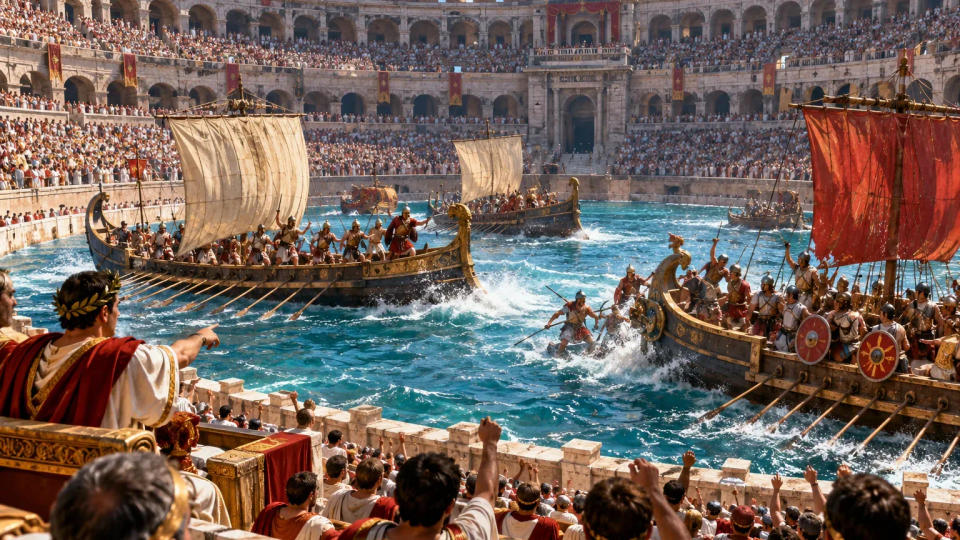
The Colosseum was different because its arena was much smaller than the great basins built specifically for naval displays. That makes full-scale triremes and massive fleet maneuvers unlikely. The vessels used inside the amphitheater were probably smaller or specially adapted for the confined space. The surviving texts do not give dimensions, so any exact reconstruction of the ships is speculative.
The spectacle was probably as theatrical as it was military. Audiences could watch crews row, ram, board, and fight at close range, surrounded by scenery and imperial ceremony. Martial also refers to aquatic performances involving mythological themes. In other words, water inside the Colosseum may have supported several kinds of entertainment, from choreographed displays to staged combat.
Naumachiae elsewhere could be lethal rather than harmless pageants. Ancient accounts describe condemned men, captives, or other forced participants fighting under staged ethnic or historical identities. The Colosseum sources do not provide enough detail to reconstruct every participant or outcome, so it is safer not to assume that every aquatic show followed the same rules. What they do reveal is the Roman appetite for spectacles that blurred theater, warfare, engineering, and imperial propaganda.
Why the Naval Battles Did Not Last
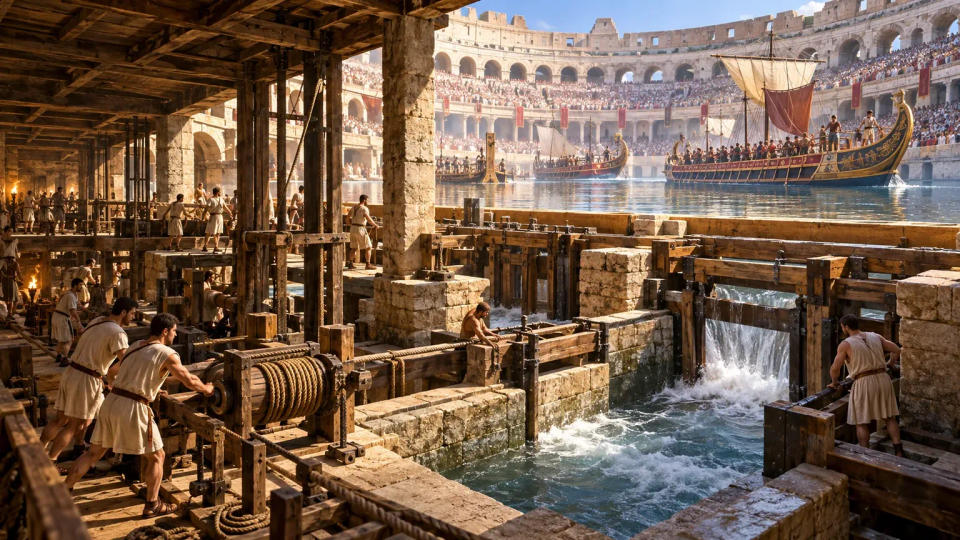
The decisive change came under Domitian, Titus’s younger brother and successor. The spaces beneath the arena were transformed into the permanent masonry hypogeum: a dense network of corridors, rooms, lifts, trapdoors, and machinery used to move animals, people, and stage equipment. The official Archaeological Park notes that once the wooden arena arrangement was replaced by masonry, water shows were no longer held there.
This makes practical sense. A deep network of masonry service corridors is extremely useful for spectacular entrances, but very inconvenient if the entire floor above must repeatedly become a basin. From then on, the Colosseum specialized in the effects for which it became famous: sudden appearances through trapdoors, animal hunts, executions, staged scenery, and gladiatorial combat.
Domitian still staged naval battles, but sources indicate that he also used a separate basin near the Tiber for larger displays. That solution avoided the limitations of the amphitheater and better suited spectacles involving something closer to real fleets. The Colosseum’s brief aquatic phase therefore seems to belong mainly to its earliest decades, before the underground complex reached its later form.
Conclusion
The Romans probably did turn the early Colosseum into a temporary water arena, but the most dramatic modern images go beyond what the evidence can prove. Ancient writers describe ships and flooding, while archaeology shows that the building’s first underground phase was different from the later hypogeum. What remains uncertain is the exact plumbing, water depth, and vessel size. That uncertainty makes the engineering no less impressive: for a short period, Rome’s new amphitheater appears to have been designed not just for blood and sand, but for water as well.
Sources & Further Reading
- Parco archeologico del Colosseo — The underground levels of the Colosseum
- Parco archeologico del Colosseo — Exploration of the ancient sewer system of the Colosseum
- Parco archeologico del Colosseo — Blood and the Arena
- Cassius Dio, Roman History, Book 66
- Suetonius, Life of Domitian