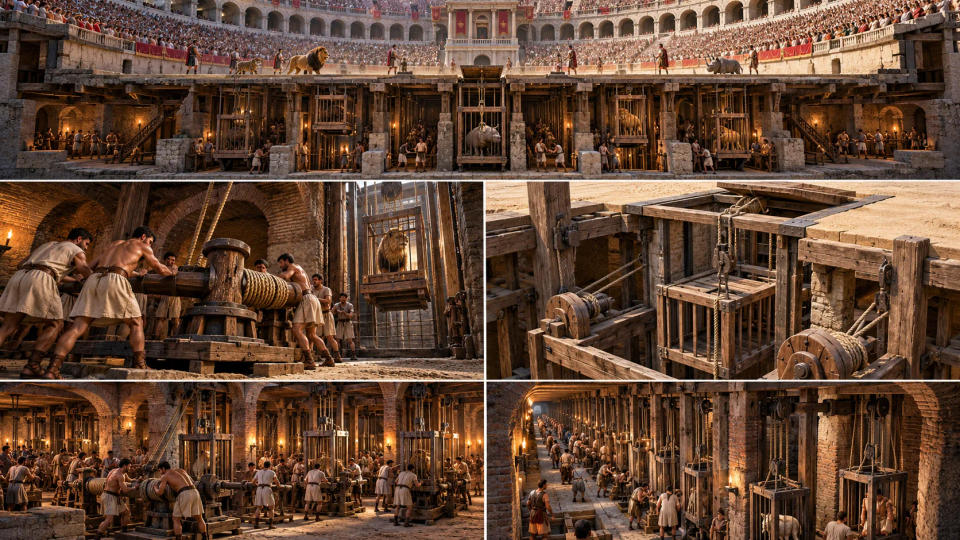
What looked like a sudden miracle in the Colosseum was often the result of hard labor in the darkness below. A lion, a hunter, or a piece of scenery could seem to rise straight out of the arena floor because Roman engineers had built a network of lifts, trapdoors, winches, ropes, and platforms beneath the sand.
These were not elevators in the modern sense. There were no buttons, electric motors, or enclosed passenger cabins. They were human-powered lifting machines, closer to freight hoists than to today's elevators. Yet their purpose was unmistakably similar: move people, animals, and heavy objects vertically from one level to another. Nearly 2,000 years ago, the Colosseum was using this technology as part of an extraordinarily complex backstage system.
The Hidden Machine Beneath the Arena
The Colosseum opened in AD 80 under the emperor Titus, but the underground world visible today developed in stages. The Archaeological Park of the Colosseum says the earliest subterranean installations were made largely of wood for the inaugural period. Under Domitian, Titus's brother and successor, the underground area was rebuilt more permanently in masonry.
This space is now known as the hypogeum. It extended beneath the arena for roughly half a hectare and included a large central corridor with 14 side passages arranged around it. The arena floor above stood about six meters higher than parts of these underground corridors. That vertical gap created both a problem and an opportunity: performers and animals had to reach the arena somehow, but if they could be raised through hidden openings, their entrances could become part of the show.
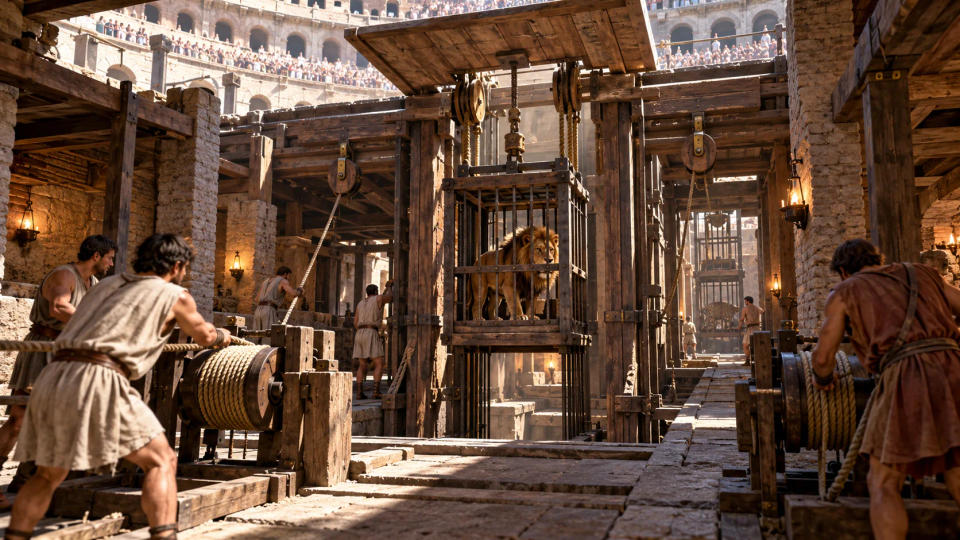
The arena floor therefore functioned much like a stage. Trapdoors concealed openings, while the machinery remained below the spectators' line of sight. Animals could wait in cages, props could be prepared underground, and workers could coordinate their appearance at the right moment. What the audience saw as spectacle depended on a crowded technical world they could not see.
How a Roman “Elevator” Actually Worked
Archaeology provides many of the clues. Researchers studying the hypogeum found vertical channels, holes, grooves, beam sockets, and semicircular cuttings in the masonry. These traces helped reconstruct where timber structures, cages, capstans, pulleys, and ramps had once stood.
One important component was the capstan: a vertical wooden shaft fitted with horizontal bars. Workers pushed the bars while walking around the shaft. As it turned, rope wound around the mechanism and transferred force through a pulley system. That lifting force raised a cage or platform upward through a shaft beneath the arena.
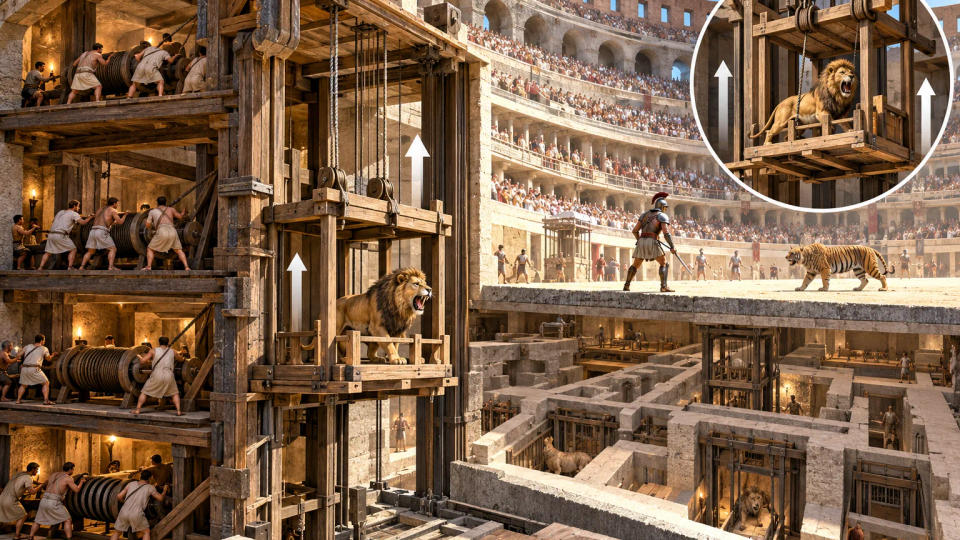
The mechanical principle was simple, but the system was not. Ropes had to run through the right path, wooden frames had to guide the moving load, and the top opening had to remain safely closed until the right moment. In reconstructions of the animal-lift system, the rising cage could interact with a trapdoor and ramp so that an animal could move from the cage into the arena once the platform reached the top.
That is why calling these devices “elevators” is useful as long as the comparison is not taken too literally. They performed vertical transport, but they depended on human muscle, timber engineering, mechanical advantage, and careful timing.
It Took an Army of Workers to Run the Show
The scale becomes clearer when the numbers are added. The Colosseum's official archaeological park documents 28 winches connected with 28 animal freight lifts during the Flavian period. These were positioned along one of the curved underground corridors. To operate all 28 at the same time, 224 workers were required—eight for each winch.
Elsewhere in the central corridor, 20 mobile platforms could raise scenery used for wild-animal hunts and executions. The spectacle above the arena therefore depended on far more than gladiators and animals. Below the floor, crews had to move cages, prepare props, control ropes, turn machinery, and respond to cues.
Imagine the difficulty of coordinating several lifts in a dark, noisy underground space while a vast crowd waited above. The machinery did not have to be fast by modern standards. It had to be reliable enough to deliver a dramatic entrance without revealing the preparation.
That hidden labor helps explain why the Colosseum was more than a building. It was also a performance machine. Architecture, manpower, animal handling, stagecraft, and mechanical engineering were all connected.
The Lift System Changed Over Time
The underground machinery was not frozen in one design for centuries. The Colosseum itself suffered damage, repair, and reconstruction. A major fire in AD 217 damaged the monument and contributed to years of closure before it reopened, and the hypogeum was rebuilt and altered more than once.
By the Severan period and afterward, the earlier arrangement was replaced by a different system in the straight corridors. The Colosseum's archaeological park describes 60 smaller lifts capable of raising both people and animals. This later system used lead winches, counterweights of different sizes, ropes, and pulleys set into travertine supports.
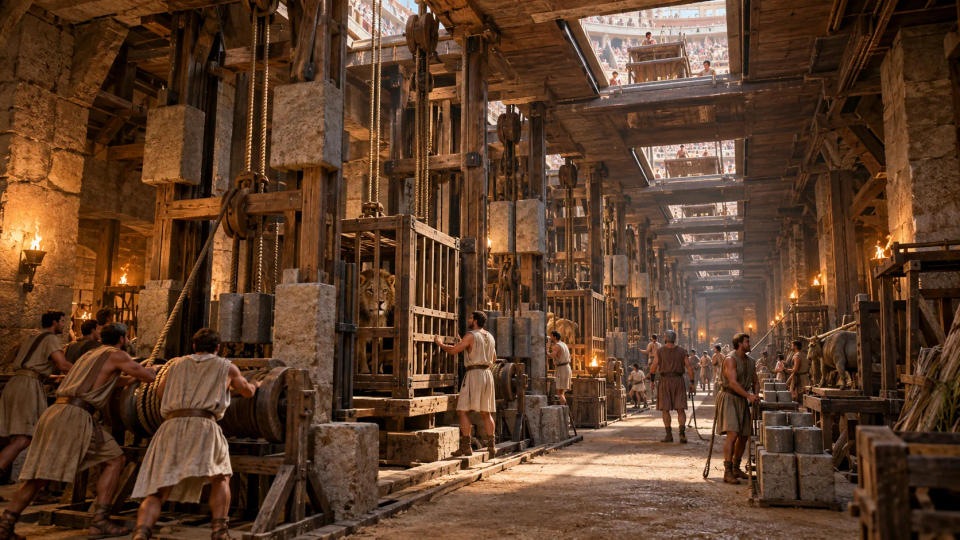
The increase from 28 earlier animal lifts to a later network of 60 smaller lifting points suggests that the underground stage machinery became denser and more flexible. It also shows why historians must be careful when describing “the Colosseum elevator.” There was not a single machine used unchanged from opening day to the final games. There were different systems installed and modified across different phases of the amphitheater's long working life.
Modern experimental archaeology has helped turn those traces into something easier to understand. In a PBS NOVA project, researchers and engineers built a full-scale reconstruction based on archaeological evidence from the hypogeum. The machine used a capstan, ropes, pulleys, a cage, and a trapdoor system. In 2015, the reconstruction raised a wolf to arena level, demonstrating how a human-powered mechanism could reproduce one of the Colosseum's most famous effects.
The experiment did not prove that every ancient lift worked in exactly the same way. What it showed was that the archaeological evidence can be assembled into a functioning machine consistent with Roman technology. The grooves and holes in the surviving masonry are not just scars in an old ruin; they are clues to a sophisticated backstage system.
Conclusion
The Colosseum's “elevators” were not futuristic inventions dropped into ancient Rome. They were clever combinations of familiar technologies—wooden frames, ropes, pulleys, capstans, counterweights, trapdoors, and organized human labor. Their real achievement was scale. Dozens of lifting points turned the underground hypogeum into a mechanical stage capable of producing sudden, theatrical entrances almost 2,000 years before modern stadium machinery.
Sources & Further Reading
- Parco archeologico del Colosseo — Elevators and platforms, or the machinery behind the show
- Parco archeologico del Colosseo — The underground levels of the Colosseum
- PBS NOVA — Colosseum: Roman Death Trap
- The Metropolitan Museum of Art — Theater and Amphitheater in the Roman World
- Smithsonian Magazine — How Ancient Romans Got Wild Animals Into the Colosseum