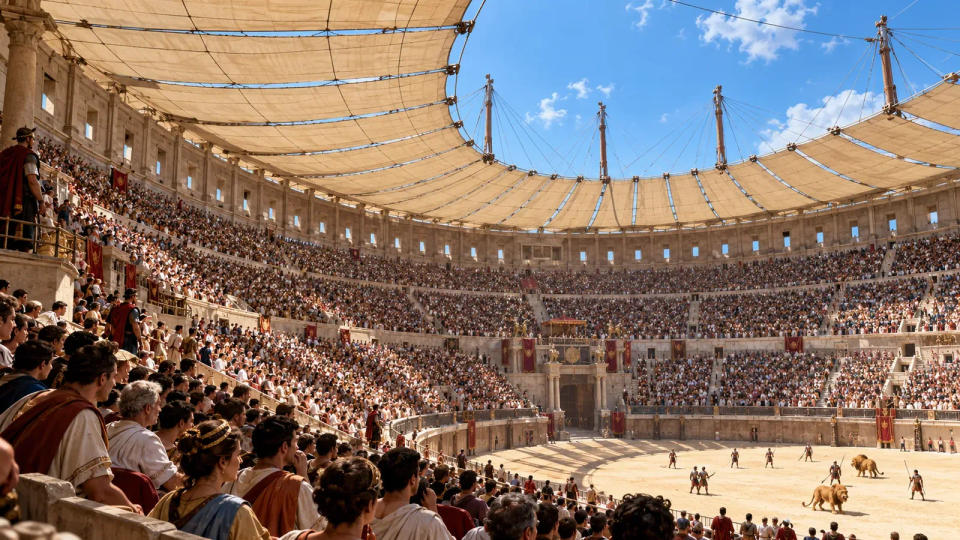
On a hot Roman afternoon, how could tens of thousands of spectators sit inside a vast stone amphitheater for hours without simply roasting in the sun? The answer was not anything like modern air conditioning. The Romans attacked the biggest problem first: direct solar heat.
The Colosseum used a huge retractable fabric awning called the velarium to shade much of the seating. Skilled sailors handled its ropes and rigging, while fountains inside the building supplied water to spectators. Roman entertainment venues could also use fine sprays of scented water, although the exact arrangement at the Colosseum is less certain than the awning itself. Together, these measures made a crowd often estimated at around 50,000 people considerably more comfortable.
The Velarium Was the Colosseum’s Main Defense Against the Sun
The most important cooling technology was surprisingly simple in principle: put a giant shade over the audience. The velarium was a system of fabric panels suspended above the seating tiers rather than a permanent solid roof. Ancient Roman theaters and amphitheaters commonly used such awnings, and the Colosseum represented the idea on an enormous scale.
Blocking sunlight mattered because the spectators sat on stone and marble surfaces that absorbed heat throughout the day. Shade could not lower Rome’s outdoor temperature, but it could sharply reduce the radiant heat falling directly on people and seats. For someone sitting through hours of animal hunts, gladiatorial contests, ceremonies, and other spectacles, that difference would have been substantial.
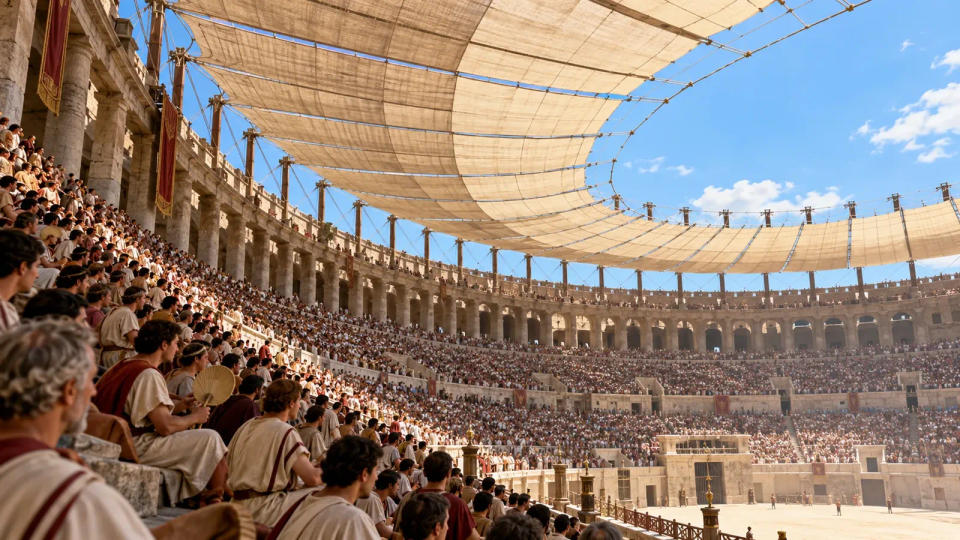
The canopy was not simply a cloth lid stretched flat across the whole amphitheater. Its exact shape is still debated, but reconstructions generally leave a large opening over the arena and arrange the fabric around the seating. That makes sense structurally and practically: the spectators needed shade, while the central performance space required light and visibility.
Roman Sailors Operated a Roof That Behaved Like a Giant Sail
A canopy this large was not something a few attendants could pull open with a single rope. The Colosseum’s upper structure included supports for a complex rigging system of masts, ropes, and pulleys. The surviving architecture shows how deeply the awning system was integrated into the building itself, even though the original timber, rope, and fabric are long gone.
The people chosen to operate it were sailors. The Archaeological Park of the Colosseum identifies the nearby Castra Misenatium as barracks for sailors from the imperial fleet at Misenum who were responsible for maneuvering the velum. That choice was practical. Sailors already understood heavy fabric, tensioned ropes, changing wind, coordinated hauling, and the danger of a large surface suddenly catching a gust.
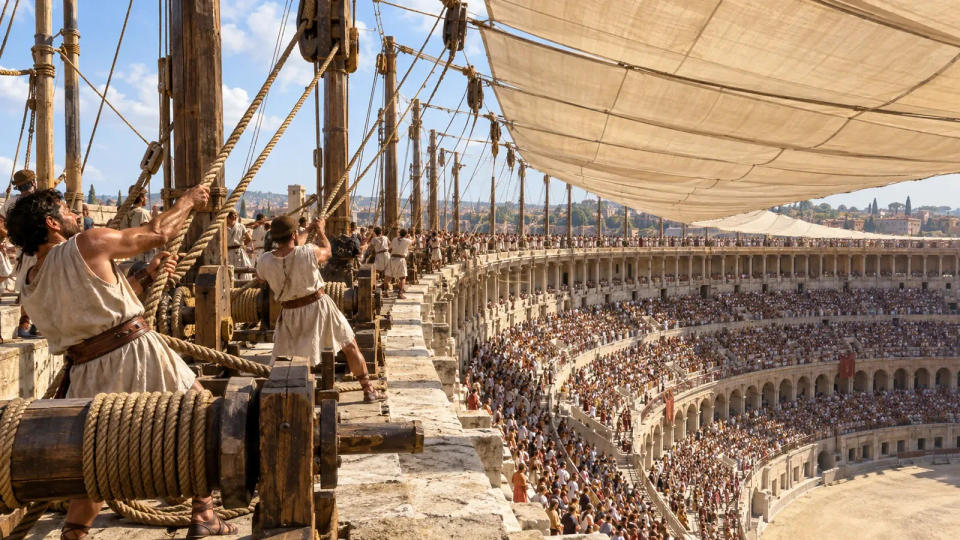
Modern reconstructions differ on exactly how the ropes were arranged and how much of the building was covered at one time. That uncertainty is important. We know the Colosseum had the awning and that sailors operated it, but there is no surviving Roman instruction manual explaining every knot, pulley, and deployment sequence.
The Colosseum Stayed Open to the Air Instead of Becoming a Heat Trap
The velarium worked because it provided shade without turning the amphitheater into an enclosed building. The Colosseum’s center remained open, and its enormous arcades, corridors, entrances, and upper openings connected the seating bowl with the outside air.
That mattered in a Mediterranean climate. A solid roof over a packed crowd would have trapped heat, odors, and moisture. A textile shade could block much of the sun while still allowing outdoor air to move through the structure. Some modern reconstructions suggest particular canopy shapes may also have helped channel breezes, but the precise aerodynamic behavior of the original system cannot be demonstrated with certainty.
The Romans therefore solved the problem less by “making cold air” and more by reducing heat gain while keeping the venue ventilated. In modern terms, it was passive environmental control: shade first, airflow second, and no attempt to seal the space from the weather.
Water Fountains Helped Thousands of Spectators Cope With the Heat
Shade was only part of the comfort system. Excavation evidence shows that water was available inside the Colosseum. The Archaeological Park notes that fountains were placed along walkways up to the third tier, giving spectators access to water during long events.
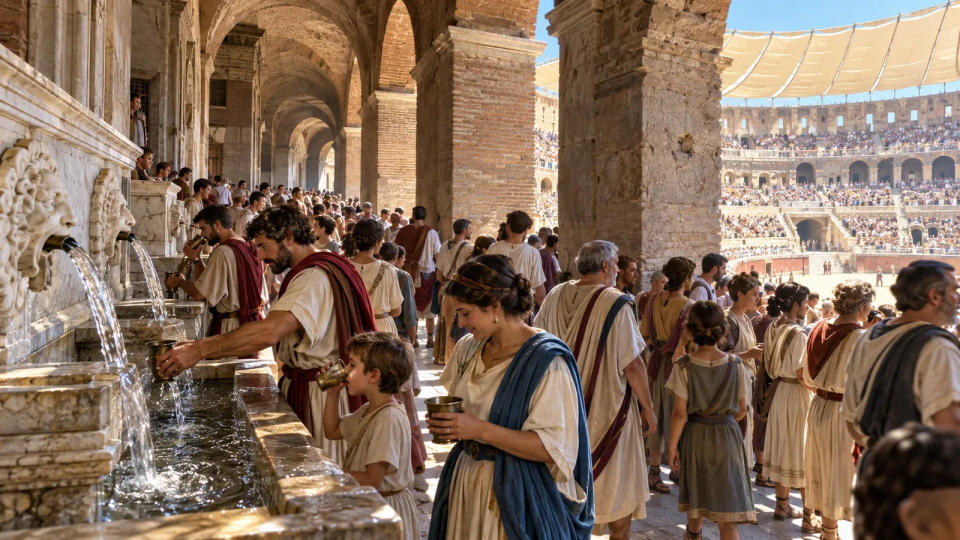
Roman spectacle culture also knew another cooling luxury called sparsiones: fine sprays or mist-like sprinklings of water, sometimes perfumed. Ancient and later historical sources describe these at theaters, amphitheaters, and other entertainment venues. They could refresh the air and the audience, especially when combined with awnings.
However, it is safer not to imagine the Colosseum as permanently equipped with a modern-style misting system. The practice of sparsiones is well documented in Roman entertainment, but the precise machinery and frequency of use at the Colosseum are not securely reconstructed. The drinking fountains are much firmer evidence for everyday spectator comfort.
What “Cooling 50,000 People” Really Meant in Ancient Rome
The familiar figure of 50,000 spectators is an estimate rather than a surviving turnstile count. Official and scholarly reconstructions vary, with some estimates running somewhat higher. Even so, the scale is clear: the Colosseum had to manage a crowd comparable to a modern stadium.
What is remarkable is how the Romans approached that problem without mechanical refrigeration. They used temporary textile architecture to create shade, naval expertise to operate it, an open building form that did not imprison hot air, and an internal water supply to support the crowd. The system would not have made a July afternoon feel cool by modern standards, but it could make the difference between sitting in direct sun and sitting beneath a vast moving canopy.
It also reveals something broader about Roman engineering. The Colosseum was not only a monument built to impress from the outside. Its designers had to think about how real people entered, found seats, drank water, endured heat, watched for hours, and eventually left. Comfort was part of making mass spectacle possible.
Conclusion
The Romans kept Colosseum crowds cooler mainly by shading them. The giant velarium, operated by sailors skilled in rigging, protected much of the seating from direct sun while leaving the amphitheater open to the air. Fountains added a reliable source of water, and Roman venues sometimes used scented sprays as an extra luxury. The exact canopy geometry remains debated, but the basic idea is clear: Rome’s answer to stadium heat was not air conditioning. It was intelligent shade, ventilation, water, and a very large amount of rope.
Sources & Further Reading
- Parco archeologico del Colosseo — Spectacles in the Colosseum Arena
- Parco archeologico del Colosseo — Life in the Stands
- Roma Capitale tourism portal — The Flavian Amphitheatre
- Energy and Buildings — “Velaria” in Ancient Roman Theatres
- Treccani — Sparsione