
How could Broadway become America’s theatrical capital when some of its busiest blocks stood near one of New York’s most notorious vice districts? It did not survive by waiting for the Tenderloin to disappear. Theaters, hotels, music publishers, and illicit nightlife grew in overlapping neighborhoods; Broadway then followed audiences and transportation north, while the old streets changed around it.
The history is less a simple victory of respectability over scandal than a story about how a city sells an evening out—and how an entertainment district can keep changing its address.
The Tenderloin Was More Than a Red-Light District
In the final decades of the nineteenth century, the Tenderloin covered a shifting stretch of midtown Manhattan generally west of Fifth Avenue, around the streets above Madison Square. Its borders were never as neat as a modern tourist map. It earned a reputation for prostitution, gambling, saloons, and political corruption, but its buildings also contained hotels, family homes, shops, and theaters.
The district’s nickname has often been attributed to police captain Alexander S. Williams, who supposedly compared the lucrative precinct to a choice cut of beef. The wording of his remark is traditionally reported rather than an independently verified transcript. What matters more than the anecdote is what the nickname conveyed: policing and protection money were entangled with nightlife.
For landlords and entrepreneurs, proximity to a theater was valuable. Performances drew people into the streets after working hours. Restaurants and hotels followed that traffic; other businesses, legal and illegal, sought the same customers. The Fashion District’s published history describes theater construction between 1870 and 1900 as an important early attraction for the sex trade in the area.
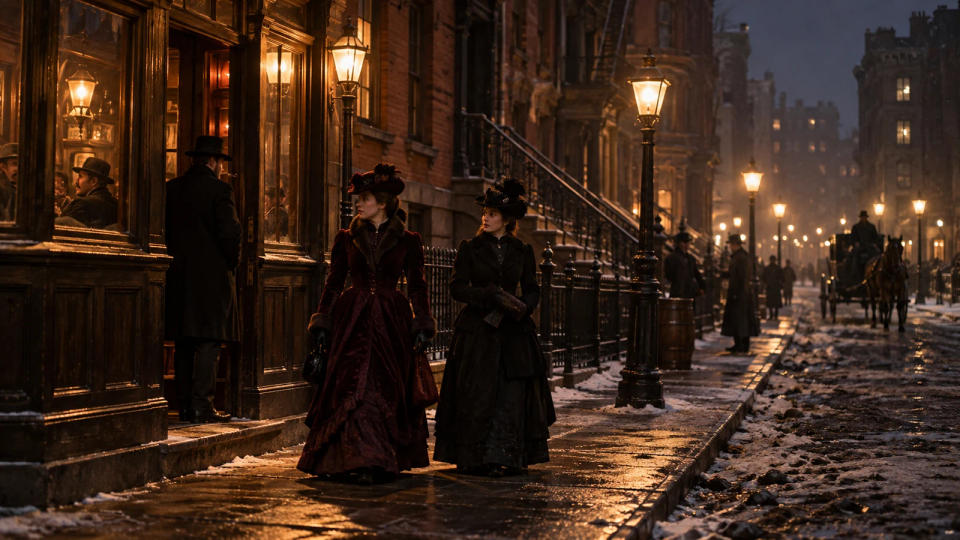
That overlap did not make every theater a brothel, or every visitor part of a single nightlife crowd. Venues differed in price, purpose, and social rules. A family choosing an evening play, a visitor entering a concert saloon, and a worker living nearby might occupy adjacent blocks without sharing the same experience.
Theaters and Tin Pan Alley Shared an Economy
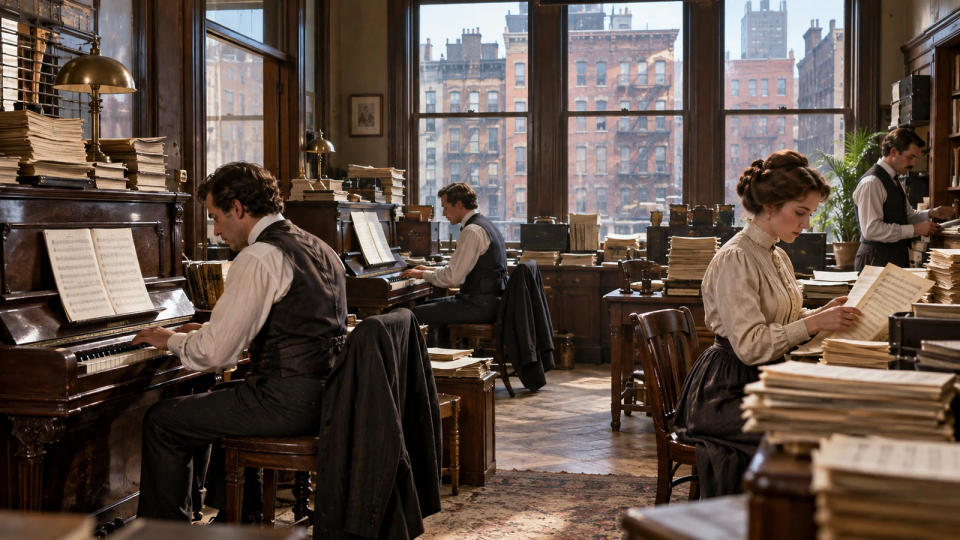
One of the district’s most consequential neighbors was Tin Pan Alley, the cluster of music publishers on West 28th Street between Sixth Avenue and Broadway. From roughly 1893 to 1910, publishers occupied converted row houses there, employing composers, arrangers, printers, and promoters. Songs were demonstrated on pianos and sold as sheet music to households long before recorded music became the dominant format.
In modern terms, those firms connected content creation, advertising, and distribution in one small area. A song heard in a theater or music hall might create demand for printed music; a publisher, in turn, needed entertainers and public venues to make a tune familiar. The link between commercial music and live performance was an economic connection, not evidence that all neighboring businesses operated together.
New York City designated five surviving buildings from the publishing block as landmarks in 2019. They preserve a reminder that this landscape of supposed scandal also helped develop American popular music. The story includes Black and Jewish musicians and publishers whose work reached wide audiences while racial discrimination and degrading minstrel stereotypes remained entrenched in the entertainment business.
That contradiction matters. A booming cultural industry did not mean an equal or welcoming city. Broadway’s growth created opportunities, but access to stages, lodging, wages, and audiences was sharply unequal.
Broadway Moved Toward the Subway—and Times Square
The decisive change was not a single police raid. Theater-building had already shifted north from Union Square and Madison Square. Developers found room for larger venues around Longacre Square, an area formerly associated with horses and carriage businesses. Oscar Hammerstein I’s Olympia opened in 1895 near Broadway and 44th Street; the New Amsterdam and Lyceum theaters followed in 1903.
Transportation made the new address increasingly attractive. Subway access meant a show no longer depended only on people who lived or worked close to it. The Museum of the City of New York reports that the Times Square station handled nearly five million passengers in 1905, its first full year of operation.
In April 1904, the city renamed Longacre Square as Times Square, anticipating the newspaper’s move into its tower, completed for occupancy in early 1905. Electric theater signs helped transform the neighborhood’s nighttime image. By World War I, most major legitimate theaters had relocated toward Times Square from older districts farther downtown.
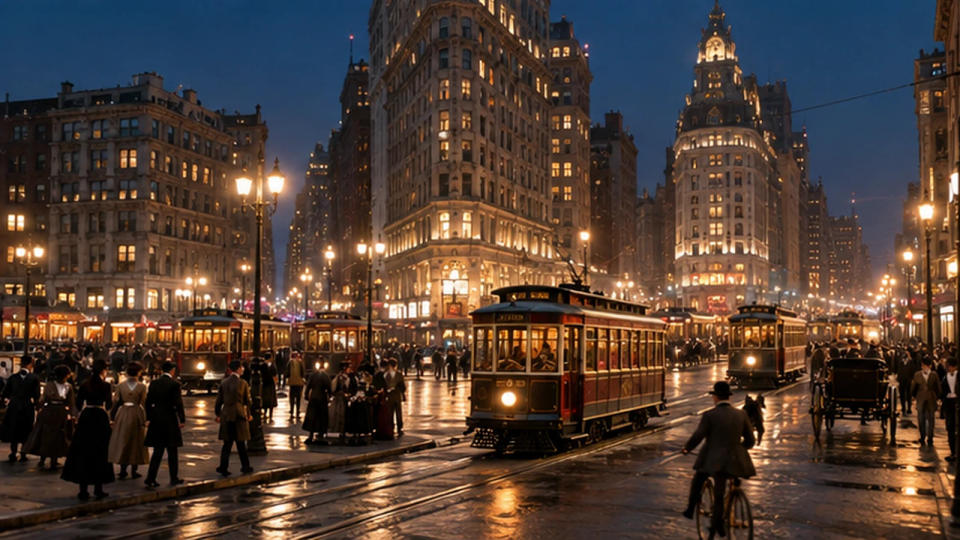
Broadway therefore survived partly by moving. The street itself did not relocate, of course. The business called “Broadway”—a shifting concentration of theaters, producers, performers, and audiences—followed new transit patterns and real-estate opportunities. Its neighbors included respectable hotels and restaurants as well as businesses with much rougher reputations. The new district was never entirely free of vice.
What Happened to the Tenderloin—and Why Survival Was Not Permanent
The older Tenderloin was transformed by more than changing public taste. In the first decades of the twentieth century, garment manufacturers and real-estate developers moved into the blocks west of Broadway. Brownstone houses gave way to garment lofts. According to the Garment District’s historical account, this change in property use had by about 1919 altered the old vice district far more thoroughly than many earlier campaigns against prostitution.
It would be misleading, however, to say that Broadway became a clean entertainment sanctuary once the Tenderloin faded. Times Square later developed its own adult-business economy. Depression-era economic pressure, the rise of motion pictures, and the conversion of some theaters changed the district again. By the 1970s, prostitution, pornography, and street crime had become central concerns in public discussion of the area.
Broadway’s second survival required preservation as well as reinvention. In the late twentieth century, activists fought the demolition of historic theaters, and the city adopted landmark protections and zoning measures. The New Amsterdam became a city landmark in 1982. Theater restorations and major commercial redevelopment in the 1990s helped make Times Square a powerful tourist destination, though they also raised questions about what kinds of businesses and communities were being displaced.
Conclusion. Broadway outlasted the Tenderloin because it was never just a fixed collection of buildings in a notorious neighborhood. It was a network of stages, workers, audiences, music businesses, transportation, and investment that repeatedly reorganized itself. The red-light district was part of that complicated urban world—not a single villain that Broadway defeated once and for all.
Sources & Further Reading
- Museum of the City of New York — From Dazzling to Dirty and Back Again: A Brief History of Times Square
- Garment District NYC — A Stitch in Time: A History of New York’s Fashion District
- NYC Landmarks Preservation Commission — Designates Five Historic Buildings Associated with Tin Pan Alley
- New York Preservation Archive Project — Theater District
- Johns Hopkins University Libraries — Mapping Tin Pan Alley