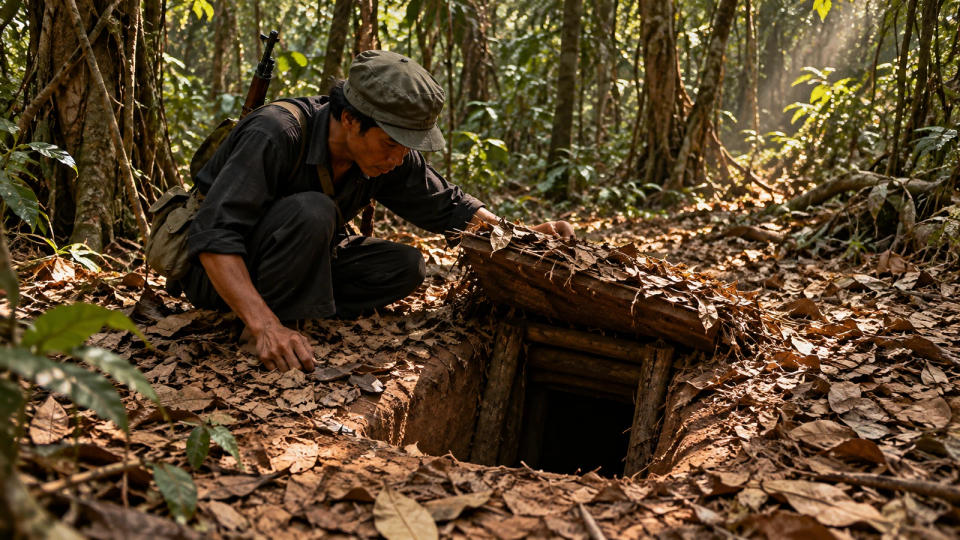
How could a largely hand-dug network of passages withstand the attention of one of the world's most heavily equipped armies? Beneath the countryside northwest of Saigon, Vietnamese villagers and guerrillas built the Cu Chi tunnels over decades, turning scattered hiding places into a concealed system for movement, shelter, supplies and military operations. Its strength came not from concrete fortifications or sophisticated machinery, but from local labor, suitable soil and an intimate knowledge of the landscape.
Calling the complex a “secret underground fortress” captures its wartime role, but it can also mislead. This was not one enormous empty cavern or a single construction project. It was an evolving network with different kinds of spaces, and its survival came at a severe human cost.
From Village Hideouts to an Underground Stronghold
The tunnel story began before the American combat buildup of the 1960s. Vietnamese heritage records trace the first shelters in the Cu Chi area to the struggle against French colonial rule in the late 1940s. Around Tan Phu Trung and Phuoc Vinh An, short passages initially concealed resistance workers, documents and equipment. These were local hiding places, not yet the elaborate complex later associated with the Vietnam War.
As neighboring settlements connected their passages and the conflict changed, the system grew. Local civilians and communist-led fighters—the National Liberation Front's guerrillas, widely known as the Viet Cong—helped extend it. Beginning in the early 1960s, Cu Chi's importance as an operating area near Saigon encouraged further enlargement and fortification. A route between two hiding places could become a route between villages, then part of a wider military network.
That gradual history matters. Building underground was neither an overnight trick nor a uniquely American-war invention. The local population had been adjusting its shelters and defenses for years, and expansion answered a practical problem: how to remain in an area subjected to patrols, bombardment and repeated attacks while still moving people and supplies.
The precise total length is difficult to pin down. Vietnam's heritage authority describes more than 200 kilometers of passages, alongside extensive surface trenches; a U.S. Army Corps of Engineers history gives a figure of roughly 130 miles. Estimates vary with the year, the boundaries counted and the changing, partly destroyed network. The important point is that Cu Chi was not a single corridor but a dispersed system that could keep growing.
How the Tunnels Were Dug, Hidden and Kept Working
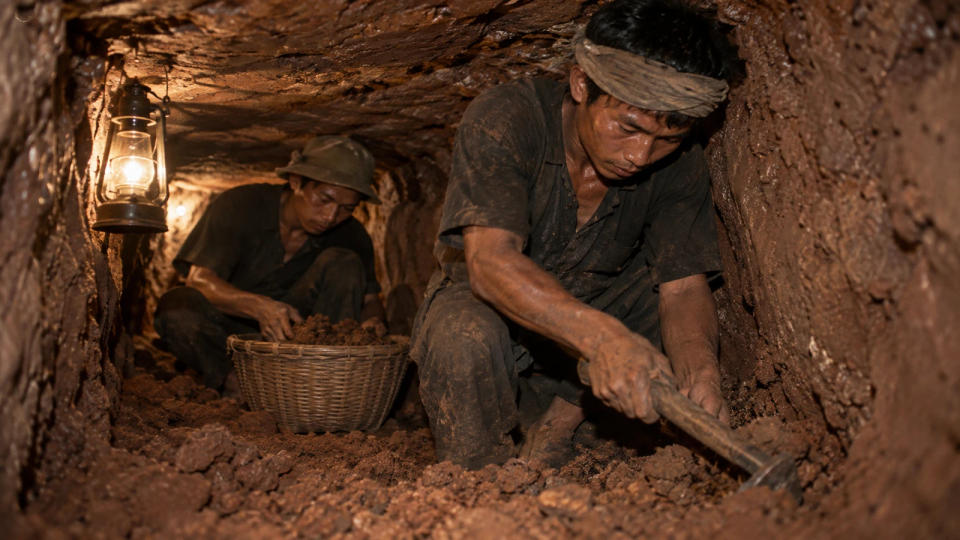
The work was physically demanding and mostly manual. Local accounts describe people cutting into the earth with hoes and shovels and carrying soil away in baskets. Some sections had to be repaired or dug again after attacks. Excavation involved more than digging a hole: a passage had to remain stable, connect to useful locations and avoid giving away its entrance.
The ground helped. Cu Chi's compact lateritic clay soil could support narrow excavated spaces better than loose sand. Builders exploited this by shaping passages with small openings, turns and branches. Not all tunnels had the same width or depth: some were temporary fighting shelters, while others were deeper, connected areas for command or care. The U.S. National Museum of the United States Army notes that the cramped shapes and layered clay frustrated attempts to find and destroy the system.
Camouflage was as important as excavation. A hatch could be hidden beneath leaves and debris, while small vents could blend into the vegetation. Concealment had obvious limits: people underground still required air, food, water and ways to escape. The network used concealed ventilation openings and wells, and it included additional routes between chambers. A tunnel that could be found from every surface opening would lose much of its advantage.
There were also several levels in portions of the complex. Vietnamese reports describe a network that included deeper passages, connected by steps and concealed covers. This was less like a modern subway—with generous clearance and a simple map—than a changing maze of narrow crawlways, branches and purpose-built rooms. Illustrations and present-day tourist sections can make it seem more uniform than it was in wartime.
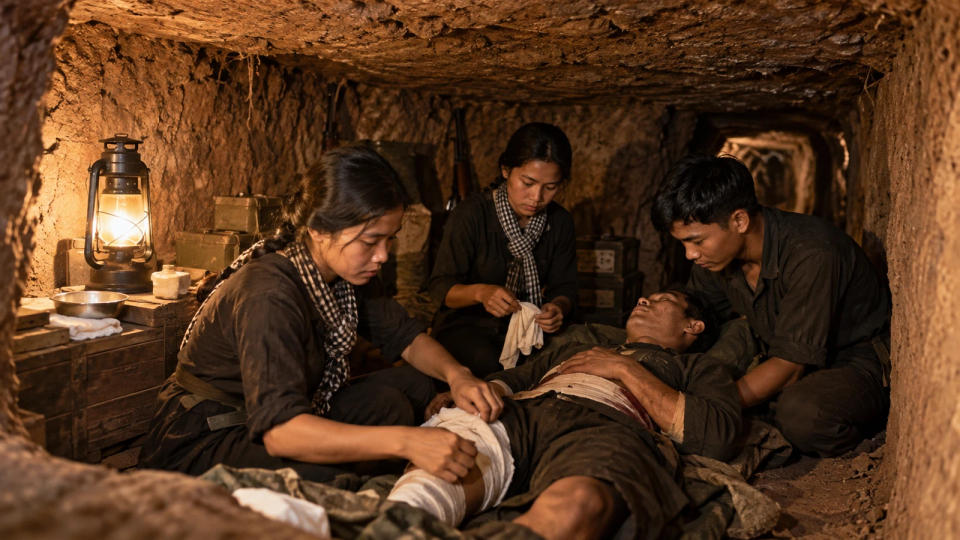
The same design that made the tunnels useful imposed harsh restrictions on their occupants. Cramped quarters, limited light, difficult movement, the need to maintain ventilation and the danger of being trapped made underground life a necessity rather than a comfortable alternative to the surface.
What Happened Below Ground—and Why the Army Struggled Above
Some areas of Cu Chi accommodated storage, food preparation, meetings, medical treatment and military planning. The Viet Cong could move between concealed positions, preserve supplies and emerge in locations that opposing troops had assumed were secure. These were not luxurious “underground cities,” even if that phrase conveys their surprising range of functions. Conditions differed from chamber to chamber, and the facilities served guerrillas and local residents in a war zone.
To American and Australian units sweeping the area, the system created an extraordinary tactical problem: an apparently cleared patch of ground might still have enemy passageways underneath. An Australian government account of Operation Crimp in January 1966 describes troops discovering tunnel entrances and underground caches while struggling to locate defenders on the surface. The tunnels did not make their occupants invulnerable, but they complicated ordinary searches, bombardment and control of the terrain.
Specialized American soldiers nicknamed “tunnel rats” were trained or selected to explore passages too small for normal movement. The U.S. Army museum describes explorers entering with minimal equipment, confronting darkness, unfamiliar turns and the danger of traps or armed defenders. Other countermeasures included demolition, mechanical clearing and attempts to deny access to portions of the network. Some measures destroyed tunnels, but the Army Corps of Engineers notes that operations from underground positions were never completely eliminated.
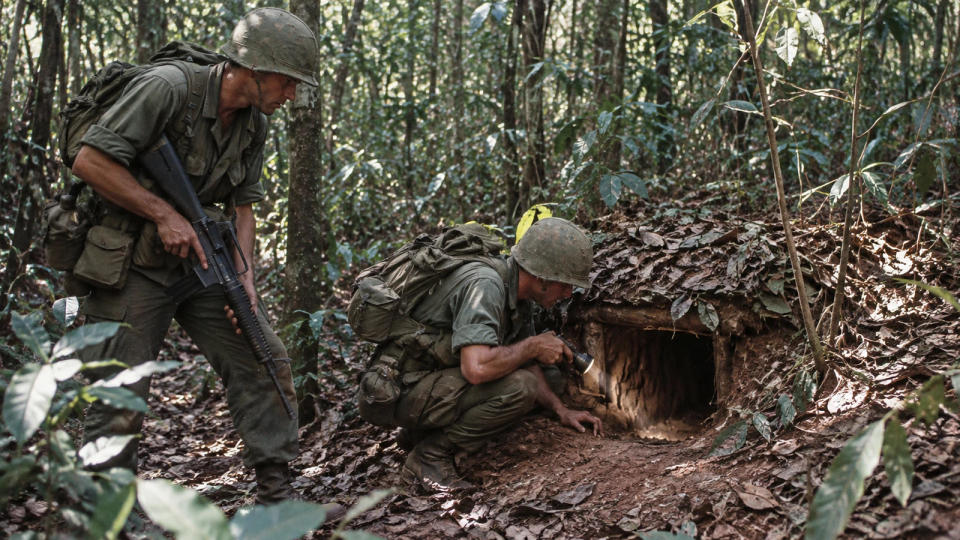
The striking detail is that secrecy did not require every tunnel to remain undiscovered. Once one passage was found, defenders could still rely on branches, hidden exits and local knowledge; attackers had to learn a layout they had never seen. This asymmetry was powerful, although its effectiveness changed as repeated assaults, bombing and ground operations damaged the network.
Nor should the story be reduced to a competition in clever engineering. Civilians helped create and sustain the tunnels, and people living in the area faced the danger of fighting and aerial attack. Wartime accounts from different sides emphasize different achievements and losses. Read together, they show both the ingenuity of a local defensive system and the brutality of the conditions that made it necessary.
Conclusion
The Cu Chi tunnels were built by patient, repeated manual labor—not by a secret industrial machine. Villagers and fighters transformed early hideouts into a layered wartime network because it offered shelter, mobility and a way to continue operating under attack. Its hidden doors and narrow passages mattered, but so did the people who dug, maintained and endured them. The tunnels remain a reminder that battlefield power does not always determine who controls the ground beneath it.
Sources & Further Reading
- Vietnam Department of Cultural Heritage — Cu Chi Tunnels Historic Site
- Vietnam Pictorial — Cu Chi Tunnels Seek World Heritage Recognition
- U.S. Army Corps of Engineers — How Army Engineers Cleared Viet Cong Tunnels
- National Museum of the United States Army — Tunnel Rats of the Vietnam War
- Australian Government Anzac Portal — Clearing Vietcong Tunnels During the Vietnam War