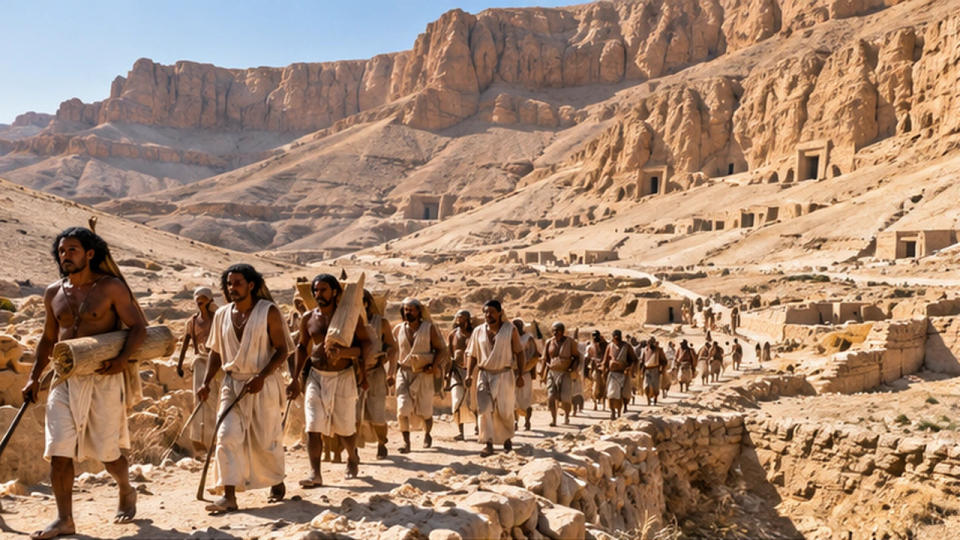
What happens when the people building a pharaoh’s eternal home cannot get enough food to feed their own households? In ancient Egypt, some of them stopped working. During the twenty-ninth regnal year of Ramesses III, the skilled royal tomb builders of Deir el-Medina protested after their regular grain rations failed to arrive. Their extraordinary walkout survives in a contemporary administrative record, the Turin Strike Papyrus.
It is often called history’s first recorded labor strike. That description needs one important qualification: it is the earliest well-documented example, not proof that nobody protested before. What makes the episode remarkable is how closely we can follow ordinary workers demanding that powerful officials honor an obligation.
The Specialists Who Built a Pharaoh’s Afterlife
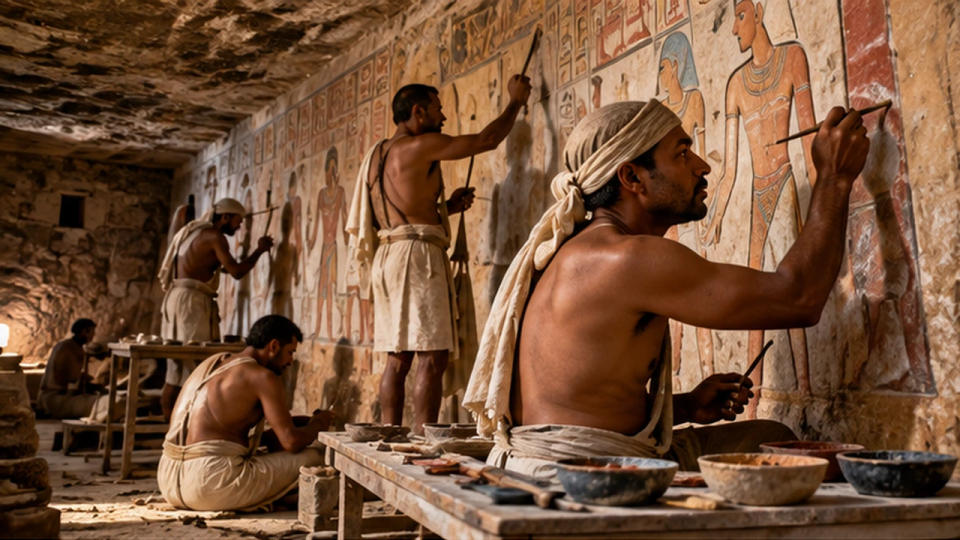
The workers lived at Deir el-Medina, a village on the west bank of the Nile near ancient Thebes, today’s Luxor. Their job was unusual. They cut, plastered, painted, and decorated royal burial chambers in the Valley of the Kings, turning rock-cut tombs into elaborate places intended to protect a ruler in the afterlife.
These were not anonymous masses of slaves dragging pyramid stones. The strike concerns an identifiable community of specialist artisans and laborers employed on New Kingdom royal tombs, many centuries after the largest pyramids were built. Different people handled different jobs, and village records illuminate a community of families, officials, scribes, and craft specialists.
The royal administration supervised the work. A high official called the vizier, roughly a chief minister, stood above the workforce, while the tomb scribe recorded attendance, deliveries, and disputes. This paperwork, sometimes written on papyrus and sometimes on limestone flakes known as ostraca, is why we know considerably more about these workers than about many other ancient communities.
Living close to a project that mattered greatly to the monarchy did not make workers immune to shortages. Their skills were essential, but they still depended on state deliveries for everyday supplies. That dependence became the heart of the crisis.
When Payment Was Food, a Delay Meant Hunger
Think of receiving most of a paycheck in bags of grain rather than money. That is closer to how payment worked for these royal workers. Regular distributions of grain helped sustain their families and could be made into bread and beer. Other provisions, including fish, vegetables, and ointments, also mattered to daily life.
By Ramesses III’s twenty-ninth year, scheduled rations were not reaching the workforce reliably. The exact administrative causes are debated. Scholars connect the difficulties to financial pressure, political problems, and possible corruption in late New Kingdom administration; the surviving papyrus establishes the workers’ unpaid provisions more directly than it establishes any single national economic cause.
So the immediate reason for the strike was not a demand for luxury or political revolution. Workers expected food that was already owed to them. When supplies stopped, the system that made specialist royal construction possible began to fail at the household level.
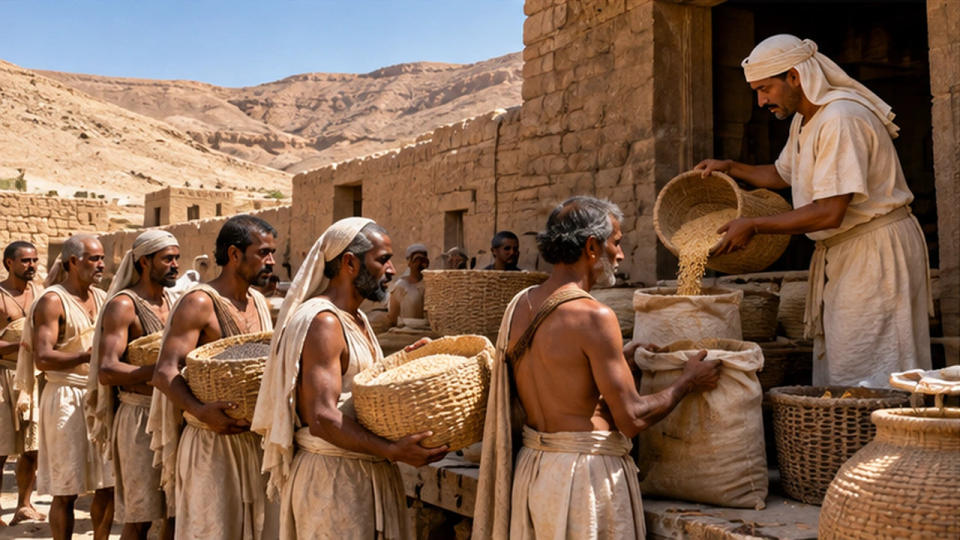
The Turin museum’s account records workers crossing a guarded boundary and crying, “We are hungry!” It also describes their complaint when eighteen days of the month had passed. That is not the same as securely establishing that every individual was exactly eighteen days past payday. The broader point is unmistakable: the grain owed to the workforce was still missing.
The Walkout That a Scribe Put on Papyrus
The evidence comes from an administrative papyrus now in Turin’s Museo Egizio, catalogued as Cat. 1880. The tomb scribe Amennakht recorded the dispute in hieratic, a quicker, cursive form of Egyptian writing used for everyday documents. Rather than being a modern tale invented around a dramatic scene, the strike is documented by the people and institutions of its own time.
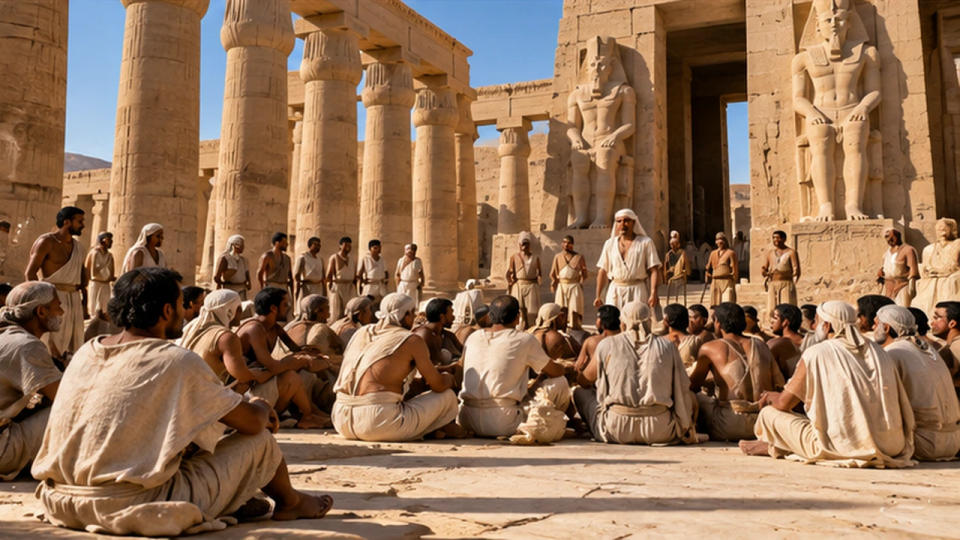
The work crew passed the necropolis guard posts and gathered at mortuary temples on the west bank. These temples were not simply places of worship; they were connected to powerful royal institutions and their stores. By staging sit-ins there, the workers made an administrative problem difficult to ignore.
Among the places named in the museum’s summary are the mortuary temples associated with Thutmose III, Ramesses II, and Seti I. Officials tried to persuade the workers to return, but the workers pressed for their missing provisions and asked that their grievance be reported to the pharaoh and the vizier.
This was a collective refusal to carry on as usual, backed by specific demands. We should not picture a modern trade union, election, or picket line: none is established by the record. But the essential features of a labor strike are recognizable. A workforce stopped work, organized around a common grievance, and confronted those responsible for payment.
The document is valuable for another reason. It preserves an official account of a labor dispute instead of a royal victory inscription. The voices of skilled workers enter a historical record that otherwise often concentrates on kings, wars, and monuments.
Did the Pharaoh’s Workers Actually Win?
The authorities did distribute some grain, so the collective action achieved immediate results. Yet there was no simple, permanent victory. The Museo Egizio describes renewed protests after payments, and its summary says the final strike preserved in the papyrus occurred in the following January. At one point, the workers rejected an order to go back to the village and insisted on taking their complaints higher.
Research on the late New Kingdom also warns against reducing the episode to one cause or a single tidy ending. Historian Edward Mushett Cole notes that delayed rations explain most of the strikes, while corruption and pressure on officials formed part of the wider context. Even the vizier’s access to temple provisions did not necessarily cover the entire shortfall.
Another distinction matters. The dispute was not a rebellion against the pharaoh’s right to rule, at least as the surviving text presents it. Workers appealed to the king as the person who should correct a failure by his administration. Their demands reveal how ordinary people could use familiar structures of authority to challenge what officials were doing.
Finally, Deir el-Medina was a specialized settlement, not a cross-section of all Egyptians. Its unusually rich written record allows a close look at one community. We cannot assume peasants, servants, quarry workers, and every other group enjoyed exactly the same leverage or received wages in the same way.
Conclusion. These tomb builders went on strike because the grain they depended on was not arriving. Their sit-ins brought at least some overdue supplies, although disputes continued. The enduring surprise is not that the workers suddenly discovered resistance, but that one ancient scribe left enough detail for us to see a powerful government being challenged by the people doing its work.
Sources & Further Reading
- Museo Egizio — Highlights: Turin Strike Papyrus
- Museo Egizio — Papyrus Cat. 1880 Collection Record
- Korea National University of Heritage — Interpretation and Notes on the Turin Strike Papyrus (2014)
- University of Birmingham — Decline in Ancient Egypt? A Reassessment (2016)
- World History Encyclopedia — Deir el-Medina