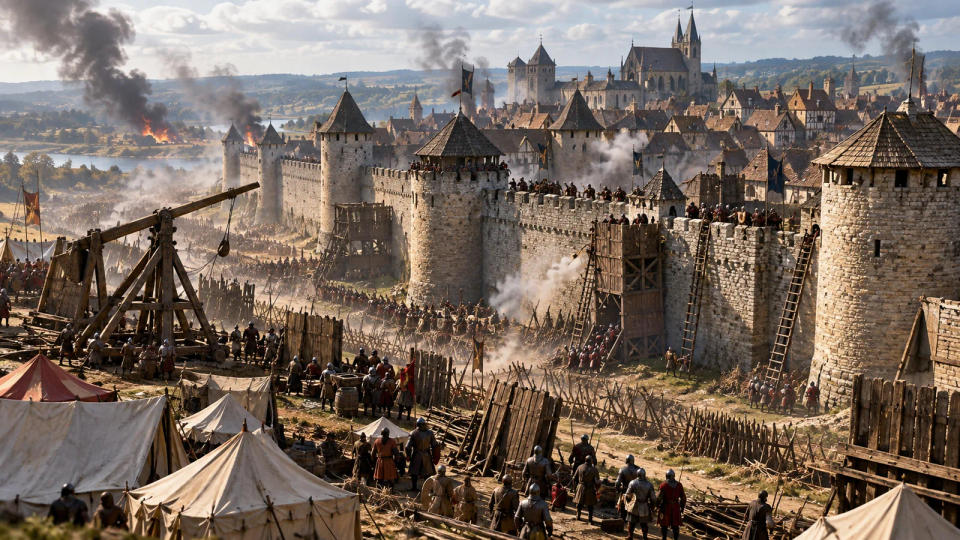
What happened after the gates of a medieval town slammed shut and an enemy army settled outside the walls? In a fortified European town, a siege changed almost everything at once: movement stopped, supplies became precious, walls became workplaces, and the decision to keep resisting had to be weighed against hunger and the danger of a final assault.
Sieges were not simply days of nonstop fighting. Much of the struggle was about preparation, repair, food, water, morale, and time. The experience varied by century, region, and the size of the town, but surviving fortifications, chronicles, and military records reveal a recognizable pattern of what defenders and townspeople tried to do.
Before the Ring Closed: Food, Water, and Fewer Mouths
If warning came early enough, preparation began before the enemy completed the encirclement. English Heritage notes that defenders could evacuate non-combatants to reduce pressure on supplies, while bringing in food and securing water. Beer and wine also mattered because wells or other water sources might be contaminated or deliberately attacked.
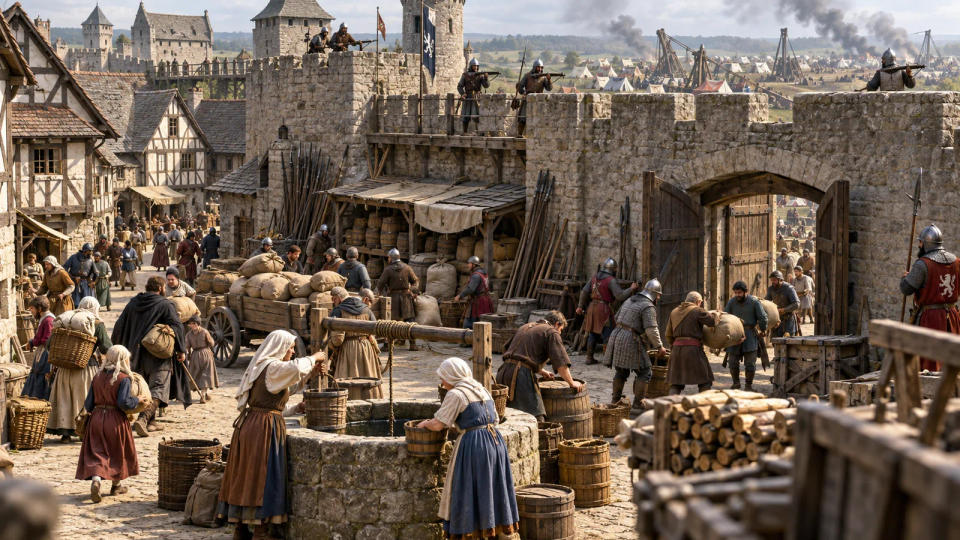
Water was especially important because a strong wall was useless if the people behind it could not drink. Wells and cisterns were valuable defensive infrastructure. At Denbigh in Wales, a fourteenth-century tower incorporated a secondary well inside the defenses; Cadw notes that this protected water source later helped the town endure sieges. It is a useful reminder that fortifications were designed around survival as well as combat.
Preparation could also reshape the town itself. Recent scholarship on urban communities under siege describes hurried wall repairs and efforts to move essential activities behind the defenses. Buildings outside the walls could become liabilities if attackers used them as cover, while access to mills, ovens, roads, and farmland might suddenly disappear. A siege therefore began as a logistical crisis before the first major assault.
The Walls Became a Workplace
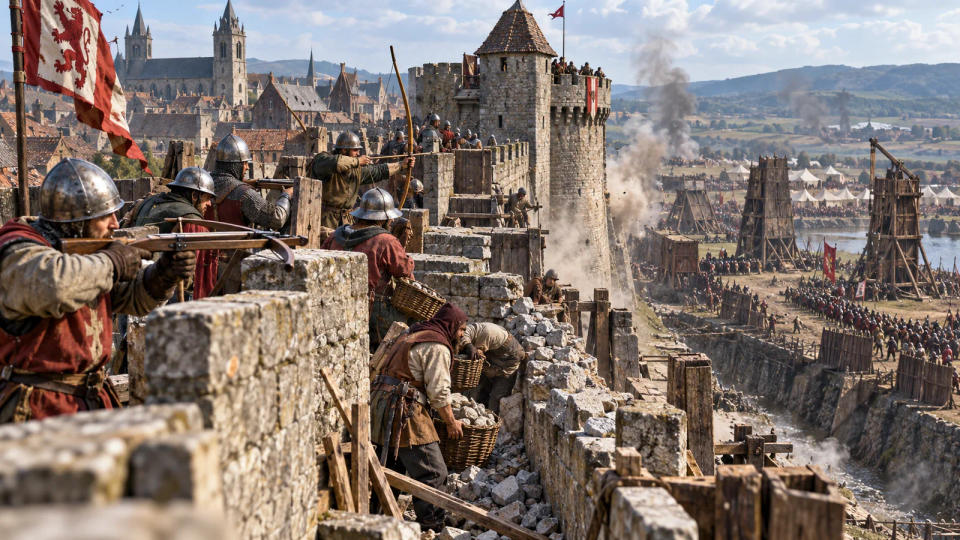
Once the siege began, the wall was not just a barrier. It became a constantly maintained fighting platform. Defenders stockpiled arrows, crossbow bolts, stones, timber, earth, and other materials. Archers and crossbowmen used crenellations and protected positions to fire at attackers, while laborers had to repair damage caused by missiles, rams, mines, or later medieval artillery.
Mining was another danger. Attackers could dig beneath a wall and weaken its foundations; defenders sometimes answered with countermines intended to intercept them underground. The remains of mines and countermines at places such as St Andrews Castle show how literal this contest beneath the walls could become.
Townspeople could also take part directly. A near-contemporary account of the 1153 siege of Ascalon describes townsmen fighting on the walls and trying to destroy a siege tower with burning materials. Such reports should not be treated as a picture of every siege, but they show that defense was not always left to a small professional garrison. In an emergency, the distinction between soldier and resident could narrow quickly.
A Siege Was Also a Battle Against Hunger
For many defenders, the most dangerous weapon was not a trebuchet but the blockade itself. If attackers could stop food, reinforcements, and communication, time began to work against the town. English Heritage describes starvation and disease as deliberate consequences of prolonged blockade, while the attacking army faced its own expensive problem: it also had to be fed and supplied for as long as the siege lasted.
Calais offers a famous example from the Hundred Years' War. Edward III besieged the port from 1346 to 1347 and maintained a fortified encampment outside it. According to the Royal Armouries, the town finally submitted after its inhabitants were starved and a French relief effort failed. The case shows why a siege could last many months even when the walls remained standing.
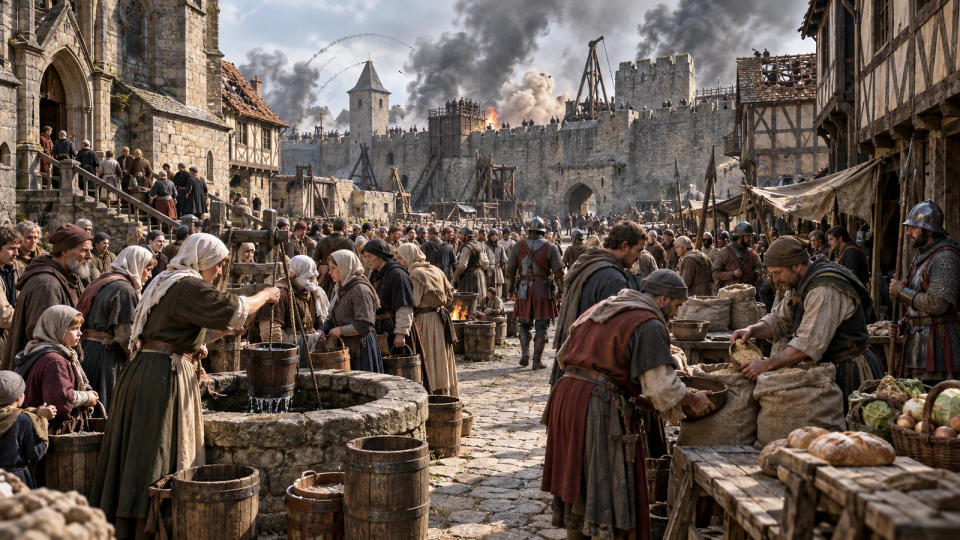
Inside a surrounded town, ordinary life did not simply stop, but it was reorganized around scarcity and defense. Water had to be obtained, food had to be prepared, and supplies had to reach the points where they were needed. How these tasks were divided differed from place to place, and medieval sources usually tell us much more about commanders and fighting than about routine civilian labor. That silence is important: historians can identify the pressures with confidence without pretending to know every household's daily schedule.
How a Siege Ended: Relief, Surrender, or Storming
Every day of resistance forced leaders and inhabitants to ask the same question: was it still worth holding out? A relief army might arrive. The attackers might run short of money, food, or time and withdraw. The walls might be breached. Or negotiations might begin before the situation became catastrophic.
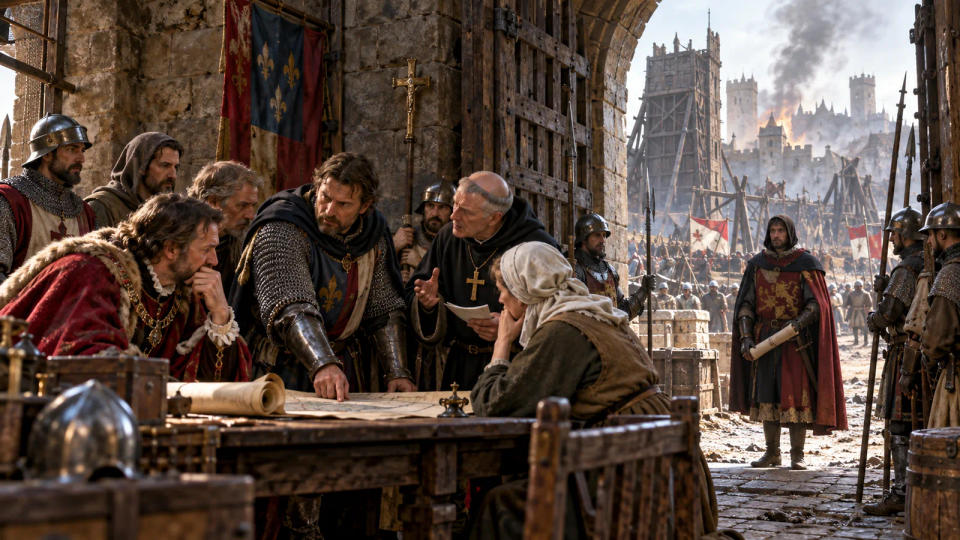
Surrender was not automatically dishonorable. In many cases it was a calculated attempt to protect lives and property after a credible defense had been made. Terms could allow some defenders to leave, but the outcome was unequal. English Heritage notes that elites were generally more likely to secure favorable treatment, while poorer residents could lose possessions, homes, rights, or freedom.
The worst danger came when a town was taken by storm. Medieval siege customs varied, but a successful assault after resistance could expose inhabitants to killing, plunder, and other violence. That threat was part of the psychological pressure of siege warfare. It explains why negotiation mattered so much: keeping the gates closed for one more day could preserve a political cause, but it could also increase the risks if no relief was coming.
Conclusion
When a medieval town was under siege, its people did far more than hide behind the walls. They reduced mouths when evacuation was possible, protected water, stored supplies, repaired defenses, fought from the walls, endured blockade, and watched for the moment when resistance no longer made sense. A siege was a military contest, but for the people inside it was equally a struggle over logistics, endurance, and the terrifying uncertainty of what would happen when the walls finally failed—or the enemy finally left.
Sources & Further Reading
- English Heritage — Medieval siege warfare
- Royal Armouries — The Hundred Years' War, 1337–1453
- Cadw — Denbigh Town Walls
- Historic Environment Scotland — St Andrews Castle
- Cambridge University Press — “Choosing to Resist: the Economics of Morale in Towns under Siege”
- Fordham University Medieval Sourcebook — The Siege of Ascalon, 1153