Titanic sank when iceberg damage flooded its forward compartments; high speed and inadequate lifeboat arrangements made the disaster worse.
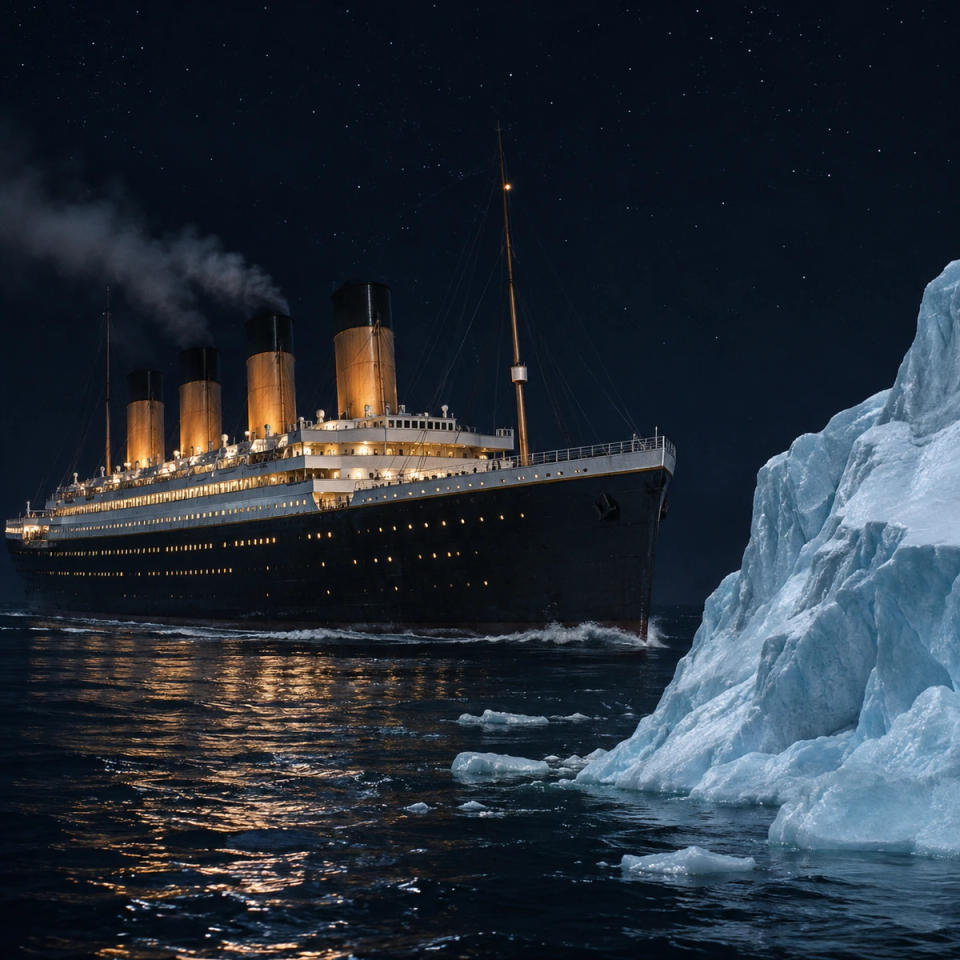
On the night of April 14, 1912, the British passenger liner RMS Titanic struck an iceberg in the North Atlantic during its first voyage toward New York. It sank early on April 15, with more than 1,500 people losing their lives. The disaster was not explained by one extraordinary failure. The collision damaged several compartments, flooding spread beyond the limits of the ship's protective design, and the evacuation system could not carry everyone aboard. The 1912 British and American inquiries examined both the physical damage and the decisions that magnified its consequences.
What Happened When Titanic Struck the Iceberg?
At about 11:40 p.m. ship's time on April 14, lookouts spotted an iceberg ahead. The ship turned, but the ice made contact with its starboard, or right-hand, side. The British Wreck Commissioner's Inquiry later described damage below the waterline across several forward compartments. Its formal judgment identified the iceberg collision, brought about by excessive speed in the circumstances, as the cause of the loss.
The familiar image of a single enormous slit running along the side of Titanic is misleading. Later studies of the wreck suggest that relatively narrow openings and separated hull seams could admit devastating quantities of seawater. An analysis reported by the U.S. National Institute of Standards and Technology found weaknesses in recovered wrought-iron rivets and proposed that rivet failures helped hull plates separate. That is an engineering interpretation of the damage, not a complete eyewitness record or proof that every opening formed in the same way.
What mattered most for buoyancy was the extent of the flooding. The British inquiry found that water entered five forward spaces so quickly that the pumps could not keep up. A further space had more limited leakage. As the damaged bow sank deeper, the water rose toward the tops of the transverse bulkheads—the walls meant to divide the ship into separate watertight sections.
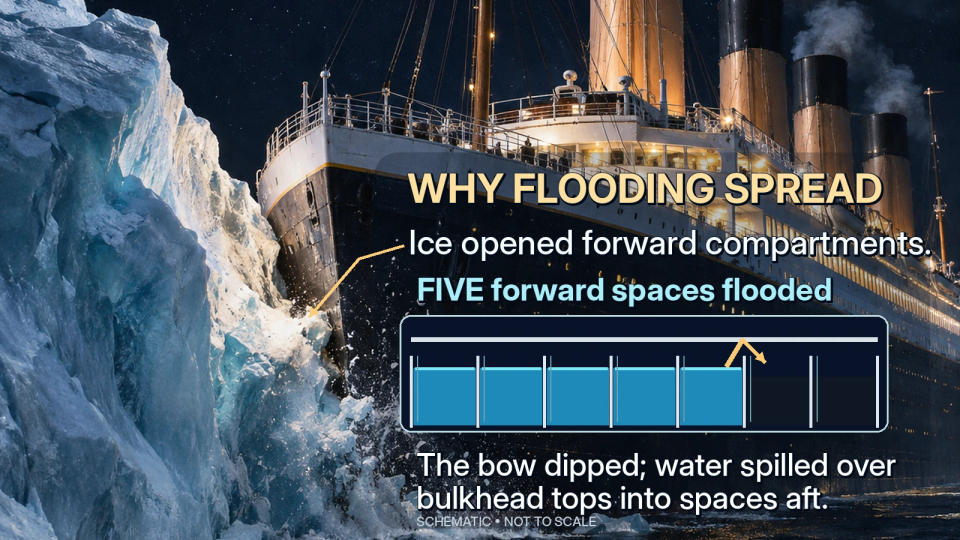
Those bulkheads were not continuous barriers to the uppermost decks. The downward movement of the bow allowed water to pass over their tops into compartments farther aft. This successive flooding removed the reserve buoyancy that had kept the ship afloat. Titanic's subdivision was meaningful protection against certain limited damage, but it could not contain the particular combination of compartments exposed to the sea. The museum's discussion of Titanic's original longitudinal plan emphasizes that its designers did not anticipate such widespread forward flooding.
Why Were There Not Enough Lifeboats for Everyone?
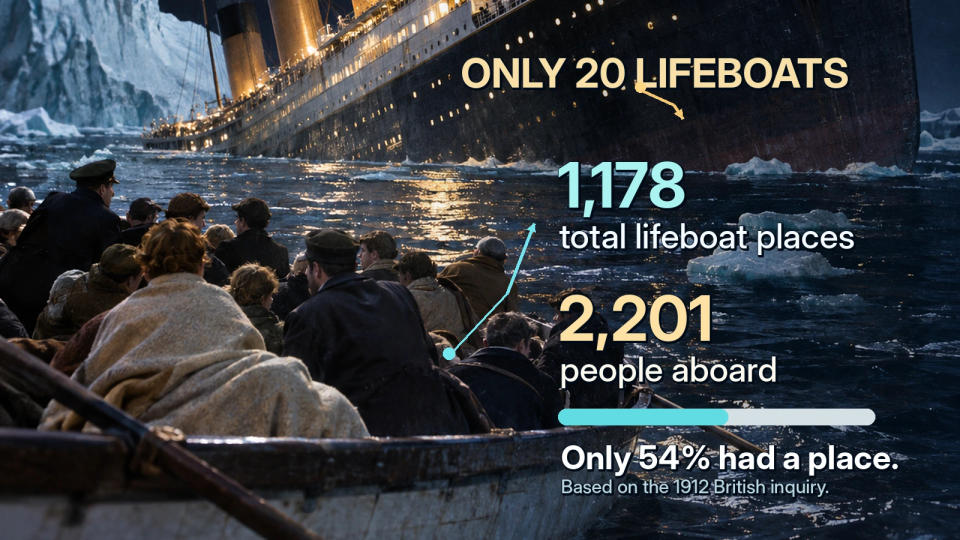
Flooding explains why Titanic sank. It does not, by itself, explain why so many people died. The ship carried 20 boats: fourteen standard lifeboats, two emergency cutters, and four collapsible boats. Their combined rated capacity was 1,178 people. According to the British inquiry's figures, Titanic carried 1,316 passengers and 885 crew—2,201 people altogether. Thus, even if all boats had been filled perfectly, they provided places for only about 54 percent of those aboard.
The lifeboat provision met the British statutory requirements then in force. That fact illustrates a failure of the safety rules rather than proof that the ship carried enough evacuation capacity. The regulations had not kept pace with passenger liners of Titanic's size. The British investigation also recorded that there had been no proper lifeboat drill or passenger muster before the emergency, although the boats had been inspected in port.
Launching the boats presented further difficulties. Many passengers initially did not understand that the ship was doomed, and some hesitated to descend into small boats suspended high above the sea. Crew members had limited practice in emergency loading. The inquiry documented boats leaving with numerous empty places: emergency boat No. 1 carried only 12 people despite a capacity of 40, while lifeboats No. 6 and No. 7 departed with approximately 28 and 27 respectively, although each was designed for 65.
Access to the Boat Deck was also unequal in practice. Third-class accommodation lay farther from the launching positions, creating difficult routes during an unfamiliar nighttime evacuation. Survival rates differed sharply by passenger class. The British inquiry rejected allegations of deliberate discrimination by officers in boat loading, but that finding should not erase the practical barriers that many third-class families faced. Accounts of individual movements are incomplete, and no single simplified story captures every passenger's experience.
RMS Carpathia arrived after Titanic had gone down and rescued survivors from the boats. The inquiry's recorded survivor totals vary slightly from figures found in other historical summaries, so the broad scale—roughly seven hundred survivors and more than fifteen hundred dead—is more useful here than claiming a universally settled count.
Could Titanic's Loss Have Been Prevented?
The collision was not an unavoidable surprise in an otherwise empty ocean. Wireless ice warnings had reached the ship during April 14. The night was calm and dark, and the absence of breaking waves around ice made spotting a berg difficult. Titanic nevertheless continued at a speed that the British court considered excessive for the conditions. The findings criticized the failure to take more effective precautions on entering ice. That does not mean every warning went entirely unread or that one single officer knowingly chose a fatal outcome.
A lower speed, a different route, or more conservative action after warnings might have reduced the risk of impact. Those are counterfactual judgments, however: history cannot establish with certainty which alternative maneuver would have worked at the precise moment the iceberg appeared. Claims that a head-on collision would definitely have saved the ship are likewise speculative. They depend on assumptions about damage, human responses, and structural behavior that cannot be tested against the lost voyage.
The aftermath produced practical changes. The U.S. Senate investigation recommended enough lifeboat capacity for every person, better assignments and drills, improvements in wireless practices, and stronger passenger-ship safety measures. International efforts subsequently produced stricter maritime rules and the International Ice Patrol. These reforms recognized that safer voyages required multiple safeguards: cautious navigation, resilient ship design, adequate evacuation equipment, and effective communication.
Conclusion
Titanic sank because iceberg damage overwhelmed its ability to remain afloat. The bulkheads slowed flooding but could not stop water from spreading once the bow descended. Excessive speed near reported ice increased the chance of collision, while inadequate lifeboat capacity and limited evacuation preparation made the human toll far worse. The central lesson of the disaster is not that technology never works: it is that a ship can comply with contemporary rules while those rules fail to address a catastrophe on the scale actually encountered.
Sources & Further Reading
- British Wreck Commissioner's Inquiry, Report on the Loss of the Titanic (1912)
- British Inquiry, Observations on Flooding and Watertight Compartments
- British Inquiry, Lifeboats and Rescue
- U.S. Senate, Titanic Disaster Investigation
- Titanic Belfast, Titanic's Longitudinal Plan
- NIST, Science Showed How a Tiny Iron Flaw Doomed the Titanic