Medieval English records show how landholding tied people to lords through overlapping loyalties, rents, and services.
Feudalism is a term historians use for arrangements that connected landholding, lordship, and obligations in medieval Europe. In its narrower sense it describes relationships associated with fiefs, or holdings under a lord, and vassalage, a bond of fidelity and service. In broader usage it can also include how rural lords collected rents and labor from tenants. Those uses bring different people and different kinds of evidence into view.
Late thirteenth-century England offers a useful close-up. A legal formula tells us how a free tenant was expected to acknowledge a lord. Estate surveys tell us what land and income a lord controlled. Put these records side by side and the familiar pyramid of kings, nobles, knights, and peasants becomes much harder to draw. The records ask more specific questions: Which land did someone hold, from whom, and on what terms?
What Did a Tenant Promise in Homage?
An English legal text preserved in manuscripts from around 1275 to 1290 describes a free tenant putting his joined hands between those of his lord. The gesture accompanied words acknowledging the relationship. The formula explicitly preserved loyalty to the king and to other lords. A man could therefore acknowledge one lord over a holding while already owing fidelity elsewhere. The familiar picture of every person reporting to a single superior misses this possibility.
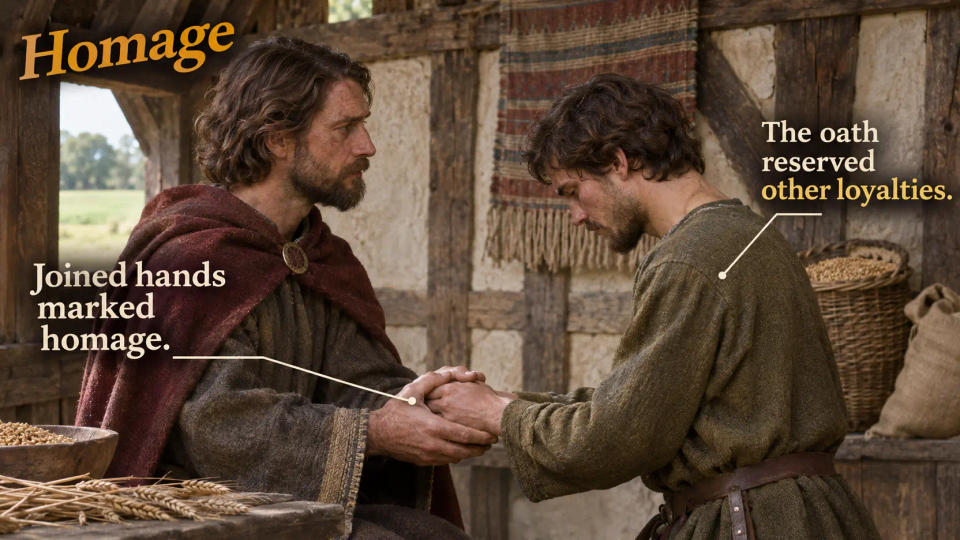
The same text distinguishes homage from fealty. For the free tenant's fealty, it describes a hand placed on a book and a promise of fidelity and performance of the customs and services due for the holding. It also supplies a separate form of fealty for a villein, a tenant of unfree status. That distinction matters because an oath between a lord and a free tenant can look superficially similar to one between a lord and an unfree tenant, while the tenant's legal position and obligations differ.
This source is a guide to the prescribed ceremony. It gives us the gesture, the formula, and distinctions its compiler considered important. It cannot tell us how often people performed it, what any individual felt while doing so, or whether the same words were used in another kingdom. The reconstruction illustrates the gesture described in the text. The room, clothing, and faces are illustrative details.
What Did an English Manor Actually Record?
A manor was an estate with land, resources, and rights that could produce income for its lord. One important distinction in estate records is between the demesne, the land managed directly for the lord, and the holdings occupied by tenants. A survey called an extent could assess the value of the demesne alongside rents and services owed by tenants. A late thirteenth-century guide to making such surveys also asks about resources such as meadows, mills, and fisheries, where relevant.
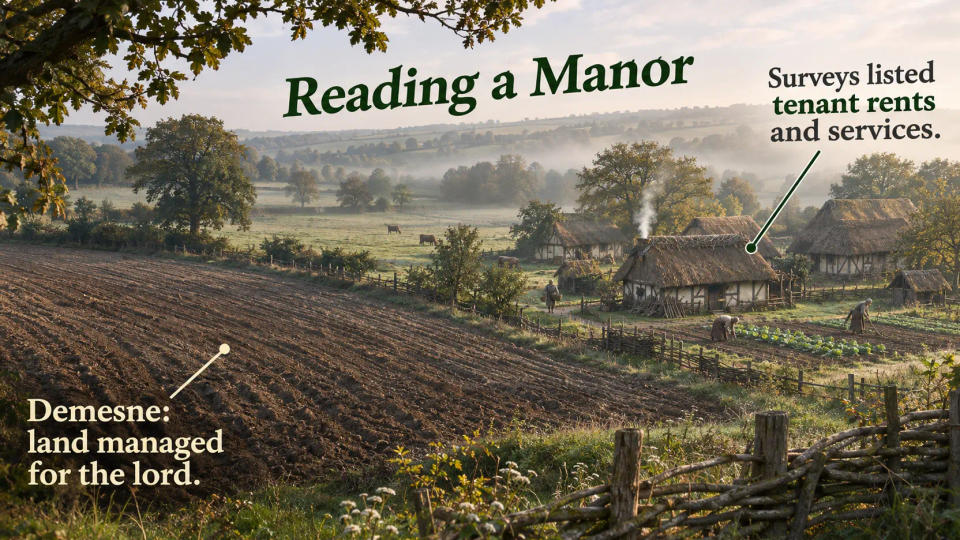
Picture two patches of cultivated ground on the same estate. One might produce a crop for the lord's household or accounts. The other might support a tenant household that owed rent or services according to its holding. Both could look much the same to a traveler passing through. The estate survey makes the difference visible by recording who benefited from the land and what was due. The illustration marks these functions in a hypothetical landscape. Actual estates could arrange land and resources quite differently.
Different records also answered different questions. A rental concentrated on tenants and rents. A custumal could list the services and rents attached to tenant holdings. An extent looked across the estate and assigned values to its resources. Even two surveys of the same property might differ in detail because a royal official and an estate manager gathered information for different purposes. The record of an obligation tells us what a survey counted as due. An account of payments or work would help establish what was actually collected or performed.
Why Do Historians Disagree About Feudalism?
The term can make several arrangements sound like parts of a single system. A lord could draw income from an estate, a free tenant could owe fidelity for a holding, and a villein could owe services under local custom. Those relationships could overlap. The document that describes homage, however, answers a different question from the survey that values an estate. Neither tells us on its own how an entire kingdom worked.
Historian Susan Reynolds challenged the idea that a standard package of fiefs and vassalage explains medieval Europe. She argued that later scholars built much of the familiar model from medieval legal writing and gave it more explanatory reach than the evidence warrants. The English documents show why the distinction between a rule and everyday practice matters. A legal writer could specify the correct words of a promise, while a surveyor could record obligations that varied by holding and by place.
These arrangements also changed over time. The Mapping the Medieval Countryside project notes that by the later fourteenth and fifteenth centuries, leasing of demesne land made older survey categories less representative in many cases. An estate might still contain the same fields while the lord received income through a different arrangement. A snapshot of one century can therefore mislead if we use it as a description of the whole medieval period.
Conclusion
Feudalism is a useful starting word when its scope is clear. The English evidence shows land held under particular terms, promises that could accommodate overlapping loyalties, and estates drawing income from a mixture of land, rent, and services. To understand a medieval relationship, start with a specific holding and ask who controlled it, what was owed, and which record tells us so.
Sources & Further Reading
- Modus Faciendi Homagium & Fidelitatem (The Manner of Doing Homage & Fealty), c. 1275
- Mapping the Medieval Countryside — The extents: a short introduction
- Susan Reynolds — Fiefs and Vassals: The Medieval Evidence Reinterpreted