Egyptian hieroglyphs used pictures to spell sounds, represent words, and give readers clues to meaning.
Ancient Egyptians wrote their language with signs that could represent sounds, words, or clues to meaning. The pictures we recognize on temples and tombs belong to the script we call hieroglyphs. A sign might look like a bird, a tool, or a piece of furniture, but its appearance alone cannot tell you what job it is doing. An owl can help spell a word that has nothing to do with birds.
Start with three questions when you see a line of signs. Where does the line begin? Which signs contribute to the spelling? Is there a sign that helps identify the meaning? You can ask those questions without knowing how to translate the whole inscription. They also explain why matching every picture to an English word quickly leads to trouble.
How Can a Picture Represent a Sound?
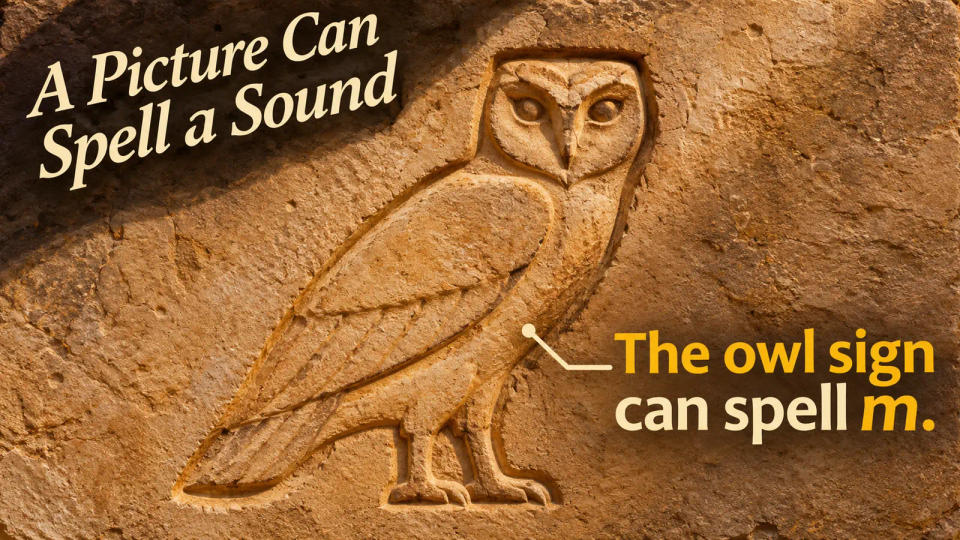
The owl sign, catalogued by modern scholars as G17, is a useful first example. It can represent the consonant conventionally written m. That does not mean an Egyptian reader had to say a word meaning owl whenever the sign appeared. In this use, the image supplied part of the spelling. The Metropolitan Museum of Art’s calligraphy guide identifies the owl by features including its head shown face-on, even though the body is shown from the side.
Some signs represented one consonant, while others represented groups of consonants. The British Museum uses a gaming-board sign as an example of a sign for the consonants mn. That is one written sign with a two-consonant value. A simple chart matching signs to individual English letters can therefore illustrate one aspect of the system, but it leaves out a large part of how Egyptian spelling worked.
Egyptian hieroglyphic spelling generally did not write vowels explicitly. When Egyptologists say a conventional pronunciation out loud, they may insert a vowel to make the consonant sequence easier to say. That convention helps people discuss a text together. It does not, by itself, tell us which vowel an Egyptian speaker would have used. The written sign, the sound value scholars assign to it, and the reconstructed pronunciation of an entire word are three separate things.
What Do Meaning Clues and Reading Direction Tell You?
Some signs could stand for a whole word. Others served as meaning clues called determinatives. A determinative generally follows the spelling and helps a reader recognize the kind of thing the word describes. It contributes information about meaning without adding a sound to the pronunciation. Think of it as a clue attached to the spelling rather than another letter in it.
The British Museum gives the example of a boat outline after the signs spelling the word for boat, conventionally transliterated dpt. The boat image helps identify the word’s subject. It would be a mistake to take that final outline as an instruction to pronounce another consonant. Compare it with the owl used as m. Both signs have recognizable pictures, but the reader uses the pictures in different ways.
Direction is another clue available before translation. In a horizontal line, look for a person or animal shown facing one side. The figures usually face toward the beginning of the line. If they face right, start at the right and read toward the left. If they face left, start at the left. Look at the neighboring signs and overall layout if one figure, such as an owl with a face shown frontally, is ambiguous. The rule is a starting point for an inscription rather than a substitute for reading its words.
Did Egyptians Always Write in Hieroglyphs?
Egyptians also used hieratic, a cursive script closely related to hieroglyphs. A writer working with ink could make abbreviated marks much more readily than a carver could cut the outlines of detailed signs in stone. The two forms could serve different jobs. Monumental writing often used carefully shaped hieroglyphs, while hieratic could be used for handwritten texts. Hieroglyphs could also be painted or written by hand, so the distinction is about the shape and use of the script as much as the material.
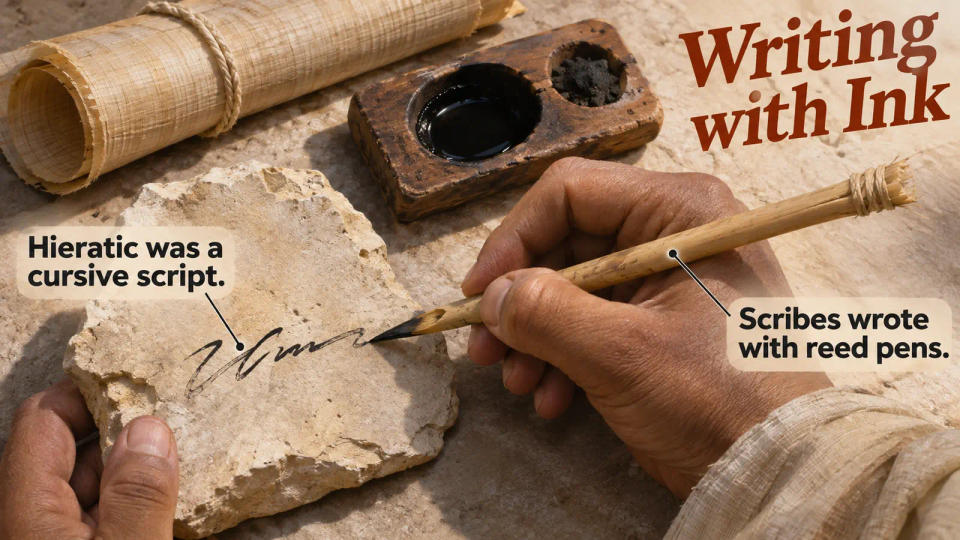
Papyrus was one writing surface. An ostracon, a piece of pottery or stone used for writing or drawing, was another. The Metropolitan Museum of Art holds a limestone ostracon from the Ramesside period that preserves an incomplete line of black-ink hieratic. The surviving piece gives a concrete example of someone writing on stone with ink. A stone surface alone does not tell you that a text was carved.
The British Museum also documents the use of handwritten scripts for correspondence and literature. A letter could be practical and personal, while a literary text could tell a story or preserve instruction. The ability to write quickly mattered in either case.
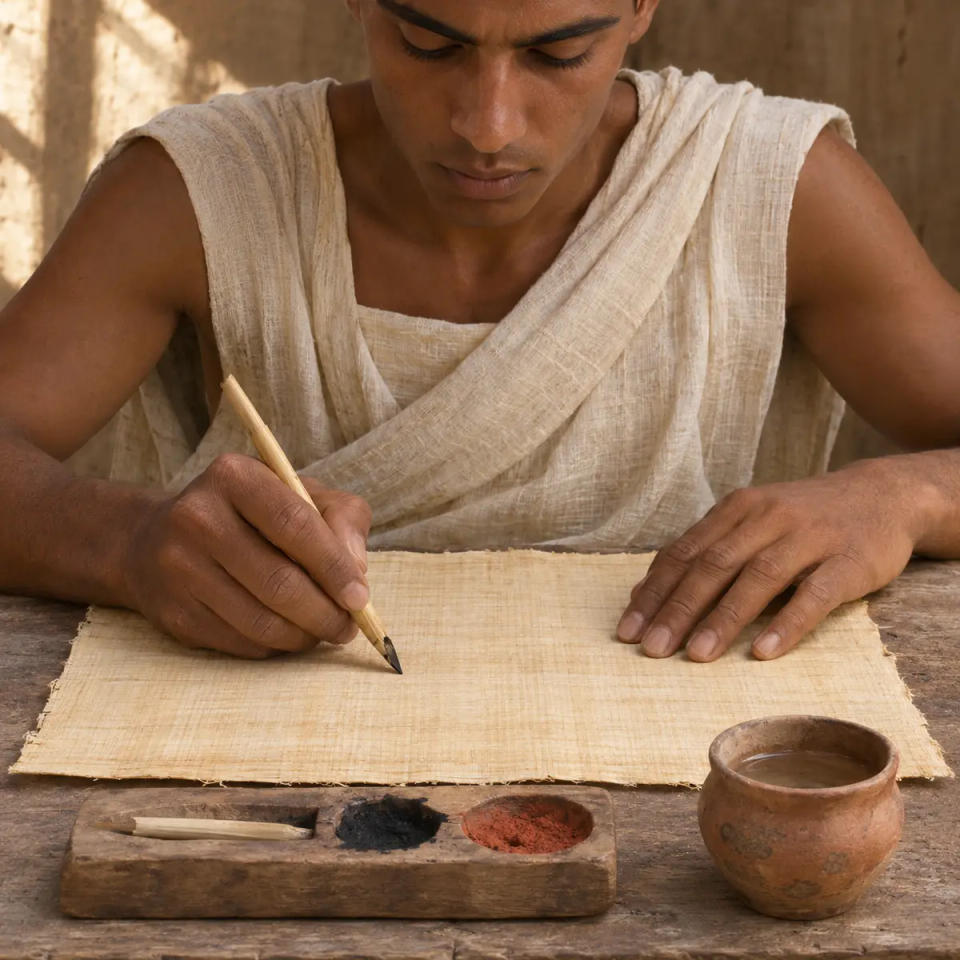
The two illustrations in this article isolate different questions. The owl shows how a sign can contribute a sound. The workspace shows what writing with a reed pen could look like. The marks in the reconstruction are illustrative. For a surviving example of hieratic writing, see the Met’s object record, where the photograph and catalogue description can be examined together.
Conclusion
Hieroglyphs become easier to approach once you separate what a sign looks like from the role it plays. A picture can supply a consonant, stand for a word, or help narrow the meaning of a spelling. The direction faced by figures can tell you where to begin, and a handwritten piece may use a more cursive script such as hieratic. Try finding the starting edge and identifying one sign’s job before attempting a translation.
Sources & Further Reading
- British Museum — Ancient Egypt: Symbols of the pharaoh
- Metropolitan Museum of Art — Ancient Egyptian Calligraphy
- British Museum — Hieroglyphs: unlocking ancient Egypt
- Australian Museum — The Scribe and Hieroglyphs
- Metropolitan Museum of Art — Ostracon with hieroglyph and hieratic