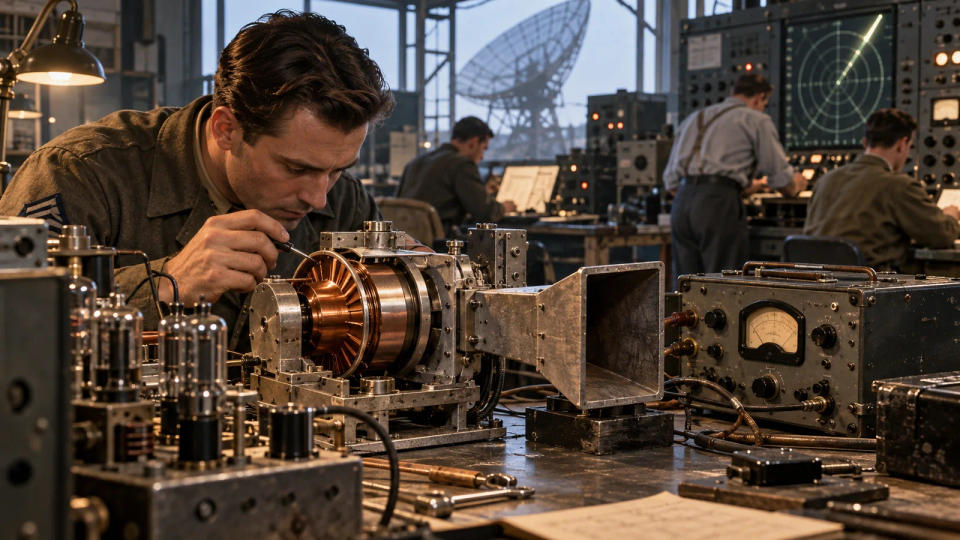
How did a weapon designed to find enemy aircraft and submarines end up reheating leftovers in ordinary kitchens? The link is the cavity magnetron, a compact device perfected for World War II radar that could generate powerful microwaves. Wartime radar research did not produce a countertop oven overnight, but it created the technology, manufacturing experience, and scientific observations that made microwave cooking practical after the war.
The familiar story often begins with Raytheon engineer Percy Spencer noticing that food near a magnetron became hot. That episode mattered, but the microwave oven was not simply the result of one melted candy bar. It emerged from years of radar development, experiments with high-frequency heating, patent work, and a long effort to turn military-scale equipment into something useful in kitchens.
The Radar Breakthrough That Made Microwave Power Practical
Microwave heating depended on a technology that was already changing warfare. In 1940, physicists John Randall and Harry Boot at the University of Birmingham developed a powerful cavity magnetron. Earlier magnetrons existed, but their design produced microwave energy at a power level and wavelength that made compact radar systems far more effective.
That mattered because radar works by sending out radio waves and detecting reflections from objects. Shorter wavelengths made it possible to build smaller antennas while still obtaining useful resolution. This was especially valuable for aircraft, where size and weight mattered. Britain soon shared the magnetron with the United States through the wartime scientific cooperation often associated with the Tizard Mission.
American laboratories and manufacturers then pushed the technology into large-scale production. Raytheon became a major supplier of magnetrons for Allied radar. Percy Spencer, who had extensive experience with radio and vacuum-tube technology, helped improve manufacturing methods so the devices could be produced in far greater numbers.
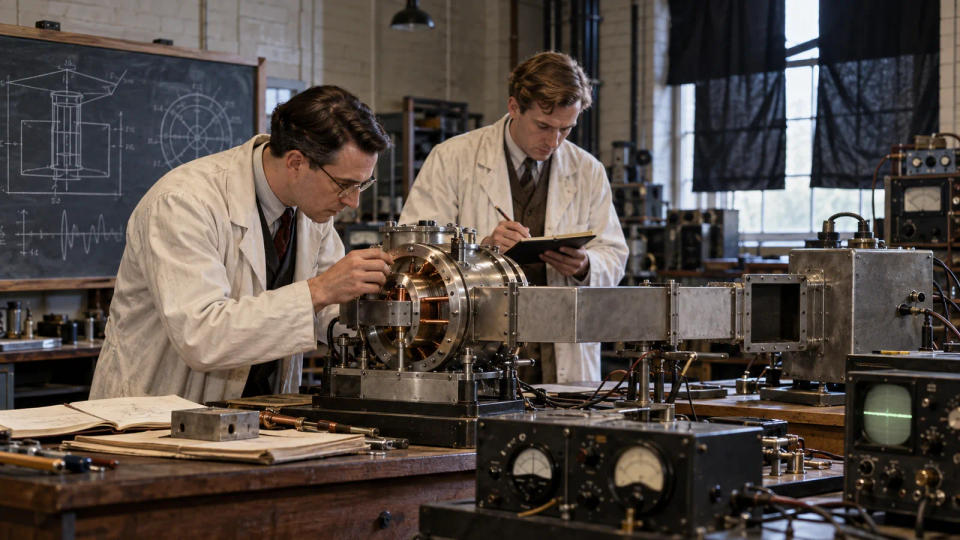
This industrial background is easy to overlook. The microwave oven was possible not only because microwaves could heat certain materials, but because wartime radar programs had created reliable high-power microwave sources and a workforce that understood how to build and control them.
Percy Spencer and the Heating Experiments at Raytheon
By 1945, Spencer was working closely with magnetrons at Raytheon when he became interested in the heat they could produce. Popular retellings say that a candy bar in his pocket melted near an operating magnetron. Other accounts describe popcorn kernels popping and an egg bursting during follow-up experiments.
Those details should be treated carefully. Later historical work based on laboratory records and recollections suggests that microwave cooking developed through a series of observations rather than a single dramatic moment. Engineers already knew that radio-frequency energy could heat materials, and experiments with electrical food heating had taken place before the war. Spencer's importance was that he recognized the practical potential of using microwave frequencies and helped Raytheon turn that possibility into a working cooking system.
On October 8, 1945, Raytheon filed Spencer's patent application for a "Method of Treating Foodstuffs." The patent described cooking food with electromagnetic energy in the microwave region, using wavelengths much shorter than those employed in earlier radio-frequency heating systems. It was granted in 1950.
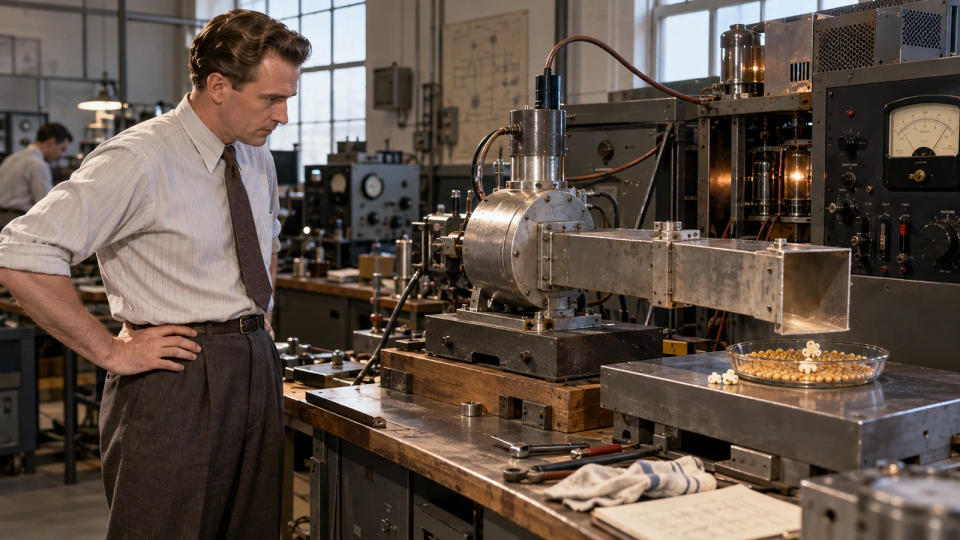
In practical terms, the magnetron generated microwave energy that could be directed into an enclosed metal chamber. Inside the chamber, the electromagnetic field transferred energy into food. Modern explanations often simplify this by saying that microwaves make water molecules vibrate, but the actual heating involves interactions between the alternating electromagnetic field and polar molecules and ions within the food.
From Wartime Hardware to the First Radarange
The first commercial microwave ovens looked nothing like the compact appliances now sitting on kitchen counters. Raytheon's early Radarange systems were large, heavy, expensive machines intended for restaurants, institutions, and other commercial settings. Smithsonian records note that the first commercial Radarange was purchased by a Cleveland restaurant in 1947 for about $3,000.
Early units required bulky electrical components and, in some versions, water cooling for the magnetron. Contemporary examples stood roughly six feet tall and could weigh hundreds of pounds. Their size reflected their military-technology ancestry: engineers were adapting equipment designed for radar laboratories and military systems, not starting with a household appliance.
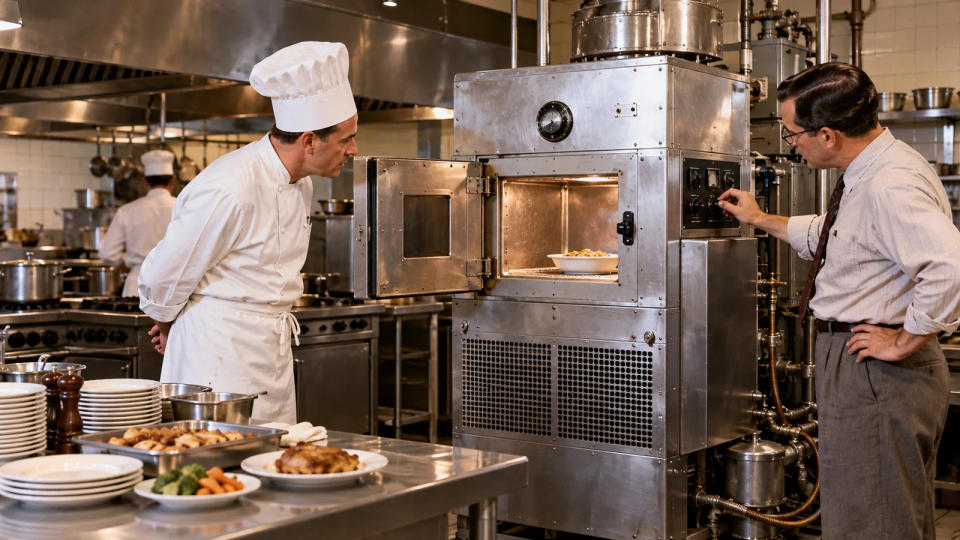
Even so, the advantages were obvious in places where speed mattered. Microwave energy could heat certain foods much faster than conventional ovens because energy was deposited within the food rather than relying only on a hot oven surface and slow heat conduction from the outside inward. That made the technology attractive for reheating prepared meals and for specialized commercial food preparation.
The name "Radarange" itself preserved the appliance's origin story. The cooking machine was a peacetime descendant of the same magnetron technology that had helped radar operators detect aircraft and ships during the war.
Why the Microwave Took Decades to Reach Ordinary Kitchens
Commercial success did not mean instant household adoption. Raytheon licensed microwave technology to Tappan, which introduced an early home model in the mid-1950s. The Smithsonian's National Museum of American History identifies the Tappan RL-1 as the first microwave oven designed for home use. A 1955 version sold for $1,295, a price high enough to keep it out of most kitchens, and consumers were still unsure how to use the unfamiliar technology.
The breakthrough came gradually as manufacturers reduced the size and cost of magnetrons, improved electrical systems, and designed ovens that fit ordinary kitchens. By the 1960s and especially the 1970s, countertop and built-in microwave ovens had become far more practical. Food companies also began developing meals and snacks specifically suited to microwave heating.
The shift changed more than cooking speed. Microwave ovens encouraged new habits of reheating leftovers, defrosting frozen food, and preparing individual portions. They became especially useful in homes where people wanted a hot meal without heating a full oven or spending long periods at the stove.
By 2000, according to the Smithsonian, microwave ovens were present in about 90 percent of U.S. households. A technology born from the urgent military need to detect distant targets had become one of the most ordinary machines in domestic life.
Conclusion
The microwave oven was not a battlefield invention in the simple sense. Its real story is more interesting: World War II accelerated the development and mass production of the cavity magnetron, Percy Spencer and his colleagues explored how that microwave energy could heat food, and postwar engineers spent years shrinking the technology into a practical appliance. Every time a microwave reheats a cup of coffee or pops a bag of corn, it carries a small technological legacy of wartime radar into the kitchen.
Sources & Further Reading
- Smithsonian National Museum of American History — Tappan Model RL-1 Microwave Oven
- Science Museum — 1940s: The Cavity Magnetron
- MIT Lemelson — Percy Spencer
- U.S. Patent 2,495,429 — Method of Treating Foodstuffs
- IEEE Spectrum — A Brief History of the Microwave Oven