
How did blood transfusion change from a desperate bedside procedure into a medical system that could save wounded soldiers far from a donor? During World War I, doctors combined several recent discoveries—blood typing, citrate anticoagulation, glucose preservation, and refrigeration—with the brutal logistical demands of industrial warfare. The result was not yet the modern blood bank, but it was a decisive step toward stored blood becoming a ready medical supply rather than something that had to come directly from another person at that moment.
That change mattered because severe hemorrhage and shock were among the most urgent problems facing military surgeons. Before preserved blood became practical, transfusion often required a suitable donor to be physically present beside the casualty, making treatment slow, difficult, and unreliable during mass-casualty battles.
Before World War I, Transfusion Still Depended on the Donor
Blood transfusion was not invented during World War I. Doctors had experimented with human transfusion long before 1914, and Karl Landsteiner’s identification of the main ABO blood groups at the start of the twentieth century helped explain why some transfusions succeeded while others caused dangerous reactions. Even so, the procedure remained technically awkward.
One major problem was clotting. Fresh blood begins to coagulate quickly once it leaves the body, so early transfusion methods often relied on transferring blood almost immediately from donor to patient. That meant the donor and recipient had to be available at nearly the same place and time—an obvious weakness in a military hospital receiving waves of badly wounded men.
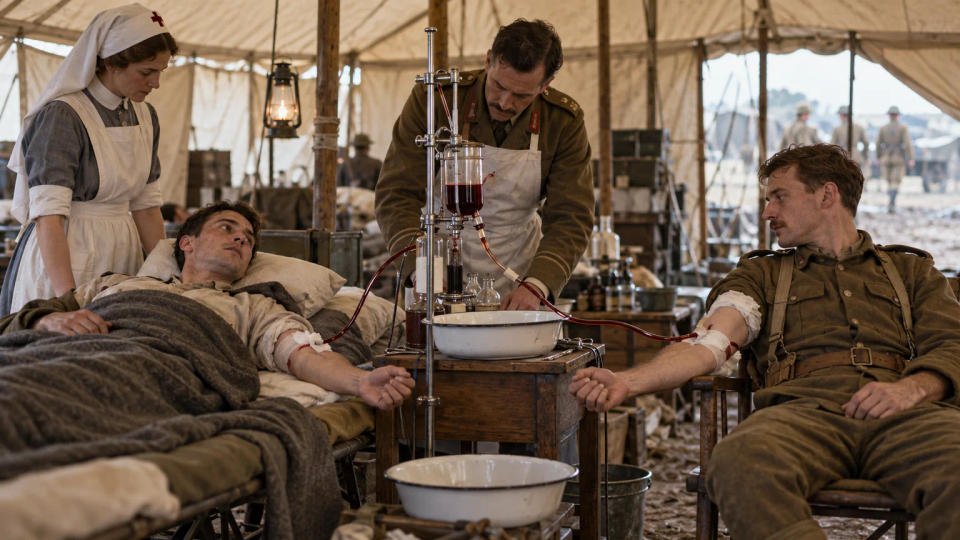
Canadian surgeon Lawrence Bruce Robertson became one of the important advocates for using whole blood to treat hemorrhagic shock near the Western Front. Working with Canadian and British medical units, he demonstrated that transfusion could restore casualties who might otherwise be too weak for surgery. His work helped convince military surgeons that blood could do something saline alone often could not: replace the lost blood itself.
Citrate and Glucose Made Stored Blood Possible
The breakthrough did not come from one wartime invention by one person. It emerged from a chain of research just before and during the conflict. Between 1914 and 1915, several investigators showed that sodium citrate could be added to blood to prevent clotting without making transfusion impractical. Richard Lewisohn in New York helped establish workable citrate concentrations for clinical use.
Then, in 1916, Peyton Rous and J. R. Turner at the Rockefeller Institute developed a citrate-glucose preservative solution. The glucose helped red blood cells survive longer during storage, while citrate prevented coagulation. Refrigeration added another crucial part of the system. Together, these advances meant blood could be collected in advance, kept for a period of time, and transfused later instead of immediately.
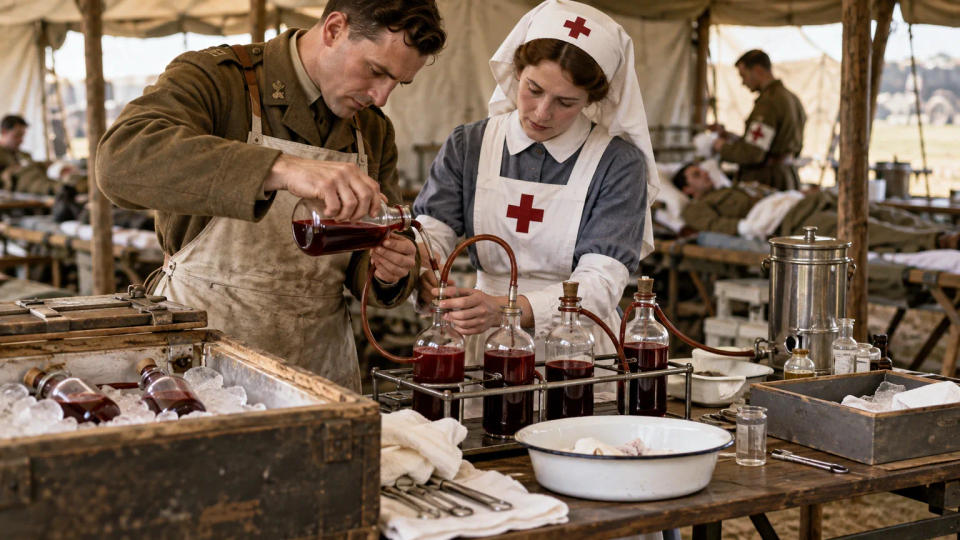
This sounds routine today, but it changed the basic logic of transfusion. Blood could now be separated in time and space from its donor. Once that became possible, doctors could begin thinking about blood as something that could be collected, stored, transported, and issued where casualties were expected.
Oswald Robertson Turned Preserved Blood Into a Battlefield Supply
American physician Oswald Hope Robertson brought that laboratory progress into wartime practice after arriving in France in 1917 with the Harvard medical unit attached to the British Expeditionary Force. Robertson had worked in Rous’s laboratory and understood the new preservation methods. On the Western Front, he began collecting blood from selected donors into glass containers containing anticoagulant and preservative solution, then keeping the blood cool until it was needed.
During the fighting of 1917 and 1918, preserved blood could be carried forward to casualty clearing stations rather than waiting for a fresh donor to appear after a wounded soldier arrived. Historical accounts often describe Robertson’s wartime service as the first blood depot or even the first blood bank. The National Army Museum, for example, identifies July 1917 as the establishment of the first blood bank on the Western Front.
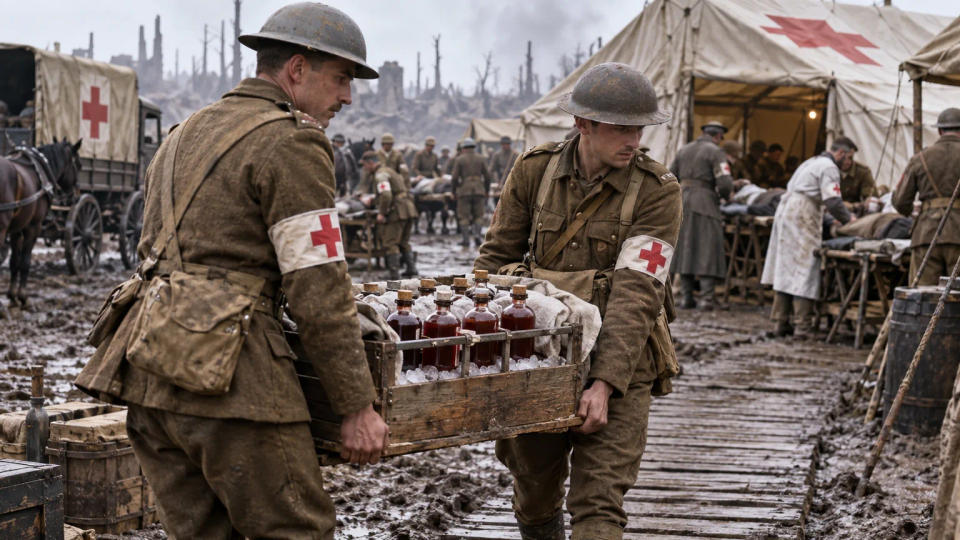
The terminology needs a little care. What Robertson organized was closer to a military blood depot than to the large civilian blood banks familiar today. But the essential idea was there: collect blood before the emergency, preserve it, move it through a supply system, and have it ready close to the place where patients would need it.
That logistical shift was especially valuable before major offensives, when medical units could anticipate heavy casualties. Instead of treating transfusion as an improvised procedure performed only when a donor could be found, armies could begin preparing blood as part of resuscitation planning.
Battlefield Transfusion Helped Reshape Emergency Medicine
World War I did not make transfusion perfectly safe. Blood-group testing was still developing, compatibility procedures were not yet standardized everywhere, storage methods were limited, and transfusion remained far less common than it would become later. Doctors also had incomplete knowledge of other blood-group systems that would be discovered in the following decades.
Still, the wartime experience showed that stored blood could be practical in trauma care. By the later years of the war, transfusion was increasingly used in the treatment of severe blood loss and shock, including to stabilize patients before or during surgery. Specialized resuscitation teams and casualty clearing stations helped integrate transfusion into a broader system of battlefield surgery.
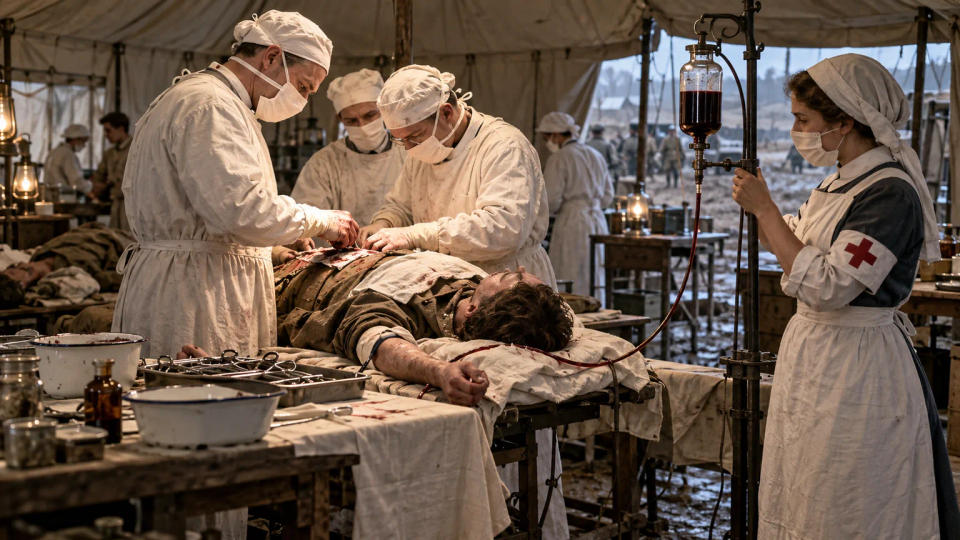
The war also taught an organizational lesson that extended beyond the front: lifesaving blood depended not only on medical technique but on donors, testing, containers, cooling, transport, records, and trained staff. In other words, transfusion was becoming a supply system as well as a procedure.
Conclusion
World War I did not create the modern blood bank in its final form, but it helped prove the system that made one possible. Wartime doctors showed that preserved blood could be collected in advance and moved toward patients instead of forcing every transfusion to begin with a donor at the bedside.
The next major steps came after the war. Blood depots and organized transfusion services expanded in several countries, and in 1937 Bernard Fantus established a hospital blood bank at Cook County Hospital in Chicago and popularized the term “blood bank.” By then, the wartime lesson was unmistakable: stored blood could be treated as an organized medical resource, ready before the emergency began.
Sources & Further Reading
- National Army Museum — First blood bank established on Western Front
- AABB — Transfusion Medicine History
- Oswald H. Robertson, “Transfusion with Preserved Red Blood Cells,” British Medical Journal, 1918
- Canadian Journal of Surgery — Lawrence Bruce Robertson and World War I transfusion
- Cook County Health — The Blood Bank