
How did a material made for wartime medicine help lead to the tissue box on a bathroom counter? During World War I, Kimberly-Clark's wood-pulp-based Cellucotton became an important substitute for scarce surgical cotton. The war did not produce Kleenex directly, but it pushed Cellucotton into large-scale medical use and gave the company the material, manufacturing experience, and postwar problem that eventually helped create a new family of disposable consumer products.
That distinction matters. Kleenex arrived after the fighting ended, and its first advertised purpose was not blowing noses at all. Its path ran from European papermaking experiments to military dressings, then through postwar product development and finally into American homes.
Cellucotton Began as a Cotton Substitute, Not a Facial Tissue
In 1914, Kimberly-Clark researchers Ernst Mahler and James C. Kimberly encountered a lightweight creped cellulose wadding while visiting paper mills in Europe. The material was made from processed wood pulp rather than cotton. Kimberly-Clark developed its own version and trademarked it as Cellucotton.
When World War I disrupted supplies and drove demand for absorbent medical material, Cellucotton found a practical use. Kimberly-Clark promoted it as a substitute for surgical cotton, and it was used in wartime dressings. The company also experimented with a flatter form of the material for gas-mask filters, although the end of the war cut short that project.
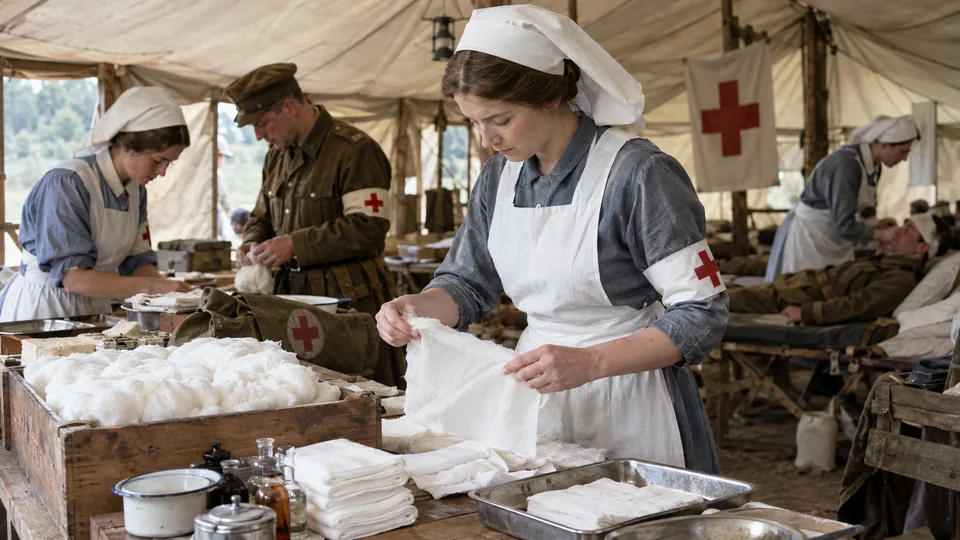
The key advantage was not glamour but function: wood pulp could be turned into a soft, absorbent material at a time when cotton was badly needed elsewhere. World War I therefore gave Cellucotton a demanding real-world test and a large wartime market.
Wartime Dressings Opened a Door to Disposable Consumer Products
One of the most important postwar developments happened outside the original military purpose. The Smithsonian's National Museum of American History notes that battlefield nurses used Cellucotton bandages as sanitary napkins because the material was highly absorbent. After the war, Kimberly-Clark adapted Cellucotton for a commercial menstrual product sold under the Kotex name.
That step is important to the Kleenex story because it showed that a material associated with emergency medicine could become an everyday disposable product. Kimberly-Clark already knew how to manufacture Cellucotton, and it now had experience turning the material into a branded consumer good.
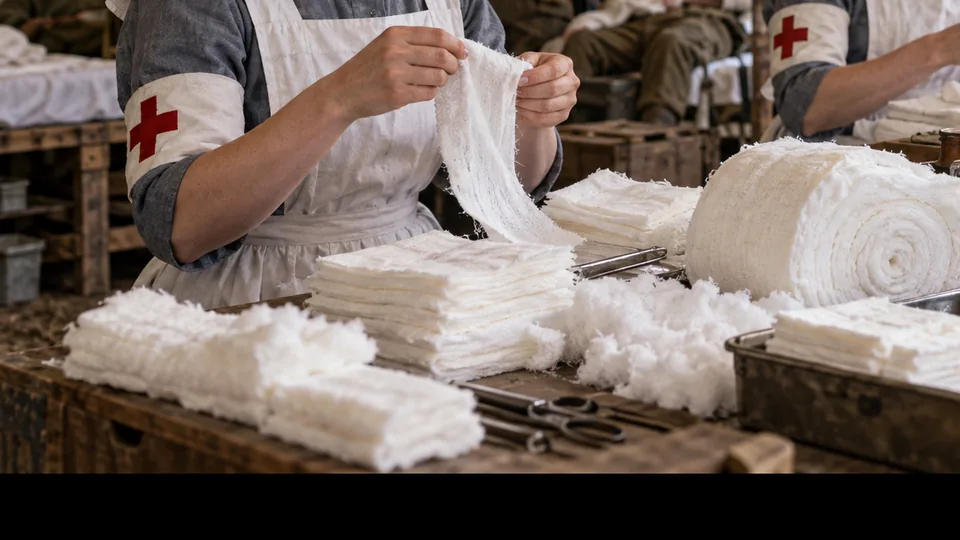
There was also a practical postwar question: what could be done with the production capacity and cellulose technology that had been so useful during the conflict? Rather than treat wartime demand as a temporary dead end, the company kept experimenting with softer, smoother forms of cellulose material.

Kleenex Was First Sold for Removing Cold Cream
In the early 1920s, Kimberly-Clark employee C. A. "Bert" Fourness worked on making the cellulose material smoother and softer. Company history describes experimentation with pressing or ironing the material until it had the feel needed for a delicate disposable tissue. The result became Kleenex, introduced in 1924.
Yet the product Americans first met was not presented primarily as a handkerchief. Kleenex was marketed as a convenient way to remove cold cream and cosmetics from the face. Kimberly-Clark's historical account says a package of 100 sheets sold for 65 cents, and early advertising connected the product with beauty routines and Hollywood-style glamour.
The brand name also reflected that consumer strategy. According to Kleenex's own history, the "Kleen" portion suggested cleansing, while the "-ex" ending linked the new tissue to Kotex. In other words, the familiar facial-tissue brand grew from a broader attempt to build consumer products out of cellulose technology refined during and after the war.
Consumers Turned Kleenex Into the Disposable Handkerchief
The final transformation came from how people actually used the product. Some customers reached for Kleenex when they had colds or allergies instead of using a cloth handkerchief. Kimberly-Clark began testing that idea in its marketing, and by 1930 the company's advertising had shifted toward the disposable-handkerchief use that now seems obvious.
Packaging helped. In 1929, Kimberly-Clark introduced a pop-up dispensing box for interfolded tissues, making it easier to pull out one sheet at a time. The combination of a soft disposable sheet and a convenient dispenser fit household routines far better than the product's original narrow role as a cosmetic remover.
Kimberly-Clark's corporate history says consumer letters and market research encouraged the change in positioning and that sales doubled in the first year of the new campaign. That account comes from the company itself, but the wider chronology is supported by museum and historical records: Kleenex appeared in 1924, was initially sold as a cleansing tissue, and was increasingly promoted as a disposable handkerchief by the end of the decade.
What World War I Actually Contributed to Kleenex
It is tempting to say that World War I "invented" Kleenex, but that overstates the connection. Facial tissue was a postwar consumer invention. What the war did was accelerate the development and production of Cellucotton, prove that wood-pulp cellulose could replace cotton in absorbent medical uses, and leave Kimberly-Clark with both technical experience and an incentive to find peacetime applications.
The chain was indirect but real: creped cellulose became Cellucotton; Cellucotton served wartime medical needs; its absorbency encouraged postwar disposable products; and further refinement produced the soft cleansing tissue launched as Kleenex. Consumers then gave that tissue the everyday job for which it became famous.
That is why the history of the facial tissue is less a story of a single wartime invention than of repurposing. A material developed for scarcity and mass medical care survived the armistice because engineers, marketers, nurses, and customers kept finding new uses for it.
Conclusion
The tissue box did not come straight from the trenches, but its material history runs through them. World War I helped turn Cellucotton into a proven mass-produced absorbent material, and the postwar search for civilian uses eventually helped make Kleenex a household product.
Sources & Further Reading
- Kimberly-Clark — Disposable Facial Tissues Story
- National Museum of American History — Sanitary Napkins (Pads)
- Kleenex — Brand History
- Wisconsin Historical Society — Cellucotton Processing Machine, 1922