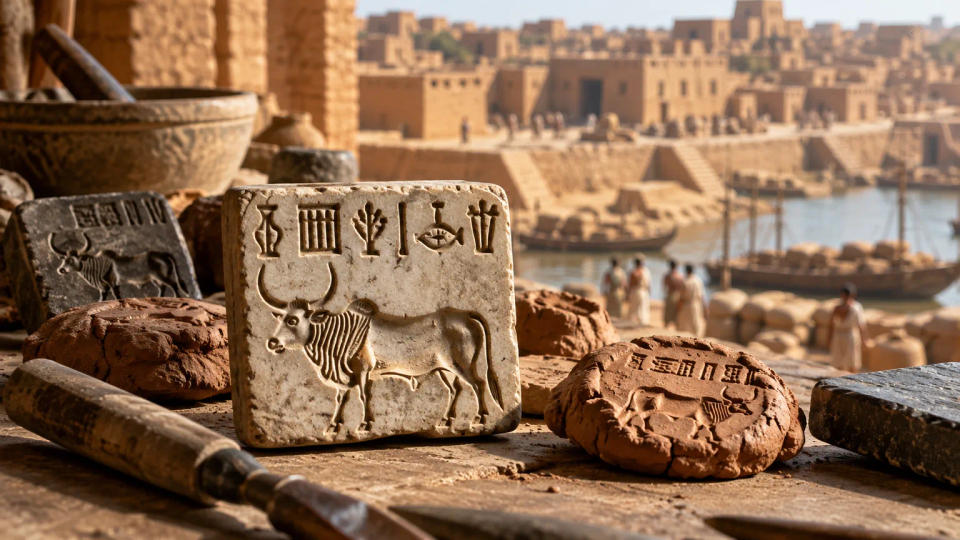
What would it take to read a civilization that left thousands of written-looking marks, but almost no long texts? That is the problem posed by the Indus script, used during the mature phase of the Indus or Harappan Civilization, roughly 2600–1900 BCE. More than a century after archaeologists began publishing its signs, there is still no decipherment accepted across the field.
The reason is not that scholars have ignored it. The script survives mostly in tiny, repetitive inscriptions on seals, sealings, tablets, pottery and other objects. There is no known bilingual inscription, the underlying language is uncertain, and even the nature of the sign system remains debated. Those obstacles combine to make the Indus script unusually hard to crack.
The Surviving Texts Are Almost All Too Short
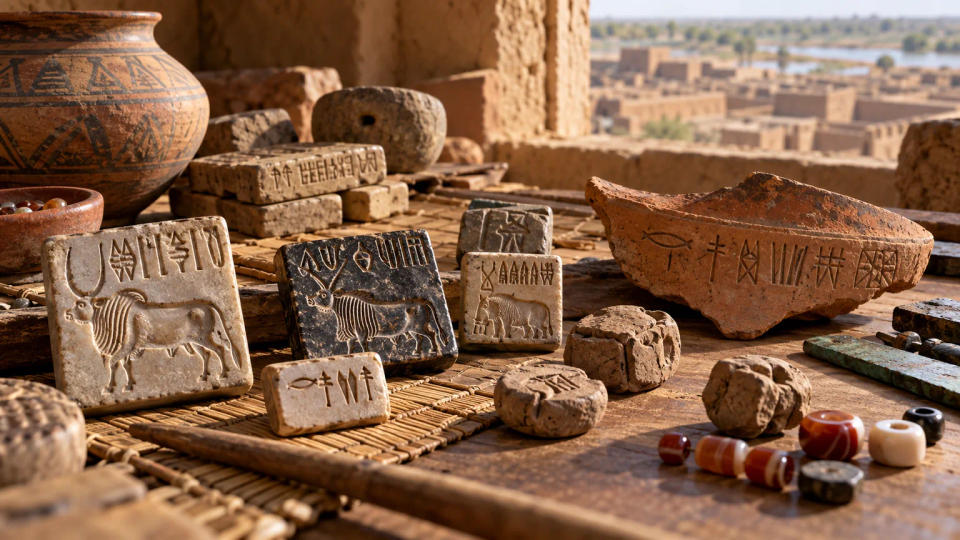
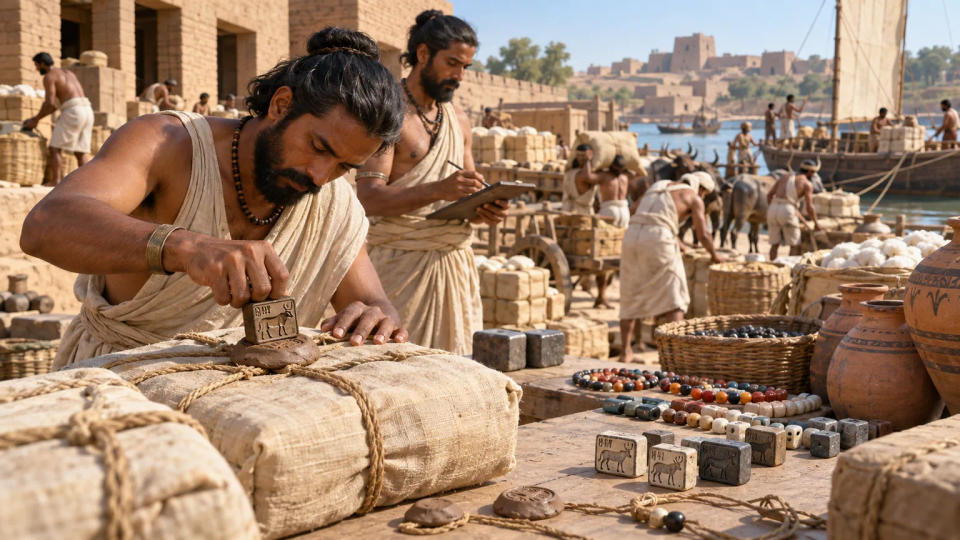
Most famous Indus inscriptions appear above animals on small square stamp seals. The Metropolitan Museum of Art dates a typical example to about 2600–1900 BCE and notes that such seals could function as marks of ownership or status. The Archaeological Survey of India likewise says most surviving examples occur on seals and their impressions, although signs also appear on terracotta and metal tablets, copper objects and pottery.
The problem is length. Researchers repeatedly emphasize that Indus texts are extraordinarily brief. Many contain only a handful of signs, and long connected documents comparable to Mesopotamian tablets or Egyptian monumental inscriptions have not survived. A short string may reveal repeated patterns, but it gives very little context for deciding whether a sign means a sound, a word, a title, a number, a commodity, or something else.

This is why the quantity of artifacts can be misleading. Thousands of inscribed objects sound like an enormous archive, yet thousands of five-sign texts do not provide the same linguistic evidence as even one long legal contract, hymn, letter, or royal inscription. Scholars can compare sign positions and frequencies, but they have very few extended sequences in which grammar might become visible.
There Is No Indus Valley Rosetta Stone
Some ancient scripts were unlocked because the same message survived in both an unknown and a known writing system. The Rosetta Stone famously helped scholars connect Egyptian hieroglyphs with a readable Greek text. Nothing equivalent has been found for the Indus script.
This missing bridge matters because researchers do not securely know what language, or languages, the signs represent. Dravidian has long been proposed by influential scholars, while other linguistic possibilities have also been argued. None has been demonstrated strongly enough to serve as the fixed starting point for a full decipherment. There is also a minority view that the signs may not encode ordinary spoken language at all.
That creates a circular trap. To identify the language, scholars would like to read the script. To read the script, it would help enormously to know the language. Without bilingual text, recognizable names, or long passages, proposed readings are difficult to test independently.
Researchers Can See Structure Without Knowing the Words
Undeciphered does not mean completely mysterious. The Archaeological Survey of India reported in 2025 that more than 400 principal characters have been proposed in the documented corpus, although exact totals depend on whether similar forms are counted as separate signs or variants. It also noted broad agreement that the usual direction of writing is right to left, while some inscriptions run differently, and that certain stroke-like signs probably function as numerical notation.
Statistical studies have added more clues. Research published in Humanities and Social Sciences Communications has examined where signs tend to occur and how short sequences are organized without assigning them specific sounds. Other computational work has found patterned constraints in sign order that resemble features seen in linguistic systems. Such results can help identify prefixes, endings, numerical elements, or recurring units—but pattern recognition is not the same thing as translation.
A sequence that regularly appears at the end of inscriptions might be a title, grammatical ending, commodity label, institutional marker, or something else entirely. Until its meaning can be anchored to external evidence, several explanations can often fit the same pattern.
Why Claimed Decipherments Rarely Win Broad Acceptance
The Indus script has inspired many proposed solutions. A common problem is that a theory begins by choosing an assumed language or sign value and then finds readings that seem to support that assumption. With short inscriptions, it is easier than with long texts to produce interpretations that appear plausible but cannot predict how unseen inscriptions should behave.
A convincing decipherment would need to work across a large portion of the corpus, explain recurring sign patterns consistently, fit archaeological context, and produce readings that can be checked rather than adjusted case by case. This standard is especially important because researchers still debate basic questions such as which marks are independent signs and which are merely graphic variants.
The debate also has consequences beyond epigraphy. If a decipherment identified the language of the Indus cities, it could reshape arguments about population history and linguistic development in South Asia. That makes rigorous testing especially important. The safest position remains that individual hypotheses can be interesting or productive without being treated as solved readings.
What Could Finally Break the Deadlock?
The most valuable discovery would be a substantial bilingual or multilingual inscription pairing Indus signs with a known ancient script. A long Indus text with clear archaeological context would also be transformative, because repeated words, grammatical patterns and internal structure could be tested over many sentences rather than a few symbols.
New excavation and better documentation may therefore matter more than a single clever algorithm. Digital sign catalogues, high-resolution imaging and computational analysis can narrow possibilities, compare variants and reveal structure. But computers cannot manufacture the missing historical key. The Archaeological Survey of India’s 2025 conference on the “current status and way forward” itself underscores that the script remains an active research problem rather than a solved one.
Conclusion
The Indus script has resisted decipherment because the evidence arrives in the worst possible combination: texts are extremely short, the language is unknown, no bilingual key has been found, and the sign system itself is still debated. Scholars have learned meaningful things about direction, repetition and structure, but those clues have not yet produced readings that can be independently verified. A future excavation may change that in a single season. Until then, the small seals of the Indus cities remain some of the ancient world’s most information-rich objects—and some of its most stubbornly silent.
Sources & Further Reading
- Archaeological Survey of India — Decipherment of Indus Script: Current Status and Way Forward (2025)
- British Museum — Indus Valley Civilisation collection overview
- The Metropolitan Museum of Art — Indus stamp seal and modern impression
- Humanities and Social Sciences Communications — Interrogating Indus inscriptions to unravel their mechanisms of meaning conveyance
- Antiquity — Dravidian and the Decipherment of the Indus Script