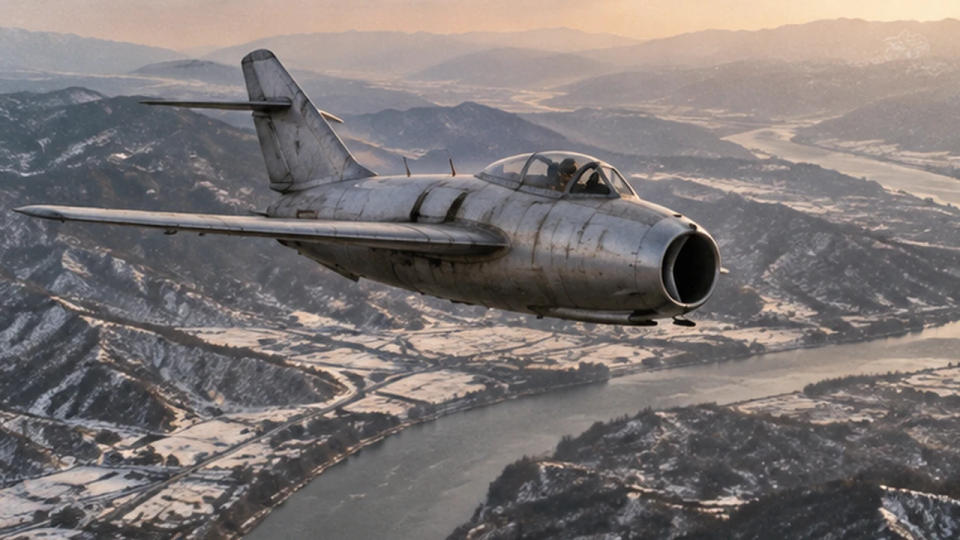
Why did American fighter pilots encounter Soviet-built jets flown by actual Soviet airmen during a war in which Moscow officially denied fighting? The answer lies in a dangerous Cold War bargain: Stalin wanted to shield North Korea and China from United Nations air power, but he did not want the Korean War to become an open Soviet-American war. The MiG-15 made that compromise possible—and also exposed how fragile it was.
The secret was never perfect. U.S. pilots sometimes heard Russian voices over the radio, even as their opponents flew aircraft marked as Chinese or North Korean. Above northwestern Korea, the two superpowers were already fighting each other, although neither advertised that fact to the world.
Why Moscow Sent Fighters Without Declaring War
North Korea invaded South Korea on June 25, 1950. The United States and other countries fought under United Nations command to defend the South. As the conflict shifted northward and Chinese forces entered the war, the skies around the Yalu River became strategically urgent. The bridges linking China and North Korea helped sustain communist forces, while U.S. bombers threatened transportation networks and military facilities.
Moscow had a problem. North Korea was an important communist ally, and China needed help building an effective modern air force. Yet sending openly identified Soviet combat formations against American units risked a superpower confrontation that neither side could reliably contain. Stalin had already been cautious about direct intervention after the United States entered the war.
According to the National Museum of the United States Air Force, Soviet pilots were in China training its new air force before the Korean War began. In August 1950 the Soviets secretly moved MiG-15s to Antung, now Dandong, opposite North Korea. Soviet pilots flew their first combat missions over North Korea in early November. Their assignment was not to conquer the Korean skies from one end of the peninsula to the other; it was primarily to defend the critical northern approaches and support communist operations.
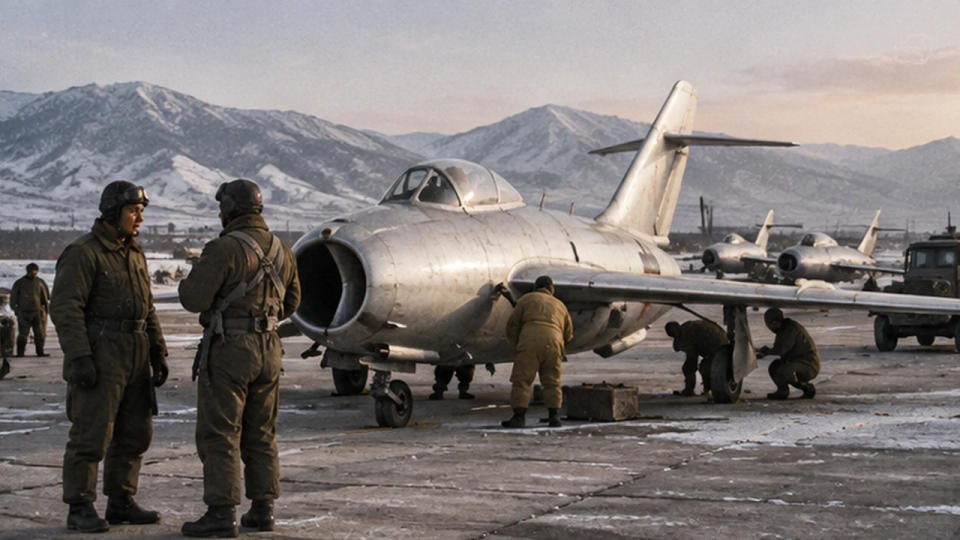
Archival research helps explain why Stalin imposed such awkward conditions. Historian Kathryn Weathersby's study of Soviet records describes an intervention deliberately kept secret. Soviet aircraft could wear North Korean markings, and Soviet pilots could wear Chinese uniforms. These measures did not change who controlled the pilots. They changed what an observer—or a government deciding whether to escalate—could publicly prove.
Secrecy was therefore not an incidental disguise. It was built into the mission. The Soviets offered a valuable military capability without openly accepting the political consequences that might follow if regular Soviet units were acknowledged as combatants.
How the MiG-15 Turned the Yalu Into “MiG Alley”
The MiG-15 was an especially useful aircraft for this limited mission. Its swept wings, strong climb and high-altitude performance made it a dangerous interceptor: a fighter designed to climb quickly and attack enemy aircraft, particularly bombers. When MiGs appeared in November 1950, they challenged the older American F-80 Shooting Star and threatened a previously favorable air situation for United Nations forces.
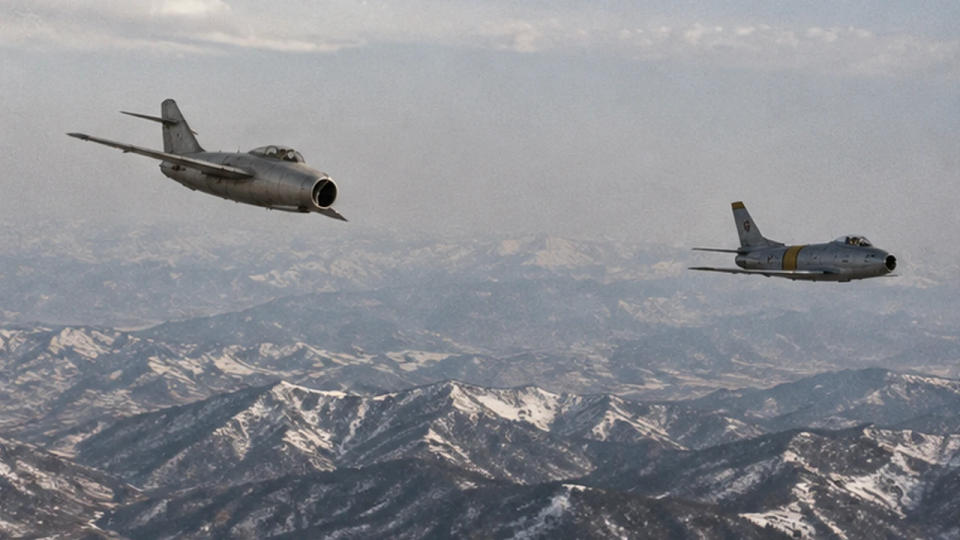
The United States responded with the swept-wing F-86 Sabre, which entered combat in December 1950. The contest was not simply a race to see which airplane had the highest published speed. Pilot training, visibility, gunsights, maneuvering and the ability to choose when to fight mattered at least as much as specifications. Some Soviet veterans brought experience from the Second World War; later, Chinese and North Korean pilots also operated the MiG-15. It would be inaccurate to describe every MiG seen over Korea as Soviet-flown.
The geography shaped the air war. Antung and nearby Chinese airfields stood across the Yalu River, outside the normal area where United Nations forces were permitted to strike. MiGs could take off from relative sanctuary, gain altitude, cross into northwestern Korea and attack aircraft there. Damaged fighters might then flee back toward Chinese territory.
Because Stalin feared a captured Soviet airman would reveal Moscow's direct role, Soviet pilots were ordered to remain near their bases and avoid enemy-held areas. The result was the air-combat zone nicknamed “MiG Alley,” concentrated in the northwest rather than throughout Korea. These restrictions protected the secret but also limited the Soviet pilots' ability to influence battles farther south.
On November 8, 1950, an American F-80 pilot, Russell J. Brown, was credited with a MiG-15 shootdown during the first all-jet air battle. The event illustrates how quickly the conflict changed: fighters that had seemed technologically advanced only a few years earlier were suddenly confronting a new generation of aircraft. Detailed victory claims from both sides should nonetheless be treated cautiously; wartime claims and later reconstructions do not always agree.
A Disguise That Became an Open Secret
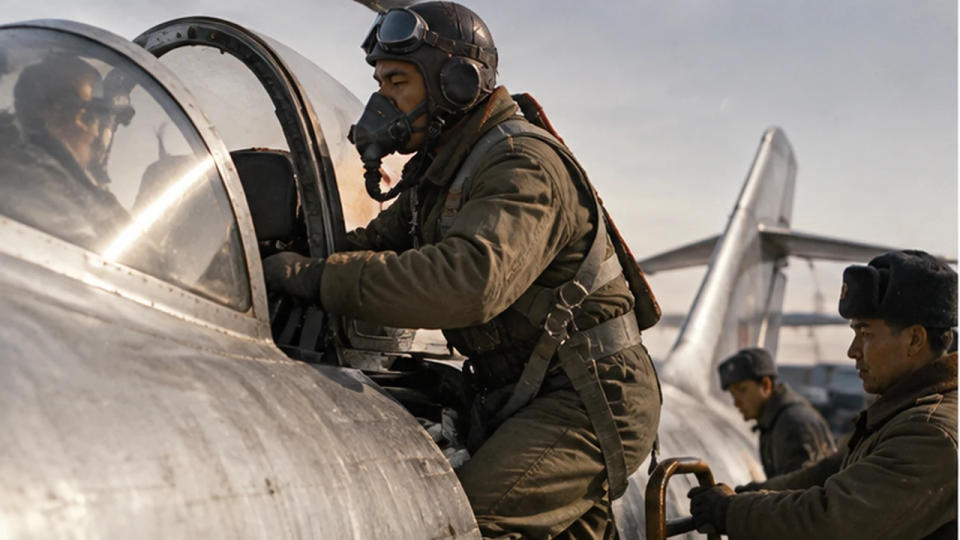
The Soviet cover story required more than different insignia. Soviet pilots were reportedly ordered to use Korean phrases in radio communications. In the pressure of combat, however, American pilots sometimes heard Russian. U.S. accounts also describe sightings of non-Asian airmen in opposing cockpits or descending by parachute. As the National Museum of the United States Air Force puts it, Soviet participation became an open secret among many combat pilots.
Sabre pilots sometimes called their more capable MiG opponents “honchos,” distinguishing them from less-experienced airmen. That nickname does not by itself prove the nationality of any particular opponent. It does show that pilots recognized differences in combat skill and experience, which were substantial in the early jet age.
Why keep pretending when so many people suspected the truth? The distinction between private knowledge and formal acknowledgment mattered. An intercepted voice or eyewitness account was not the same thing as a captured Soviet officer, a public Soviet order of battle or a Kremlin admission. Ambiguity gave leaders room to avoid turning an already devastating regional war into an open military showdown between nuclear-armed rivals.
Both sides operated under boundaries intended to reduce that danger. The Soviets restricted where their crews could fly; United Nations forces were generally barred from attacking bases across the Chinese border. Those rules were imperfect and did not prevent fierce fighting. But they reveal a striking contradiction: the belligerents were pursuing lethal air combat while carefully limiting the places where that combat could happen.
The aircraft itself continued to attract extraordinary attention. In April 1953, U.S. authorities offered a reward for an intact MiG-15. The Korean armistice came on July 27 without the United States acquiring one for flight tests. Only on September 21, after the fighting had stopped, did North Korean pilot No Kum-Sok land his MiG-15bis at Kimpo. He was a North Korean pilot, not one of the covert Soviet flyers; his story is a reminder that nationality and aircraft type should not be confused.
Conclusion
Soviet pilots secretly flew MiG-15s in the Korean War because Moscow wanted to defend its communist partners and contest U.S. air power without openly fighting the United States. False markings, restricted flight areas and attempted radio deception were tools of that risky strategy. The result was a real, often deadly air war inside a larger war whose political limits were as important as the jets themselves.
The most revealing fact is not that the secret eventually became known. It is that an imperfect secret could still serve a purpose: it helped rival governments fight in the same sky while trying to prevent the conflict from becoming something even more catastrophic.
Sources & Further Reading
- National Museum of the U.S. Air Force — Soviet Pilots over MiG Alley
- Kathryn Weathersby, Wilson Center — Soviet Aims in Korea and the Origins of the Korean War, 1945–1950
- National Museum of the U.S. Air Force — MiG Alley: Sabre vs. MiG
- National Museum of the U.S. Air Force — Air Superiority: Controlling the Skies
- U.S. Air Force — Korean War Pilot Achieves Aviation First
- National Museum of the U.S. Air Force — The Story of the MiG-15bis on Display