
What if an enemy stopped a courier carrying a message that could change the course of a war? Long before computers, people protected secrets in two basic ways: they hid the message itself, or they changed its contents into something an outsider could not understand. Both approaches had surprisingly long histories, and neither always worked.
These were not substitutes for modern digital security in the technical sense. Many were already forms of encryption, but they relied on parchment, wooden rods, letter substitutions, secret instructions, and the judgment of the people carrying them. The most fascinating part is how often a message's safety depended on ordinary objects.
Ancient Messages: Hide the Letter or Rearrange Its Words?
The Greek historian Herodotus described a striking concealment trick: a warning was supposedly tattooed onto a messenger's shaved scalp and hidden until his hair grew back. It is an ancient literary account, not proof that this was a routine intelligence method. Still, it captures the simplest idea behind steganography: make the existence of a message difficult to notice.
Another device associated with ancient Greece was the Spartan scytale. Later descriptions explain how a narrow strip of material could be wound around a rod, written on, then unwound. The letters on the loose strip would appear disconnected until the recipient wrapped it around a matching rod.

It sounds like an elegant military cipher. Yet historians disagree about what early Spartan sources actually establish. The clearest descriptions of the rod as a cryptographic device come from later writers, while earlier references do not settle the question. The scytale is useful for understanding a transposition technique, but claims that Spartan commanders routinely used it centuries earlier deserve caution.
Either way, hiding information and scrambling information solved different problems. A concealed letter was vulnerable if discovered; a scrambled letter could be seen but not immediately understood. Combining the two offered an obvious advantage, provided the receiver knew what to look for.
From Caesar's Letter Shift to the First Codebreakers
Julius Caesar is associated with a simple but memorable system. According to the Roman biographer Suetonius, Caesar replaced each letter with one three places further along the alphabet when writing confidential material. In a modern English demonstration, A becomes D, B becomes E, and C becomes F.
That is a substitution cipher: the letters stay in the same order, but each is replaced according to an agreed rule. It could prevent a casual reader from understanding a message. Someone who knew or guessed the shift, however, could reverse it quickly. Simple ciphers were practical because the sender and receiver needed little equipment; their weakness was just as simple.
By the ninth century, scholars in the Arabic-speaking world had developed a more systematic way to attack secret writing. The polymath al-Kindi left a surviving explanation of what we now call frequency analysis. In ordinary language, some letters occur more often than others. When a cipher consistently replaces the same letter with the same symbol, those patterns can survive in disguised form.
Counting repeated symbols did not magically reveal every secret. The length of the message, the language, the kind of cipher, and the codebreaker's skill all mattered. But it changed the contest. Keeping the alphabet substitution secret was no longer enough if a careful reader could work backward from patterns in the text.
Renaissance Cipher Wheels and Mary, Queen of Scots
European rulers and diplomats needed more elaborate systems as political correspondence expanded. In the 1460s, the Italian humanist Leon Battista Alberti wrote a treatise describing movable cipher disks. Rotating alphabets made it possible to change how letters were represented within a message, rather than relying on a single fixed substitution.
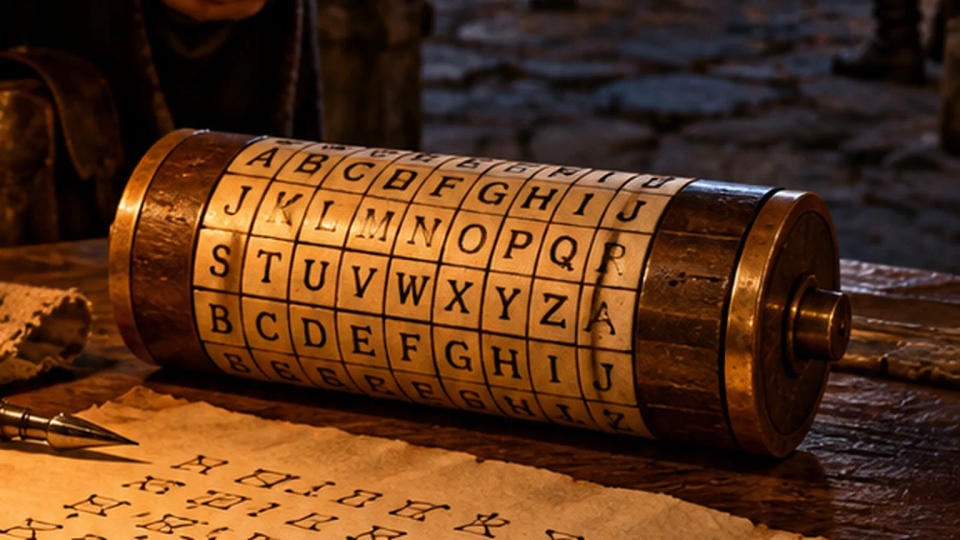
Early cipher wheels were not electronic machines. They were small physical aids to a more demanding mental task: keeping sender and recipient synchronized as the substitution changed. If one person used the wrong setting, even a legitimate recipient could find the text unintelligible. More complexity improved resistance to some attacks, but it also introduced room for mistakes.
The danger of an intercepted cipher became devastatingly clear in 1586. Mary, Queen of Scots, was imprisoned in England while conspirators sought to replace Elizabeth I. Letters between Mary and Anthony Babington traveled through a covert channel involving beer barrels. What Mary did not know was that Elizabeth's intelligence chief, Francis Walsingham, had compromised the channel.
Walsingham's cryptanalyst Thomas Phelippes deciphered Mary's correspondence. A letter dated July 17, 1586, became central evidence in the Babington Plot. According to the British Library's account, the intercepted letter was also altered before it continued to Babington, in an effort to obtain more incriminating information.
This case illustrates a flaw no clever alphabet can fix on its own. A message can be encrypted yet still pass through a courier or delivery route controlled by an opponent. The attacker may learn its contents, alter it, or discover who is communicating. Secrecy depends on the entire chain, not just the cipher.
Invisible Ink and Secret Networks in the American Revolution
Two centuries after Alberti, the American Revolution created another urgent demand for confidential correspondence. George Washington depended on information from inside British-controlled territory. Agents in the network commonly called the Culper Ring used coded letters, intermediaries, and precautions intended to protect both intelligence and identities.
Some messages were concealed inside seemingly harmless correspondence. The Smithsonian's National Postal Museum describes a June 1779 example in which Washington enclosed sensitive instructions within an innocuous outer letter. If the outside letter attracted less attention, the real message had a better chance of arriving.

Revolutionary-era espionage also made use of invisible ink, including specially prepared secret writing that required an appropriate method to reveal. The important point was not that paper looked magical. It was that a seemingly ordinary letter could carry more than its visible words. If a searcher did not suspect another layer, the hidden writing might escape notice.
These methods were hardly foolproof. A suspicious letter could be examined, a courier questioned, a codebook lost, or a spy identified. Even a perfectly written secret message was useless if it arrived too late. Intelligence depended on trusted people and reliable routes as much as it depended on chemistry or clever symbols.
What connects Herodotus's tale, the debated Spartan rod, Renaissance cipher wheels, and Washington's letters is a recurring practical question: what will an interceptor actually see? Sometimes the answer was nothing unusual. Sometimes it was a string of strange letters. Sometimes it was an ordinary-looking document whose visible words were only a cover.
Conclusion
Before digital encryption, secret communication was already a contest between concealment, cryptography, and codebreaking. People used the tools they had—wood, ink, paper, metal disks, and human networks—and learned that protecting a message meant protecting its journey too.
Sources & Further Reading
- U.S. National Archives — A Glimpse into the Art of Secret Writing
- University of New England Museum of Antiquities — Ancient Codebreaking
- University of New England Museum of Antiquities — Medieval Codebreaking
- Carnegie Mellon University Libraries — Alberti's Treatise on Ciphers
- British Library — The Gallows Letter
- Smithsonian National Postal Museum — Letters of the Revolutionary War