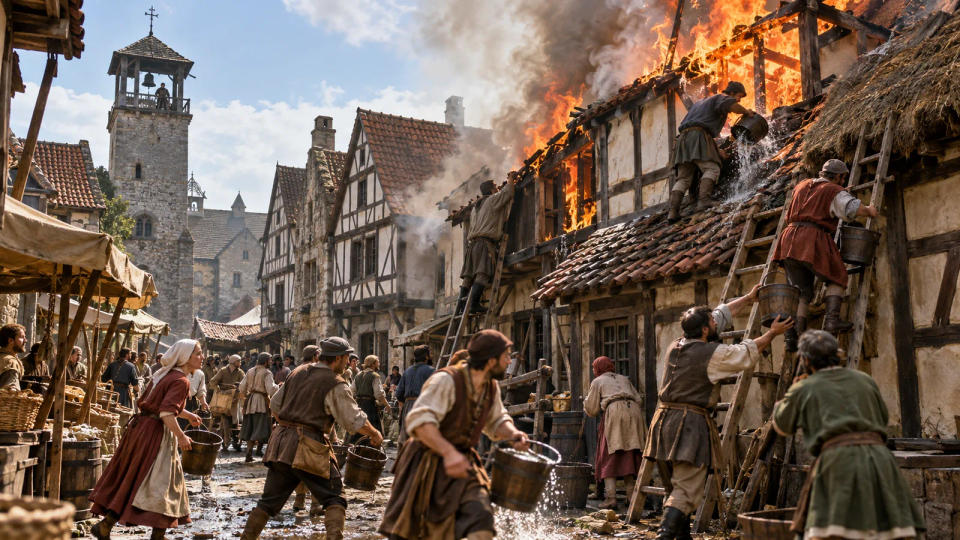
What happened when a roof caught fire in a medieval town, long before a modern fire engine could race to the scene? Neighbors carried water, watchmen raised the alarm, and townspeople used buckets, ladders, and long hooks to keep the flames from reaching the next building. Their best defense, though, often began years before the fire: rules about how houses could be built and how dangerous work should be done.
That combination of quick action and prevention mattered. Homes, workshops, and market buildings crowded together, while cooking, heating, baking, and metalworking all depended on flame. Medieval towns were not helpless in the face of fire, but neither could they count on stopping a blaze once it took hold.
Spotting Smoke Before a Fire Spread
In a closely built town, a small fire could become a neighborhood emergency. Timber frames, wooden roofs, and combustible coverings gave flames places to travel. The danger was especially serious when a fire reached an upper floor or roof, where it could threaten surrounding buildings.
Early warning was therefore essential. The Germanisches Nationalmuseum describes fire watches organized in medieval towns to spot outbreaks. Watchmen and other townspeople could alert a community before a blaze grew beyond the reach of people carrying water by hand.
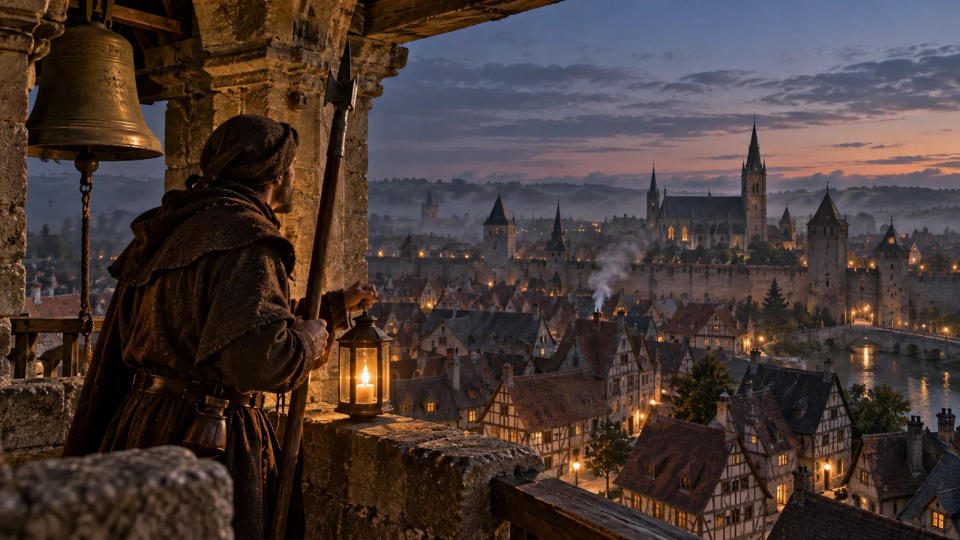
Watch systems varied from place to place. In some towns, guarding the streets was tied to broader arrangements for keeping order and protecting the walls. Such arrangements were not modern fire departments: they were local systems of vigilance, dependent on people recognizing danger and responding quickly.
That distinction is important. The familiar image of a single bell waking an entire medieval city may be plausible in some settings, but it should not be treated as one universal procedure. Surviving records tell us more reliably that organized watches and public obligations formed part of urban fire protection.
Water, Buckets, and the Duty to Help
Once flames were discovered, there was no motorized pump waiting around the corner. People needed containers, a source of water, and enough hands to move it. Wells, water supplies, and stored water were practical defenses only if residents could reach them in time.
Some towns prepared collectively. Research on late medieval Ghent notes that more than a hundred buckets were kept beneath the aldermen's hall and distributed by officials when fire broke out. That is a striking detail: firefighting equipment was not always left to whichever householder happened to own a bucket.
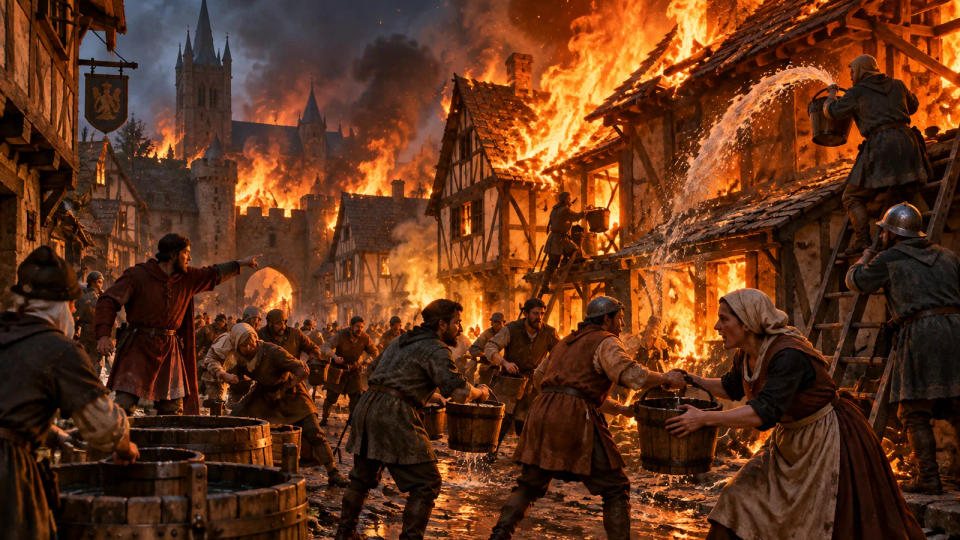
In German towns described by the Germanisches Nationalmuseum, citizens had an obligation to help fight fires. Local rules called for leather buckets and other equipment to be available. A fire master could direct the response, while certain trades were expected to contribute useful resources, including the large tubs associated with bathhouses.
Passing buckets from hand to hand was straightforward, but the limits were severe. Water had to be carried to the flames, lifted if the fire was high up, and replenished again and again. When the nearest supply was far away, every trip cost time. A large fire could easily outrun a line of people with small containers.
Nor were these rules identical throughout Europe. A town's wealth, water access, political organization, and building materials shaped what it could actually provide. Written regulations show what authorities wanted residents to do; they do not prove that every household was prepared on every occasion.
Why Firefighters Brought Hooks and Ladders
Water was only part of the medieval toolkit. Studies of German towns record requirements to have ladders, buckets, and crooks or hooks ready. A ladder helped people reach a roof or upper wall, while a long-handled hook could pull burning thatch or other material away from a structure.
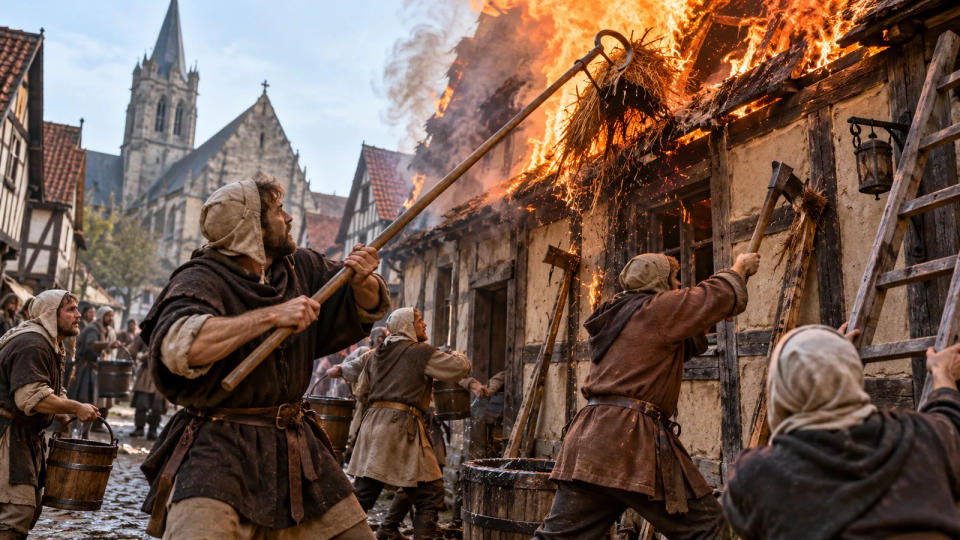
The aim was not always to rescue the building already burning. Removing fuel could slow the fire and protect the houses beside it. In a town where walls and roofs stood close together, saving a row of homes might mean accepting serious damage to one structure.
Hooks and axes could be used to strip away vulnerable material or dismantle parts of buildings. These were dangerous, labor-intensive actions, and there was no guarantee that they would work. Falling beams, thick smoke, and spreading flames made the task hazardous even without the heat-resistant clothing and breathing equipment available today.
The important point is that medieval firefighting was not simply a frantic attempt to splash water at fire. It involved trying to control what could burn next. Firebreaks, pulled-down materials, and access by ladder offered ways to intervene when a bucket alone could do very little.
Building Rules Were Another Kind of Firefighting
Perhaps the most lasting medieval answer to urban fire came from building regulations. London provides an unusually well-documented example. Following destructive fires, its authorities encouraged safer construction, including stone walls that could help stop flames crossing from one property to another.
The city's 1189 Assize of Buildings addressed boundaries and shared walls, while also reflecting concern about the damage fire could cause. A further response followed the disastrous fire of 1212. Historic England records that building bylaws issued under King John called for combustible roof coverings to be replaced by clay tiles.
Tile was not a magic shield. Fire could still destroy interiors, beams, shops, and possessions. But a roof that did not ignite as readily as thatch could make a meaningful difference when buildings stood almost shoulder to shoulder. More resistant roofs and dividing walls were, in effect, defenses that remained on duty day and night.
Rules could also reach into everyday trades. Historian Carole Rawcliffe's research on late medieval British towns describes efforts to regulate dangerous ovens and furnaces, ensure that equipment and water were available, and punish carelessness. The concern extended beyond the household hearth to the places where people earned a living.
Enforcement remained difficult. Stone and tile cost money, and old buildings could not be transformed overnight. Rawcliffe also emphasizes that towns responded unevenly, especially where poverty, warfare, or a shortage of suitable materials stood in the way. An order written into a town record was not the same as a street made safe.
The history of fire prevention therefore tells us something larger about medieval urban life. Town authorities tried to solve a danger that no single resident could manage alone. A neighbor's roof, workshop oven, or neglected supply of water could determine the safety of everyone nearby.
Conclusion
Medieval towns fought fires with watchmen, shared equipment, human effort, and tools designed to remove burning material. They also fought them in advance through rules about roofs, walls, and hazardous work. These measures did not eliminate devastating fires, but they show communities organizing against a threat that demanded everyone's attention.
Sources & Further Reading
- Germanisches Nationalmuseum — City & Country: urban fire watches and communal firefighting
- Carole Rawcliffe — Fire Prevention in Late Medieval British Towns and Cities (Oxford Academic, 2026)
- Janna Coomans and Léa Hermenault — Public Works, Spatial Strategies, and Mobility in Late Medieval Ghent (Journal of Urban History)
- Historic England — Conservation Bulletin 33: A Clay Roof over One's Head
- Ulf Christian Ewert — Water, Public Hygiene and Fire Control in Medieval Towns (2007)