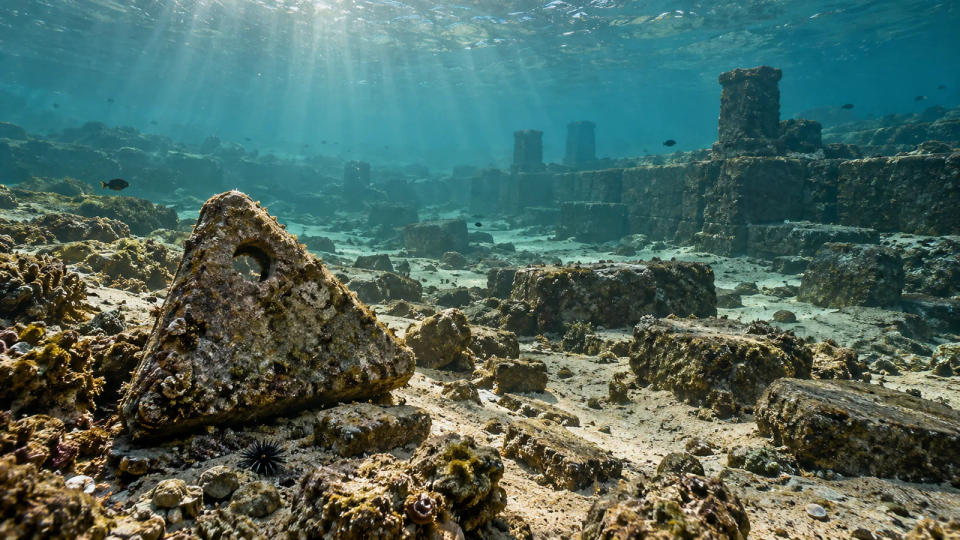
Could a city from Indian legend really be lying beneath the Arabian Sea? Off the coast of Gujarat, researchers have documented stone anchors and submerged structures near Dwarka, a place closely associated with Krishna. The finds are real, but they do not yet prove that the lost city described in sacred tradition has been discovered.
There is a second story, too: an alleged prehistoric city in the Gulf of Khambhat, sometimes mixed up with Dwarka in sensational retellings. These are different locations, studied with different evidence. Understanding that distinction makes India's underwater ruins more interesting, not less.
Why Dwarka Became a Search for a Lost City
Modern Dwarka stands on India's western coast, where the Gomati meets the Arabian Sea. It is an important Hindu pilgrimage destination, and traditions linked to the Mahabharata describe Krishna's splendid city being swallowed by the sea after his departure from the world.
For believers, the story carries religious meaning beyond the question of where particular buildings once stood. For archaeologists, it raises a narrower problem: was there an ancient coastal settlement here, how old was it, and what happened as the shoreline changed?
Those questions are worth asking even without treating an epic as a dated eyewitness account. Gujarat's coast has long connected inland communities with routes across the Arabian Sea. Harbours could prosper, shift position, erode or disappear as channels changed and storms damaged waterfront structures.
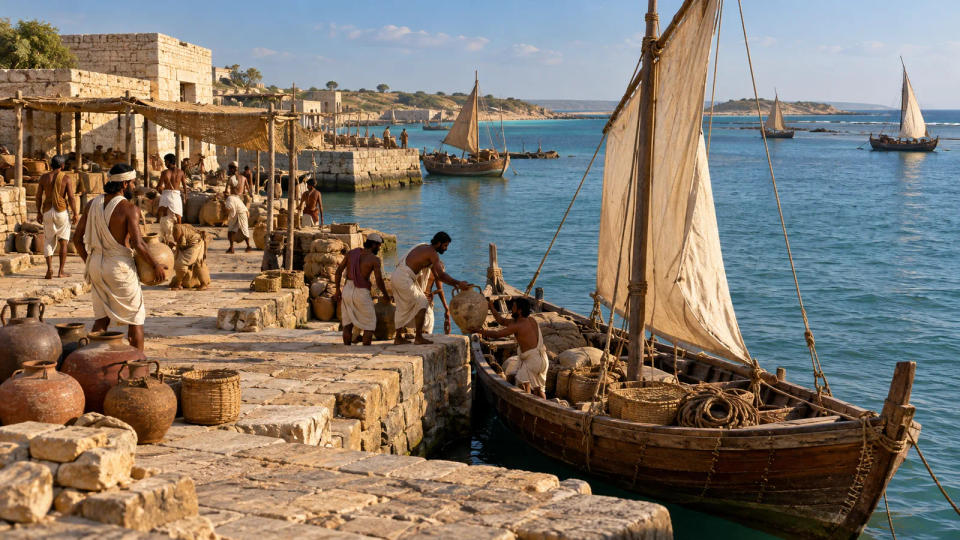
In the 1980s, archaeologist S. R. Rao and colleagues reported structural remains and objects from investigations around Dwarka and nearby Bet Dwarka island. Rao interpreted some evidence as belonging to a very early submerged settlement. Later studies, however, questioned whether the offshore structures could be dated so confidently.
That disagreement is central to the mystery. Finding masonry underwater is not the same as determining when it was built, how it was used, or whether it belonged to the city of a particular text.
What Archaeologists Actually Found Underwater
The most persuasive evidence from Dwarka's waters is not a spectacular palace. It is a collection of practical maritime objects: stone anchors, worked blocks and possible remnants of waterfront installations.
Researchers documented multiple kinds of anchors, including triangular stones with holes for ropes and wooden components, as well as heavier grapnel-shaped forms. Some examples were found on rocky seabeds several metres below the surface. Their presence strongly suggests that vessels once anchored in this area.
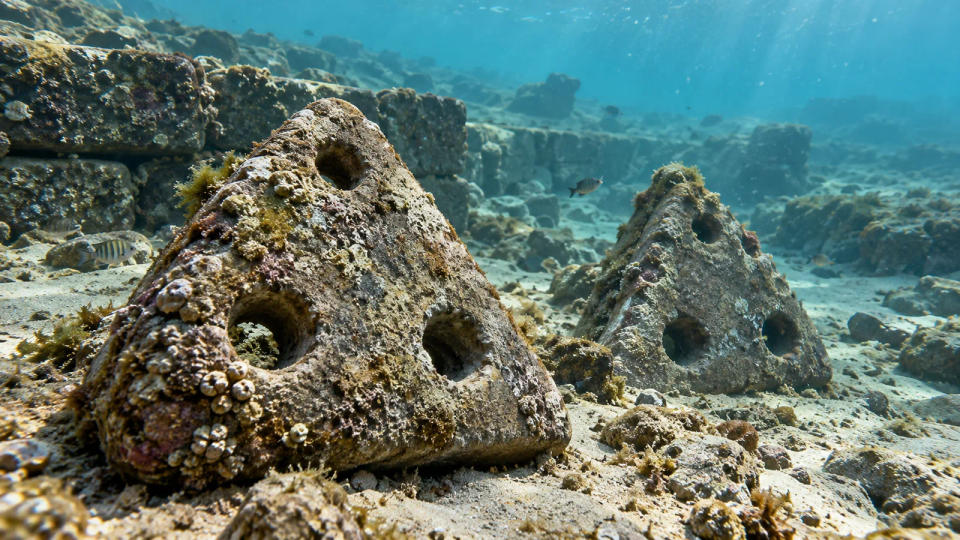
But an anchor is an awkward clock. Similar designs could remain in use for centuries, and an object resting near a wall does not automatically date that wall. A 2001 study in the International Journal of Nautical Archaeology noted that some anchor types had extremely broad historical ranges, while grapnel anchors were associated with medieval Indo-Arab seafaring.
A 2004 study by A. S. Gaur, Sundaresh and Sila Tripati offered a more cautious interpretation of the structures off Dwarka. The authors suggested that some stonework may have belonged to a jetty rather than a residential quarter. They also pointed out the absence of the pottery that might normally be expected from a submerged habitation area at that location.
Bet Dwarka complicates the picture in a useful way. Finds there include pottery and evidence of activity across different periods, including early settlements and later maritime exchange. The region's history may stretch across many centuries without every discovery belonging to one dramatic moment of destruction.
The Other Mystery: A Supposed City in the Gulf of Khambhat
Another claim began around 2000, when India's National Institute of Ocean Technology surveyed the Gulf of Khambhat, also called the Gulf of Cambay, farther south along the Gujarat coast. Sonar readings showed patterns on the seabed that some investigators interpreted as an enormous submerged settlement.
News reports soon described a city thousands of years older than the Indus civilization. A piece of wood recovered from the seabed was said to be about 9,500 years old. If that date had securely belonged to a human-built city, it would have been an extraordinary discovery.
But that crucial connection was missing. Sonar measures reflected sound; it does not, by itself, show that regular-looking forms are walls rather than natural geology. Material collected by dredging also loses much of the archaeological context needed to establish which object lay in which layer, beside which structure.
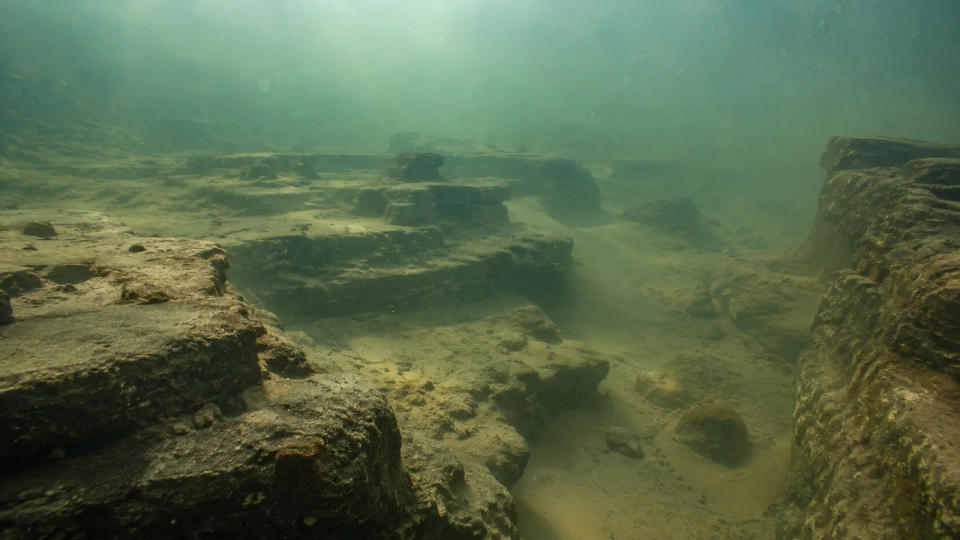
The wood's age, even if correctly measured, dates the wood. It does not establish the date of a city whose buildings have not been securely identified or associated with that sample. An old fragment could have moved through coastal sediments long after the tree grew.
Archaeologists challenged the claims at the time. In February 2002, the Times of India reported that officials of the Archaeological Survey of India doubted the proposed identification and questioned how the recovered wood had been tied to human settlement. The Gulf of Khambhat should therefore not be presented as a confirmed prehistoric metropolis—or confused with the documented anchors and structures off Dwarka.
Why the Underwater Search Is Still Going
Marine archaeology is especially demanding because waves and currents can move objects, erosion can expose older layers, and structures built at different times may end up close together. An apparently impressive collection of stones needs careful mapping, comparison and, wherever possible, excavation in a recorded context.
That is why researchers look beyond the shape of a wall. Pottery styles, inscriptions, construction methods and the relationship between objects and sediments may help separate ancient habitation from a later harbour repair. Repeated surveys can also reveal whether a structure remains fixed in place or whether stones have been displaced.
The work is continuing. In February 2025, India's Archaeological Survey announced renewed investigations near Dwarka's Gomati Creek. Its stated aims included documenting submerged remains and building archaeological expertise. A March 2025 government statement described plans to assess the age of material through scientific study of sediments and marine deposits.
In July 2026, India's Ministry of Culture confirmed that research and exploration were underway at Dwarka and Bet Dwarka, with both places included in underwater investigation plans extending to 2030. That announcement was a report of continued research, not a declaration that Krishna's city had been located.
There is a more revealing question than whether divers will uncover a perfect city beneath the water: can they reconstruct the changing coastline and the activities of people who lived and traded along it? A stone anchor can document a real voyage without answering every question about the buildings nearby.
Conclusion
India's underwater discoveries do reveal a rich maritime past, especially around Dwarka and Bet Dwarka. What remains unproven is a direct identification with the legendary city of Krishna, or a 9,500-year-old city in the Gulf of Khambhat. The genuine mystery lies in what careful research may yet recover from a coastline shaped by both people and the sea.
Sources & Further Reading
- S. R. Rao (1987), Marine Archaeological Explorations Off Dwarka, Northwest Coast of India, Indian Journal of Marine Sciences.
- A. S. Gaur, Sundaresh and Sila Tripati (2004), An Ancient Harbour at Dwarka, Current Science.
- Gaur and colleagues (2001), A Group of 20 Stone Anchors from the Waters of Dwarka, International Journal of Nautical Archaeology.
- The Times of India (2002), ASI Doubts Claims About Cambay Settlement.
- Government of India, Ministry of Culture (2025), Underwater Archaeology Wing Begins Explorations in Dwarka.
- Government of India, Ministry of Culture (2026), Underwater Cultural Heritage.