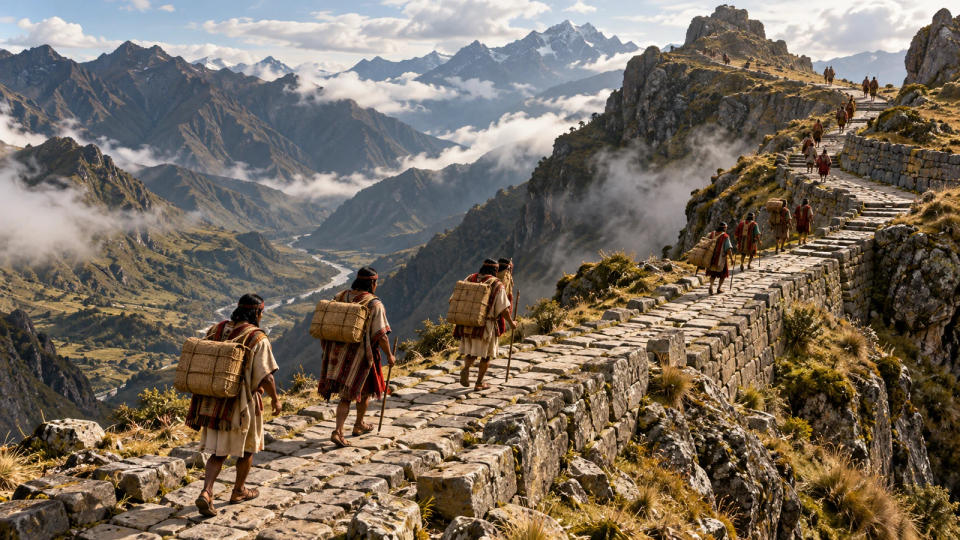
How could the Inca connect mountains, deserts, and rainforests with more than 30,000 kilometers of roads without trucks, excavators, or iron tools? They did not solve the problem with a single miraculous invention. They combined inherited pathways, precise knowledge of local terrain, stoneworking, bridges, and an enormous organized workforce. The result was the Qhapaq Ñan, a road network that helped hold the Inca state together.
Its engineering was impressive, but its most important machine was a social system capable of planning, supplying, and maintaining work across the Andes. That distinction also helps explain why the routes look so different from one region to the next.
A 30,000-Kilometer Network Built Over Generations
The first surprise is that there was no single 30,000-kilometer road. The Qhapaq Ñan was an interconnected network of major routes and smaller branches. According to UNESCO, four principal routes radiated from Cusco, the Inca capital, linking settlements, production centers, and places of worship across the mountains and toward the Pacific coast.
UNESCO describes a system of more than 30,000 kilometers, while the Smithsonian's National Museum of the American Indian uses an estimate of roughly 40,000 kilometers. These figures reflect different ways of describing a huge, partly surviving network, rather than a precise measurement of every road built in a single campaign. The important point is its continental scale.
Nor did Inca rulers start from bare ground. Earlier Andean communities had already created routes between valleys, highland fields, and trading centers. The Inca incorporated and enlarged parts of that older infrastructure. UNESCO dates the network's greatest expansion to the fifteenth century, although its underlying history stretches further back.
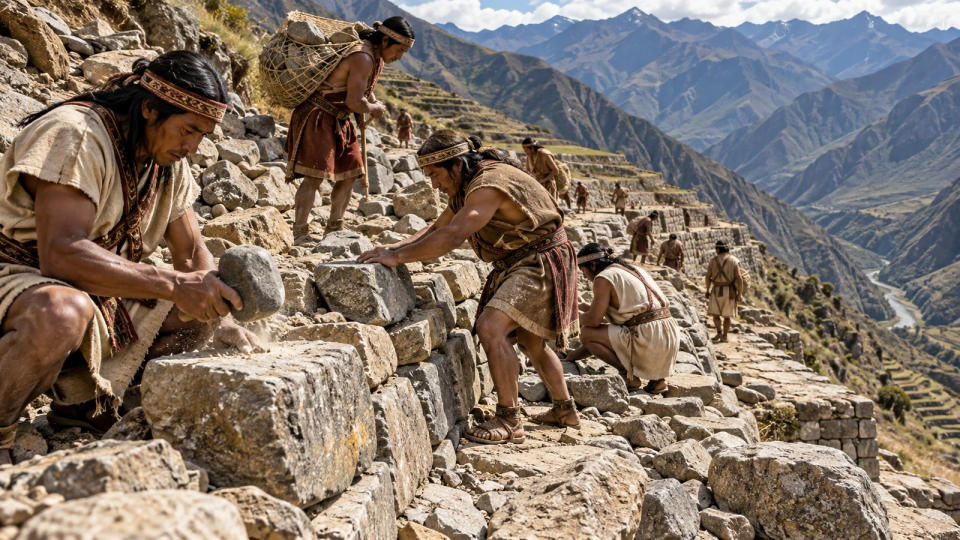
Road builders had to think about where people could walk, where pack llamas could travel, and where a slope might fail after rain. A practical route did not need to resemble a modern highway. In places, a narrow trail with solid footing was better than a broad, level road that required cutting away half a mountain.
Much of the network was designed for people on foot and caravans of llamas, not wheeled wagons. The builders lacked wheeled carts for hauling, iron implements, and large draft animals. Yet those limitations were manageable because their engineering matched the transport system they actually used.
How Stone, Stairs, and Drainage Replaced Heavy Machinery
Consider the challenges of laying a route across an Andean slope. Cut too deeply and the hillside becomes unstable; build too close to the drop and travelers face a dangerous edge. Inca builders could support a path with stone retaining walls, shape a track against a rock face, or create steps where the climb was too steep for an ordinary trail.
The tools were simpler than modern machinery but not the knowledge. Stone could be broken, shaped, fitted, and moved with human labor and locally available materials. The Smithsonian emphasizes that the roads were made without iron tools or wheeled hauling equipment. What varied was the construction method: paving on some stretches, compacted surfaces elsewhere, steps on steep ground, and walls where the landscape demanded them.
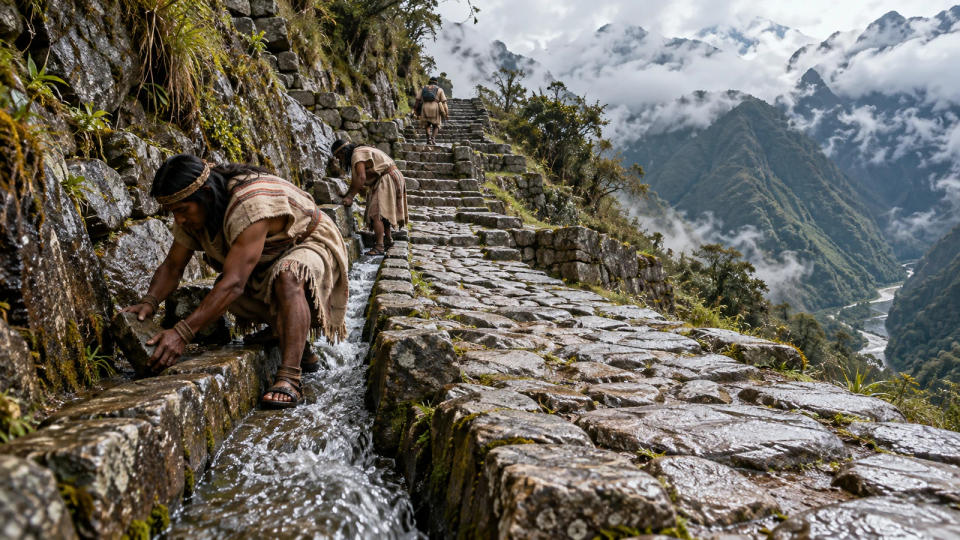
Water was a major engineering challenge. Rain could turn a path into mud, wash away its surface, or undermine a retaining wall. Side ditches, drains, and carefully placed stones helped direct water away. In the cloudier parts of the Andes, drainage was not decorative; it helped a road remain usable after storms.
The American Society of Civil Engineers notes that steps, culverts, and suspension bridges were all part of this adaptable system. The point was not to apply one standard design everywhere. A road in a dry coastal desert faced different problems from one in a wet mountain forest, and the builders responded accordingly.
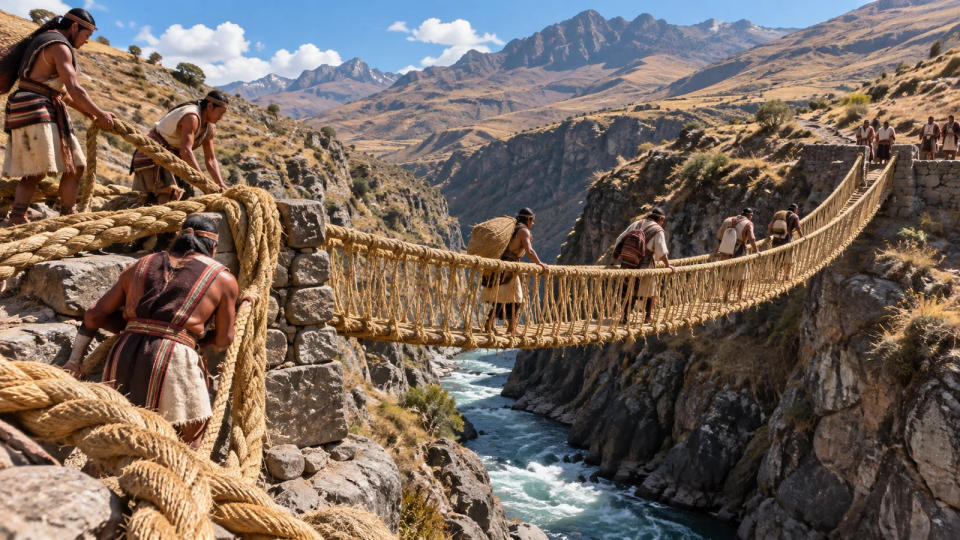
The steepest obstacles called for another solution: bridges made from braided natural fibers. Suspension bridges could cross gorges where building a stone arch was impractical. The surviving Q'eswachaka bridge tradition in Peru offers a living example of the specialized knowledge required, though a modern reconstruction should not be mistaken for an untouched fifteenth-century bridge.
The Labor System That Kept an Empire Moving
The stones and ropes are only half the answer. Who carried them, built the walls, and returned when a section needed repair? Under the Inca state, the mit'a required households to provide periods of labor for public tasks. People could be assigned to road construction, agriculture, military service, or other work. The state redistributed food and other resources in connection with these obligations.
Andean traditions of mutual assistance, often discussed under the idea of ayni, formed part of this wider world of reciprocity. But a state labor levy was also an obligation enforced within an empire. Calling the entire road system a voluntary community project would hide the political power behind it. Local expertise mattered, yet so did the Inca authorities' ability to organize large numbers of people.
Once built, the roads needed constant attention. A storm could damage a ditch; a slope could release stones; ropes on a bridge could wear. A durable network was therefore not just a feat of initial construction. Its usefulness depended on upkeep by communities and workers across many regions.
The payoff was remarkable. Government messengers known as chaskis relayed information along the routes, passing messages between runners at designated stops. The Smithsonian's educational guide describes these runners carrying spoken messages, small parcels, and sometimes khipu—knotted cords used for record-keeping. The relay system turned a winding mountain path into a communication corridor.
State officials, armies, and llama caravans also used the roads. Storage facilities and stopping places supported the movement of people and provisions, allowing food and materials to be redistributed over long distances. The road therefore served more than transport: it helped the central government exercise authority over distant territories.
This is the great paradox of the Qhapaq Ñan. Its builders worked without the heavy machines we associate with large infrastructure, yet the completed network acted like a sophisticated logistical machine. Roads, labor obligations, food stores, bridges, and messengers were interconnected parts. Remove one part, and the others became less effective.
Conclusion
The Inca built their extraordinary road network by adapting inherited Andean routes, using local stone and fiber, tailoring construction to difficult landscapes, and mobilizing labor on a massive scale. The network was neither one road nor the achievement of one generation. Its enduring lesson is that infrastructure depends as much on organization, maintenance, and local knowledge as it does on tools.
Sources & Further Reading
- UNESCO World Heritage Centre — Qhapaq Ñan, Andean Road System
- Smithsonian National Museum of the American Indian — Building the Road
- Smithsonian National Museum of the American Indian — The Great Inka Road: A Guide for Teachers
- American Society of Civil Engineers — Qhapaq Ñan: The Inka Imperial Road
- Smithsonian Magazine — How the Inca Empire Engineered a Road Across Extreme Terrain