A medieval chronicle records Genghis Khan's death, yet gives readers no identifiable grave to visit. His burial place remains unconfirmed; Burkhan Khaldun and the surrounding Khentii landscape in northeastern Mongolia are associated with the burial tradition, rather than an authenticated discovery. The mystery lies in the gap between a powerful historical association and evidence that could identify one particular burial.
The surviving sources answer different questions. A chronicle preserves a ruler's story, a sacred landscape carries memory, and archaeological surveys identify physical traces. Combining them can guide interpretation, but treating them as interchangeable creates certainty that the evidence does not supply.

Cover: AI reconstruction of medieval mounted travel, not a portrait of Genghis Khan, a funeral procession or a located grave.
What the Medieval Record Actually Says
The Secret History of the Mongols is an essential starting point. In section 268, it places Genghis Khan's death in the Year of the Pig, 1227. Igor de Rachewiltz's translation describes him as having “ascended to Heaven.” The passage does not identify a burial chamber, describe a surviving monument or provide directions to a grave.
Elsewhere, section 103 connects the young Temüjin with Burqan Qaldun, another spelling of Burkhan Khaldun. After escaping danger, he credits the mountain with protecting his life and expresses continuing reverence for it. This helps explain the mountain's importance in his remembered life. It does not, by itself, locate his final resting place.
Stories about concealing the grave must be handled separately. Columbia University's Asia for Educators describes a horse-trampling funeral story explicitly as a legend. Repeating it without that qualification changes its evidentiary status. A vivid account of how a grave disappeared is not the same as a contemporary record establishing that the event occurred.
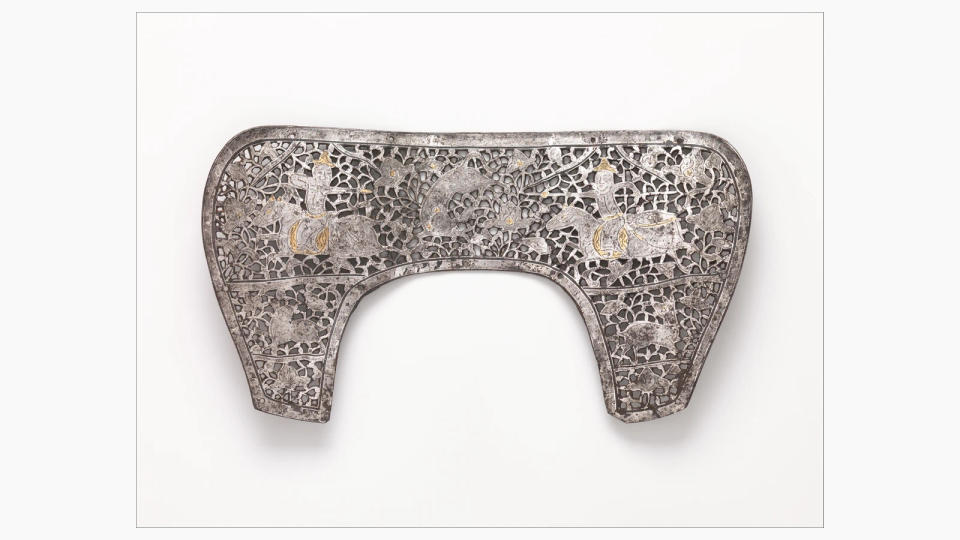
The Metropolitan Museum of Art, Pommel Plate from a Saddle, 13th–15th century, 2010.336. Purchase, Arthur Ochs Sulzberger Gift, 2010. Public Domain/CC0; proportionally fitted with pale margins. This is contextual material, not Genghis Khan's property or a find from his tomb.
The saddle plate illustrates the difference between an actual object and an attractive attribution. The Met identifies it as Mongolian, Central or West Asian, or Tibetan, and dates it broadly across the thirteenth to fifteenth centuries. Its hunting imagery and craftsmanship reveal a material world associated with Mongol patronage. They cannot establish an individual owner's identity or a royal burial location.
Why Burkhan Khaldun Remains Central
UNESCO describes Great Burkhan Khaldun and its surrounding sacred landscape as a place associated with Genghis Khan's reputed birth and burial. The site entered the World Heritage List in 2015. Its significance includes mountain worship and the relationship between Genghis Khan's memory and Mongolian cultural traditions. Heritage recognition does not amount to archaeological certification of his grave.
The setting matters physically as well as culturally. In the central Khentii mountain chain, open steppe meets the coniferous forests of the Siberian taiga. UNESCO also describes traditions involving sacred mountains, rivers and ovoos, or stone cairns, shaped by shamanic and Buddhist practices. This is a living cultural landscape, rather than an empty search area whose only value would be a royal tomb.
Those distinctions explain why a map label cannot settle the mystery. A mountain name identifies a landscape; a burial tradition associates a person with it. Confirming a grave would require a further connection between that person and a particular archaeological context. The strength of the wider association does not remove the need for that final step.
Nor should a cairn or stone arrangement be labeled a grave simply because it appears in a significant region. Its age, purpose and relationship to surrounding features require investigation. Respecting the landscape means taking its existing meanings seriously, while keeping historical claims proportional to the evidence available.
What Modern Searches Have—and Have Not—Found
A research project published in PLOS ONE in 2014 shows what technology can contribute. Albert Yu-Min Lin and colleagues used online volunteers to examine satellite imagery for unusual features. More than 10,000 participants contributed approximately 30,000 hours and generated 2.3 million feature classifications across about 6,000 square kilometers. The project converted many separate observations into priorities for field investigation.
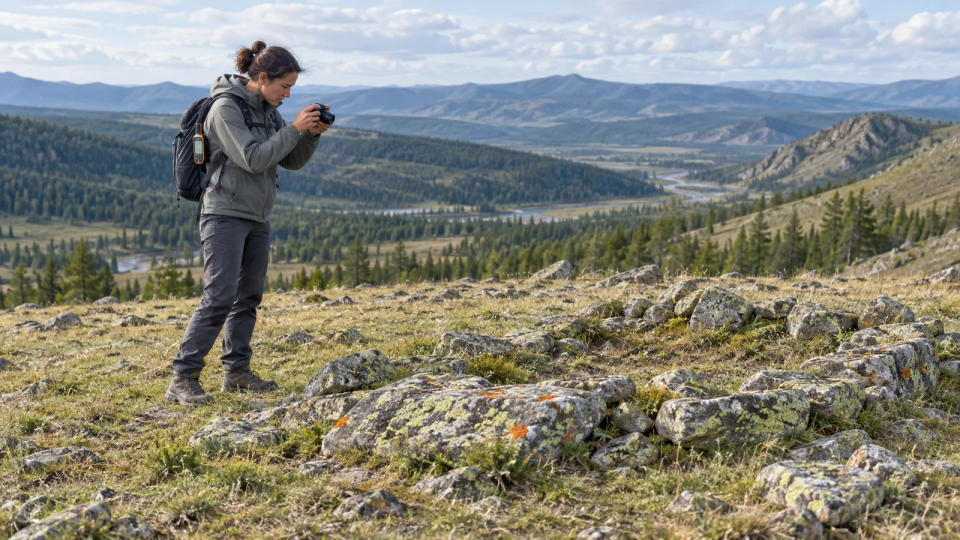
AI illustration of modern surface documentation, not a photograph of the published expedition or an identified royal burial. No excavation is depicted.
The field team confirmed 55 archaeological or culturally significant sites among the surveyed locations. The paper discusses features from different periods, including Bronze Age monuments and Mongol-period burials. It also reports false positives, where apparently promising patterns were other kinds of features. The achievement was archaeological survey, not the identification of Genghis Khan's tomb.
The researchers faced an unusual problem: the target's appearance was unknown. There was no securely identified example of this particular tomb against which every promising shape could be matched. Satellite observations therefore generated questions for further assessment. They did not supply a royal name simply because several people noticed the same unusual pattern.
UC San Diego's account describes the Valley of Khans expedition as a non-invasive remote-sensing investigation. That distinction matters: research can document a landscape without excavating a suspected burial. Finding a possible structure, confirming an archaeological site and identifying a named ruler are separate achievements. Technology can help locate features; attribution still needs independent evidence.
Conclusion
The most responsible answer is that Genghis Khan's exact burial place remains unknown. Burkhan Khaldun offers a historically and culturally important association, while medieval writing and modern research illuminate different parts of the problem. Neither a legend nor an unusual satellite feature closes the gap. Until a particular burial can be connected convincingly with the ruler, the lost tomb remains an unresolved question within a landscape that already has enduring significance.
Sources & Further Reading
- The Secret History of the Mongols, translated by Igor de Rachewiltz, shorter version edited by John C. Street (2015), sections 103 and 268 — medieval literary testimony in modern translation.
- UNESCO, Great Burkhan Khaldun Mountain and its surrounding sacred landscape — cultural significance and reputed burial association.
- Lin AYM and colleagues, Crowdsourcing the Unknown: The Satellite Search for Genghis Khan (2014) — survey results, not a royal tomb discovery. The 2015 correction concerns the author's citation.
- The Met, Pommel Plate from a Saddle, 2010.336 — contextual object with qualified date and cultural attribution.
- Columbia University, Asia for Educators: The Death of Chinggis Khan — distinguishes a funeral legend from historical certainty.
- UC San Diego, Cultural Heritage Engineering Initiative: IGERT, Valley of Khans — institutional account of non-invasive field research.