Three Flannan Isles lighthouse keepers vanished in December 1900; a deadly wave is the leading explanation, but exactly what happened is unknown.
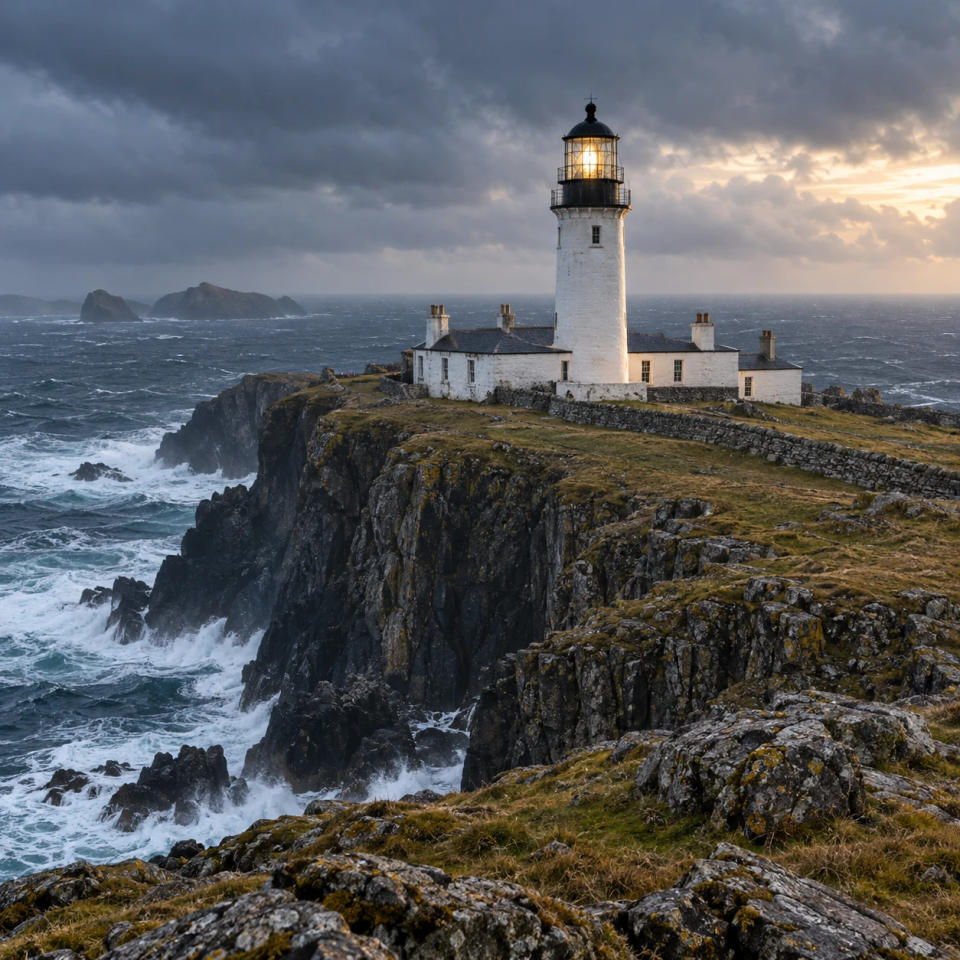
In December 1900, three men disappeared from the lighthouse on Eilean Mòr, a remote Scottish island in the Outer Hebrides. Their names were James Ducat, Thomas Marshall and Donald McArthur. When a relief vessel finally arrived, the lighthouse was deserted, its equipment prepared for use, and the men nowhere to be found. The leading contemporary explanation was a wave sweeping them into the sea near a damaged landing area. No witness or recovered body established the exact sequence.
The case became an enduring maritime mystery because the station looked surprisingly orderly and the circumstances were never witnessed. Yet the original correspondence, now described by the Northern Lighthouse Board and National Records of Scotland, offers a more concrete story than the supernatural versions circulating today. The reconstructed scenes in this article are modern illustrations, not photographs of the missing men or the accident.
What Happened at the Lighthouse in December 1900?
Flannan Isles Lighthouse stands on Eilean Mòr, the largest of a small group of rocky islands west of the Isle of Lewis. Designed by engineer David Alan Stevenson, the white tower and its associated buildings served an exposed sea route. There was no radio link between the island and shore in 1900. A shore observer could watch for signals, but crews depended on scheduled relief vessels for visits and supplies. Heavy seas could prevent landing.
Ducat was the principal keeper, Marshall an assistant keeper, and McArthur an occasional keeper substituting for William Ross, who was absent through illness. A fourth member of the station's staff, Joseph Moore, was ashore when the accident occurred. The first warning came from a passing steamer: its crew noted around midnight on 15 December that the lighthouse light was not visible. The observation was reported after the vessel reached port, but it did not produce an immediate successful inspection.
On 26 December 1900, the lighthouse tender Hesperus arrived for its regular visit. No landing preparations or customary signals appeared. Captain Harvie used the ship's horn and a rocket, but received no response. Moore went ashore and climbed to the buildings. He found the keepers missing, the beds empty, and no fire burning in the kitchen. Other crew members joined a search. They kept the light operating while the authorities investigated.
The absence was not an instantaneous locked-room puzzle. Moore reported the entrance gate and exterior doors closed, but the kitchen door open. His account described a normal working station, with cleaned machinery and a lamp ready to light. The small details matter because they help distinguish a sudden interruption of routine from the popular image of a household abandoned in mid-meal.
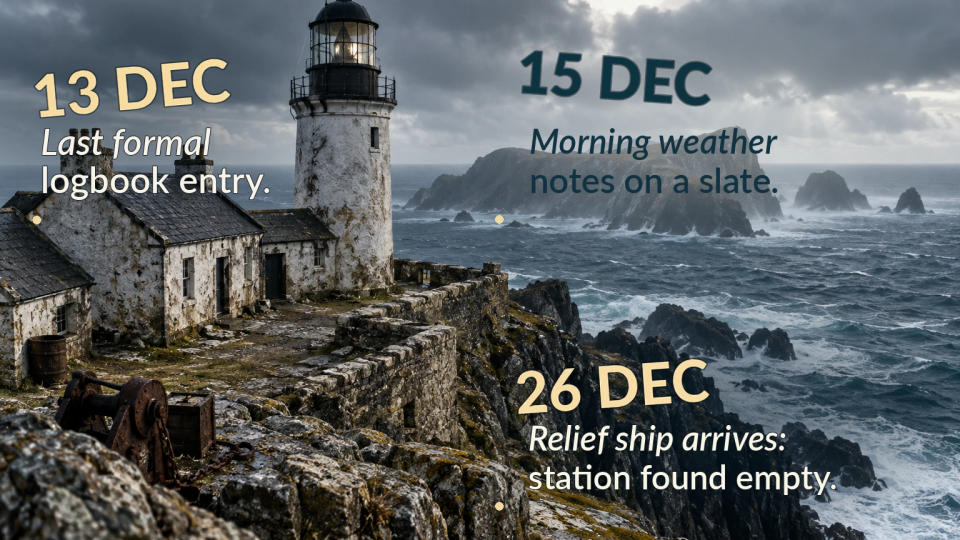
AI-generated historical background with a source-checked English timeline; illustrated scene is not a historical photograph or a scale map.
The timeline needs care. The last full entries in the official logbook were dated 13 December, but readings and particulars from the following days were recorded separately on a slate for later transcription. Weather observations on the slate reached the morning of 15 December. Because that day's morning duties were completed, investigators concluded the disappearance probably occurred later on 15 December, not on the date of the last formal log entry.
Why Did Investigators Suspect a Giant Wave?
The most physical clues lay outside the lighthouse, especially at the west landing, where men and supplies could be transferred between boats and shore. Superintendent Robert Muirhead examined the site after the disappearance and filed a report dated 8 January 1901. It described displaced or twisted iron railings, missing landing equipment, scattered ropes and a heavy stone that had been moved by the sea. At the east landing, much of the equipment remained as it had been after the earlier relief.
The height of the damage was striking. Muirhead reported a life buoy torn from its fastening near a path well above sea level and equipment removed from a platform area below it. Such findings support the idea that powerful seas had struck the west side. They do not, by themselves, date every impact to the exact hour when the keepers vanished.
Clothing offered another clue. Moore knew that Ducat and Marshall wore sea boots and protective outerwear when going toward the landings; those garments were missing. McArthur's usual outer coat was still inside. These observations fit the possibility that two men went to inspect or secure gear, with the third following in haste or for another reason. But the surviving evidence does not prove why any of them left, whether they departed together, or what each was doing at the final moment.
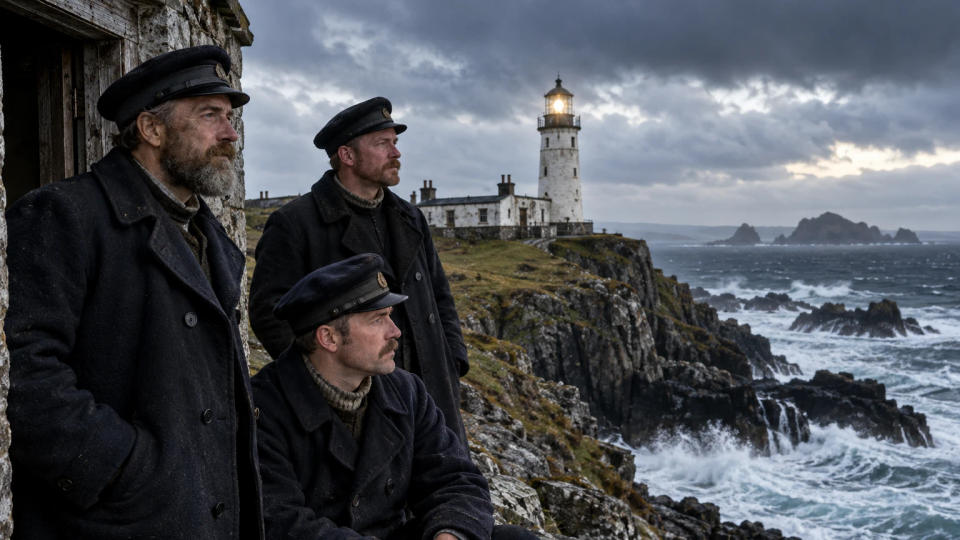
Modern hypothetical reconstruction illustrating the dangers of isolated lighthouse work, not a record of the three men's actual appearance or final actions.
Muirhead's proposed sequence was straightforward: the men probably went toward a landing place after heavy weather and were overwhelmed by an unexpectedly large breaking wave, often called a roller. This explanation accounts for the damaged equipment and the workers' likely clothing. The official archives describe probable drowning; the bodies were never recovered. It remains an evidence-based conclusion rather than an established eyewitness account.
Which Famous Details Are Evidence—and Which Are Legend?
Popular retellings often begin with an untouched meal, an overturned chair, an eerie storm-filled logbook, or an unexplained final message. Those details are not equivalent to the contemporary investigation. The widely repeated image of a table awaiting its occupants appears prominently in Wilfrid Wilson Gibson's poem Flannan Isle, a literary treatment rather than a witness statement. National Records of Scotland instead describes a tidy kitchen and cleaned pots and pans. Artistic imagery should not be converted into police evidence.
Stories of keepers weeping in terror or praying through impossible weather also require caution. The archival account of the logbook and slate does not authenticate dramatic quoted confessions. Nor does the recorded absence of a visible light by itself demonstrate sabotage or a supernatural event. Ships, lighthouse machinery, communications delays and difficult weather were all ordinary parts of maritime history in 1900.
There are still legitimate questions. Why did all three leave a functioning station, if that is what happened? Did one keeper go first, and did others attempt to help? Was the damaging sea surge part of the same event that caused their deaths? The historical documents leave room for uncertainty on those points. They do not supply positive evidence for an abduction, a conspiracy or a paranormal cause.
Finally, the mystery had a human aftermath. The National Records of Scotland records surviving relatives, death registration entries referring to probable drowning, and administrative discussions about payments to families. The three men were skilled employees with lives beyond the legend. Remembering that makes the distinction between a researched account and a thrilling invented scene especially important.
Conclusion
The Flannan Isles keepers most likely died when dangerous seas caught them near a landing place in December 1900. Official records point to a normal morning on 15 December, evidence of powerful waves, and a deserted but orderly station discovered eleven days later. Without witnesses or recovered bodies, their individual movements remain unknown. The most responsible answer is neither a perfect solution nor a supernatural mystery: it is a probable maritime accident with an unproven final sequence.
Sources & Further Reading
- Northern Lighthouse Board — Flannan Isles: original correspondence and 1901 investigation
- National Records of Scotland — The Flannan Islands Lighthouse: A Disappearance (2026)
- National Records of Scotland, Open Book — Flannan Isles Lighthouse Keepers: The Disappearance (2023)
- National Records of Scotland — Lighthouse Archive Research Guide
- Northern Lighthouse Board — Flannan Islands Lighthouse History and Specifications