Why the Berlin Wall fell on November 9, 1989: protests, a confused travel announcement, and crowds that forced the border open.
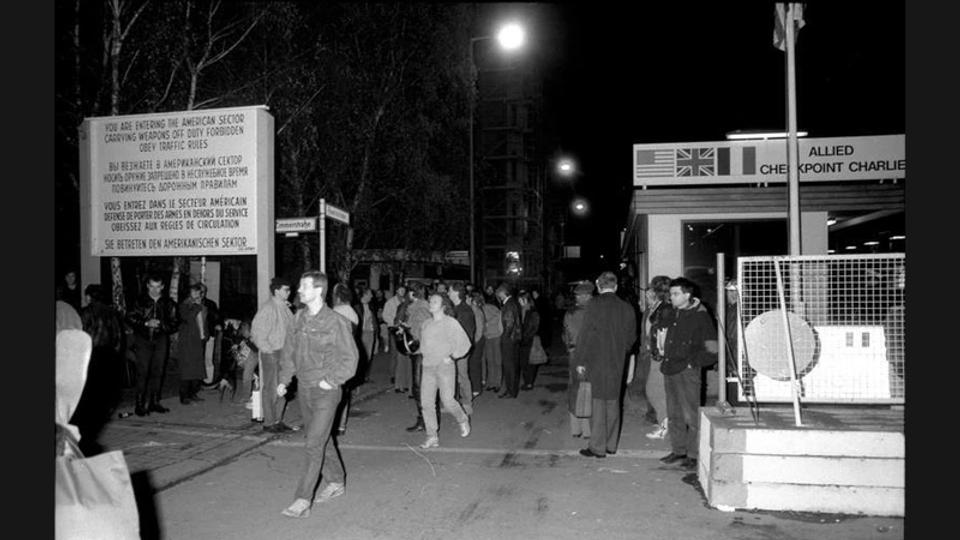
Checkpoint Charlie during the night into November 10, 1989; this is a different crossing from Bornholmer Straße. Photo: Bundesarchiv, Bild 183-1989-1110-018 / Klaus Oberst, CC BY-SA 3.0 DE. Proportionally resized, padded and converted to WebP; adaptation under the same license.

The Berlin Wall did not fall because workers received a scheduled order to demolish it on November 9, 1989. Its border crossings opened after months of political pressure converged with a confused announcement, rapid news coverage, and crowds demanding passage. The decisive change was the collapse of border control that evening, rather than the disappearance of the concrete wall.
The distinction explains why a press conference matters as much as the familiar photographs of celebration. East Germany's leaders intended to announce travel concessions. Citizens understood that they could leave immediately, while the guards expected to enforce a border whose rules had suddenly become unclear. The German government chronology traces how those incompatible expectations met at the checkpoints.
Why East Germany Could No Longer Contain the Pressure
The German Democratic Republic, usually called East Germany or the GDR, faced pressure from two directions during 1989. Some citizens sought to leave; others stayed and demanded political change. According to the Federal Agency for Civic Education, Hungary began dismantling its border installations with Austria in May. Routes through neighboring states and crowded West German embassies weakened East Germany's ability to control emigration.
Inside the country, demonstrations challenged censorship, restrictions on travel, and the ruling Socialist Unity Party's authority. Leipzig's Monday demonstrations became especially important, and a huge rally filled central East Berlin on November 4. These were connected developments, but leaving the country and reforming it were not identical political choices. The movement cannot be reduced to one demand or one leader.
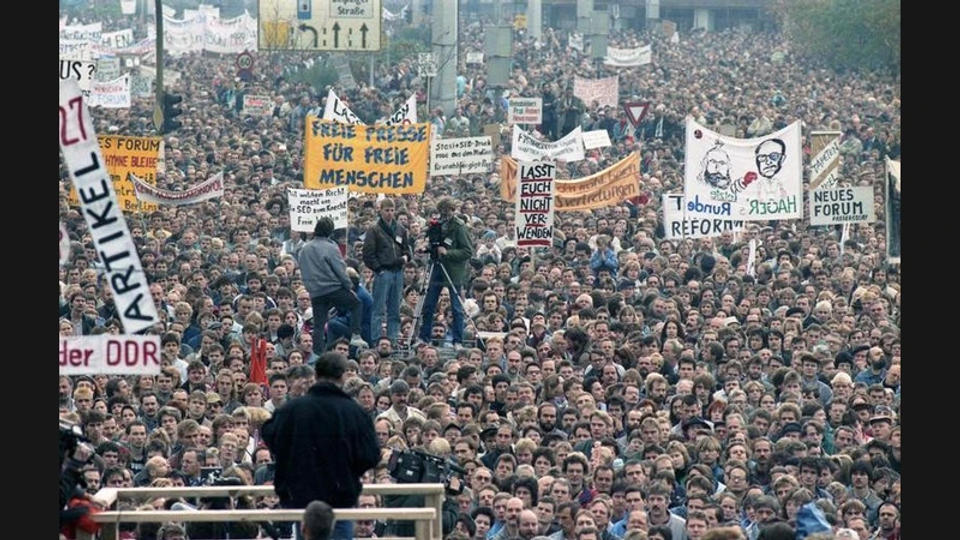
A contemporary photograph of the Berlin demonstration on November 4, five days before the border opened. Photo: Bundesarchiv, Bild 183-1989-1104-437 / Bernd Settnik, CC BY-SA 3.0 DE. Proportionally resized, padded and converted to WebP; adaptation under the same license.

Soviet leader Mikhail Gorbachev's reforms formed part of the wider setting. East Germany's leadership could no longer assume that familiar methods would restore stability. Erich Honecker's departure and Egon Krenz's succession did not remove public distrust. A travel reform was therefore an attempt to regain political control in a crisis, rather than an announcement that the state intended to surrender its power.
What Schabowski Announced—and What Viewers Heard
On November 9, officials prepared new travel arrangements. The Federal Archives account identifies an important administrative mismatch: a decision paper specified publication on November 10, but the press statement read by Günter Schabowski omitted that timing. Krenz passed him the material without explaining the publication schedule. The problem was larger than a single mistaken word; the public statement and the machinery needed to implement it were out of step.
Near the end of the televised press conference, shortly before 7 p.m., journalists asked when the rules would apply. Schabowski answered that, as far as he knew, they applied immediately. That answer transformed a bureaucratic announcement into a public expectation of immediate movement. It did not provide the border troops with a clear operational instruction.
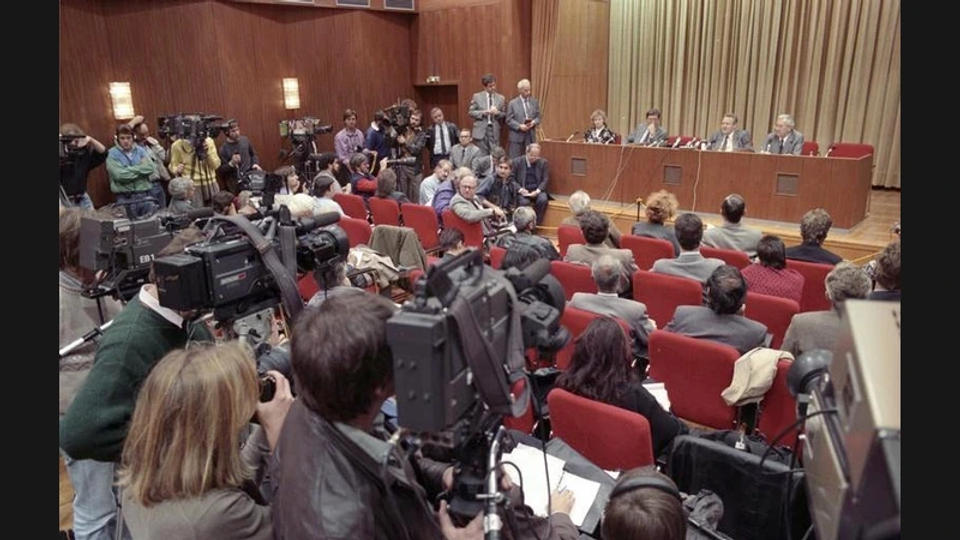
The actual press conference in East Berlin on November 9, 1989, photographed by Thomas Lehmann. Photo: Bundesarchiv, Bild 183-1989-1109-030 / Thomas Lehmann, CC BY-SA 3.0 DE. Proportionally resized, padded and converted to WebP; adaptation under the same license.

The Haus der Geschichte collection entry preserves the episode through Schabowski's original handwritten briefing notes. The museum authenticated the document through several kinds of examination before acquiring it in 2015. It is evidence of the press conference's preparation, not a demolition order. Reading the surviving paperwork alongside the recorded announcement helps explain why later descriptions of a simple, planned opening are misleading.
Broadcasting accelerated the consequences. The government chronology describes East Berliners watching the announcement and hearing Western broadcasts report an opening. Thousands then went to the crossings. A statement made inside a press room was becoming a test of authority on the street: would the guards permit what the public believed the government had just promised?
How Crowds Turned an Announcement Into an Open Border
At Bornholmer Straße, the announcement collided with the actual checkpoint system. Berlin’s monument authority identifies this crossing as the first to raise its barriers, with the other Berlin crossings following during the night. That local sequence matters: the border did not open everywhere through one synchronized action, and the Brandenburg Gate was not the first checkpoint to release the crowds.
At first, limited passage did not resolve the situation. More people arrived, and the personnel at the crossings had not received instructions matching the televised message. Bornholmer Straße opened fully at roughly 11:30 p.m. Accounts differ slightly on the precise minute, so the broader sequence is more reliable than a claim that one universally agreed second marked the entire Wall's fall.
The Haus der Geschichte overview emphasizes both the application requirements that the travel rules still envisaged and the public understanding that formalities had disappeared. This gap is central to the story. The authorities attempted to regulate departure; the crowds acted on the belief that movement had become a right they could exercise immediately. Guards ultimately let people through without a clear command that had prepared them for this outcome.
Opening the crossings also accelerated political change beyond the border itself. On December 1, the GDR parliament removed the ruling party's constitutional leadership claim. Opposition representatives and established parties subsequently met at a Round Table. Germany's unification followed on October 3, 1990. Those later decisions should not be folded into the events of November 9: an open border created new possibilities, but it did not instantly settle the country's political future.
Conclusion
The Berlin Wall fell on November 9 because a weakening regime lost control of the relationship between its promises and its border guards. Protest and emigration created the crisis; the announcement supplied an immediate trigger; broadcasting and public action carried it to the checkpoints. Remembering all three stages gives citizens and border personnel their place in an event too often explained as one official's accidental sentence.
Sources & Further Reading
- Federal Agency for Civic Education: “Als die Mauer fiel – der 9. November 1989”
- Federal Archives: “November 1989”
- Haus der Geschichte: Original “Schabowski-Zettel”
- German Federal Government: “Die Mauer ist offen!”
- Berlin Monument Authority: “Bornholmer Straße”
- Haus der Geschichte: “Fall der Mauer”