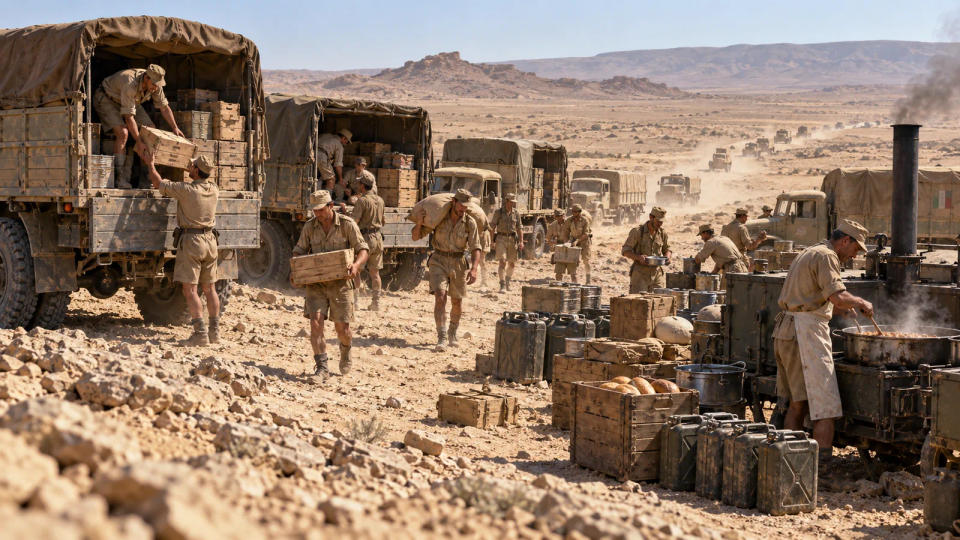
How do you deliver dinner to a soldier hundreds of miles from the nearest supply port, with little fresh water and no reliable railway? That was an everyday problem for the German Afrika Korps in North Africa. Its men ate because ships, trucks, field bakeries, and mobile kitchens kept moving—though the food was often monotonous, and the system could fail when the army advanced too far.
Rommel's Afrika Korps was the German formation within a larger German-Italian force fighting in Libya and Egypt from 1941. Its dramatic tank battles have received most of the attention, but the less glamorous effort to feed the troops was just as important. A tank could race ahead; flour still needed transport.
First, the Food Had to Cross the Mediterranean
Most of the supplies supporting the Axis forces in North Africa began their journey outside Africa. Cargo was shipped from Italy across the Mediterranean to Libyan ports, especially Tripoli and Benghazi when they were usable. German troops depended on a transport system in which the Italian navy, merchant shipping, port workers, and motor transport all played essential roles.
Unloading at a port was only the beginning. The distances across Libya were immense, and there was no adequate eastward railway to carry supplies to the battlefield. Trucks had to move food, water, fuel, and ammunition along the coastal road or rough desert tracks. Sand damaged engines and tires; vehicles needed fuel and maintenance merely to deliver more supplies.
This created a painful arithmetic problem. Every extra mile between the port and the fighting meant more driving time, more wear on the trucks, and more fuel burned by the supply convoys themselves. A successful advance could make the next meal harder to deliver, even if new territory had been captured.
Nor were German troops the only mouths to feed. The wider Axis army included large Italian contingents, and their requirements competed for the same shipping capacity and overland transport. Allied naval and air attacks threatened the route across the Mediterranean, but even cargo that arrived safely could be delayed or stranded far behind the front.
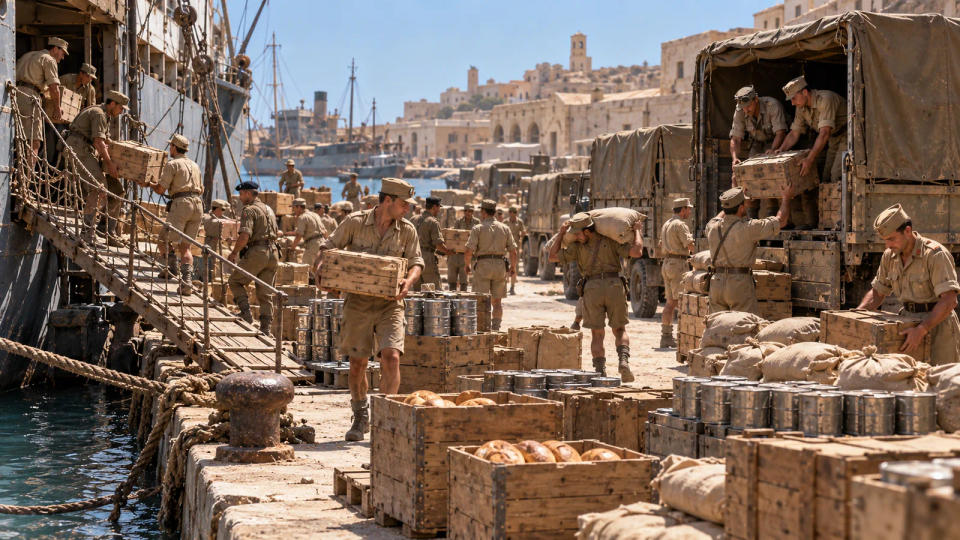
For supply officers, feeding the army meant solving transport problems before anyone opened a tin or cut a loaf.
What Was Actually on a German Soldier's Menu?
There was no single menu that every Afrika Korps soldier received every day. The food available depended on the unit, its location, the date, and the fortunes of the transport columns. Still, surviving reports reveal how the system was supposed to function.
One wartime Allied intelligence report, based on interrogations of German prisoners, described a battalion whose companies requested rations every three days. A battalion rations officer collected food from supply dumps and arranged delivery by truck. Bread was collected separately from a field bakery. The report also described additional company reserves and a one-day emergency ration carried by each man.
In that particular battalion, troops reportedly received one hot meal a day, made in a mobile field kitchen brought as far forward as practical. This is valuable evidence of an organized feeding system, not proof that every German unit enjoyed a hot meal every night.
Field bakeries were especially important because bread remained a familiar staple. A German military photographic report from Derna in May 1942 documented a bakery said to turn out some 12,000 to 15,000 loaves a day. Behind a mobile army stood workers mixing dough, tending ovens, loading bread, and sending it out with the next trucks.
Preserved foods filled the gaps. Werner Mork, a German truck driver who later recalled his service in North Africa, described tins containing lentils, beans, peas, cabbage, and fatty meat. He remembered eating them cold when heating food was impossible. His testimony is one soldier's recollection, but it captures a basic truth about desert rations: calories were easier to deliver than variety or freshness.
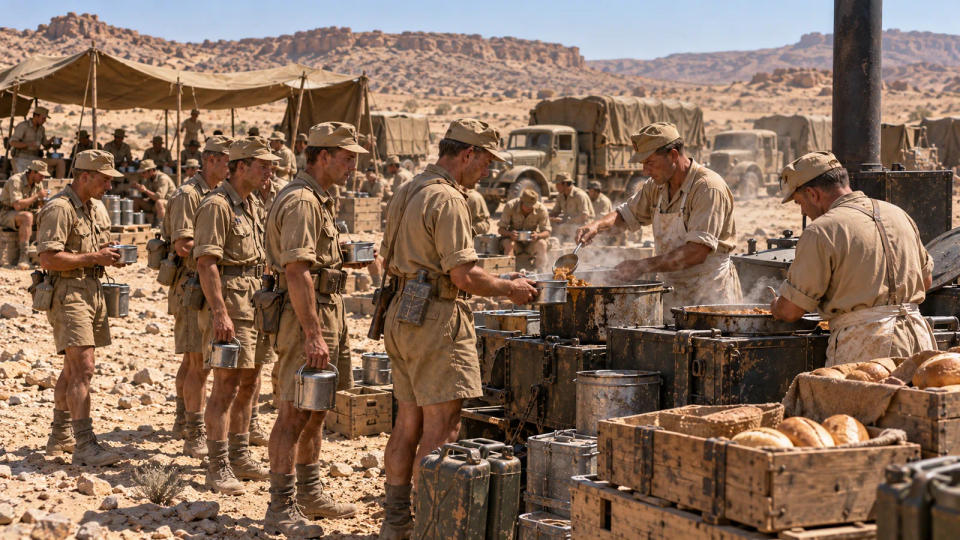
Even with bakeries and kitchens operating, isolated soldiers sometimes had only ration tins.
Water Could Be Harder to Deliver Than Dinner
Food could be stored; water needed constant delivery. Soldiers needed it to drink and cook, while vehicles also required water for cooling. With natural sources limited, water points, storage containers, and tanker trucks became part of the feeding system.
Mork recalled collecting freshwater at places such as Benghazi and Derna whenever his truck reached them. Every usable container was filled. He remembered long waits at crowded water points, and said the brackish water available elsewhere was unpleasant even when boiled for tea. His account helps explain why a meal was about more than food: preparing it consumed water that was precious in its own right.
It is tempting to assign one neat daily water allowance to the whole Afrika Korps, but conditions and reported allocations differed. A postwar study of German desert warfare described varying requirements and restrictions. It also noted that soldiers could receive cold rations at midday and hot food in the evening when conditions permitted. These were practices shaped by heat and logistics, not guarantees.
Diet and health were closely connected. German reports criticized the heavy, fatty preserved foods as poorly suited to the climate. Fresh vegetables and fruit were difficult to supply regularly, while unsafe water and poor sanitation contributed to illness. The National WWII Museum notes that shortages of drinkable water and widespread sickness weakened Rommel's army as the campaign continued.
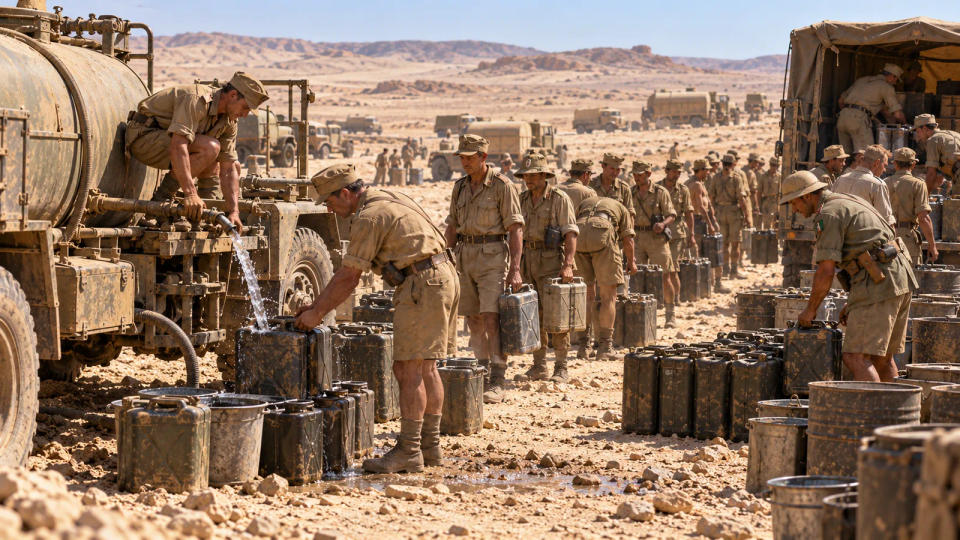
Keeping soldiers supplied with liquid was therefore as much a matter of military readiness as comfort. A delivery of fresh water could be more eagerly awaited than a better-tasting ration.
Captured Rations Helped, but They Could Not Fix the System
One unexpected source of food was the enemy's supply stock. During advances, German and Italian forces sometimes seized British stores, including canned food. Mork recalled British corned beef, sardines, chocolate, and cigarettes appearing among captured goods. He also described unequal access: desirable items did not necessarily reach ordinary infantrymen, and men in transport units sometimes helped themselves.
The capture of Tobruk in June 1942 brought access to additional British provisions. The same wartime intelligence report that described the three-day ration system noted that one German battalion received canned fruit and vegetables after Tobruk fell. Captured food supplemented, rather than replaced, regular rations.
Captured stores offered temporary relief, not an independent supply system. Once consumed, those goods had to be replaced. Food taken in one successful advance did nothing to shorten the road from the ports or make the next shipment immune to attack.
That problem became acute during the advance into Egypt in 1942. As the front moved farther east, every delivery demanded more from an overstretched fleet of trucks. Fuel and ammunition frequently took priority. Mork remembered that food and other loads had to wait when the most urgent military cargo needed moving.
By the time the Axis advance stalled near El Alamein, shortages, mechanical exhaustion, and disease had become serious weaknesses. Allied forces were better placed to reinforce and supply their own front. The eventual Axis defeat cannot be explained by an empty mess tin alone, but neither can it be understood without the trucks, ports, and water supplies that kept an army in motion.
Conclusion
Rommel's soldiers were fed through a fragile chain of ships, ports, trucks, bakeries, field kitchens, and stored rations, with captured supplies occasionally filling the gaps. The story is less about culinary ingenuity than the limits of warfare in a vast desert: feeding thousands was possible, but doing it reliably while the front kept moving was another matter.
Sources & Further Reading
- U.S. wartime intelligence material, “German Rations in Libya” — prisoner-interrogation report on one battalion's rations and delivery system.
- Deutsches Historisches Museum, “Werner Mork: Kriegsalltag in Nordafrika 1942” — retrospective eyewitness account.
- ImagesDéfense, report from Derna, 23 May 1942 — wartime photographic documentation of a military bakery.
- U.S. Army historical study, Desert Warfare: German Experiences in World War II — postwar German assessments prepared for the U.S. Army.
- The National WWII Museum, “Drive to Nowhere: The Myth of the Afrika Korps, 1941–43” — historian Robert Citino on operational limits.
- National Army Museum, “The Struggle for North Africa, 1940–43” — campaign and desert-logistics overview.